
Finance approves the refresh. Now the real work begins.
You’ve got 300 laptops spread across employees in 12 countries. Some are two years old and still fast. Some are five years old and barely functional. A few are in storage, uncatalogued, condition unknown.
No one has any idea about what you have until you go looking.
This is a real problem. People tell you what to do with laptops after they’re retired. But, they don’t tell you how to actually run the project of retiring them. That’s where bulk retirement falls apart.
Retirement is not a single task. It’s a project with multiple stages and many different stakeholders from finance to HR. Depending on the condition of each device, the outcome differs as well.
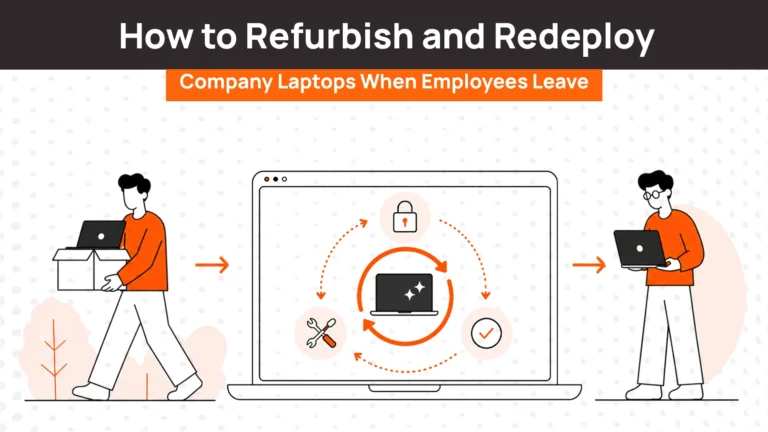
Some should be redeployed, while others should be refurbished. A few others would be completely worn off, and need to be recycled. Getting that distinction right is what separates a well-run retirement project from one that wastes money and creates chaos.
The Bulk Laptop Retirement Process
Before diving into each step, here’s the full workflow so you can see how the stages connect.
| Stage | What Happens |
| Refresh planning | Decide scope, timeline, and criteria for retirement |
| Identify devices | Audit fleet to determine which laptops qualify for retirement |
| Notify employees | Communicate the timeline and what’s expected of them |
| Retrieve devices | Coordinate returns from employees across all locations |
| Inspect and grade | Assess every returned device against a consistent standard |
| Choose next step | Redeploy, refurbish, employee buyback, ITAD, or recycle |
| Execute and document | Process each device, update asset records, close the loop |
Each stage feeds the next. Skip inspection and you’ll recycle laptops that could have been redeployed. Skip planning and retrieval becomes a months-long scramble. The workflow only works when every step happens in order.
Step 1: Identify Which Laptops Should Be Retired
Once you’ve decided it’s time for a refresh, the next challenge is figuring out which laptops actually need to go.
Age alone is a poor criterion. A well-maintained 4-year-old ThinkPad used for basic tasks may have two more productive years. A 3-year-old device in heavy use with a failing battery and multiple repair incidents may need to go now.
Evaluate each device against these criteria:
Age and warranty status
Most business laptops hit natural decision points at 3, 4, and 5 years. Once warranty expires, repair cost exposure increases. Devices beyond 5 years typically struggle with modern software and security requirements.
Battery health
Battery capacity below 70% of original significantly affects usable work time. For remote employees who work away from power outlets, this becomes a productivity issue. Check cycle counts and health data from MDM or diagnostic tools.
Repair history
A device that’s had three repairs in 18 months is telling you something. Track repair cost against replacement cost. If cumulative repairs exceed 40-50% of replacement value, retirement makes financial sense.
Performance against current requirements
Can the device run your current standard configuration without significant slowdowns? AI tools, video conferencing, and modern security software require more resources than they did three years ago. Devices that can’t keep up affect productivity.
Current assignment status
Devices assigned to active employees with several years ahead of them warrant different treatment than devices in storage or assigned to roles with high turnover.
Run this evaluation across your fleet and segment devices into: retire now, retire in 6-12 months, and keep. This gives you a manageable scope for the current project.
Step 2: Plan the Retirement Project
Most bulk retirement projects fail in execution. Planning prevents that. This section is almost entirely absent from other roadmaps for retiring laptops, which is why retirement projects become chaotic.
Define your timeline
Work backwards. When do replacement devices need to arrive? When do employees need their new laptops? That gives you your endpoint. From there, plan retrieval windows, inspection processing time, and disposition logistics.
For 300 devices, plan on 8-12 weeks minimum from project kick-off to completion. Rushing retrieval creates employee friction. Rushing inspection creates bad decisions.
Confirm stakeholders early
IT, HR and finance own different parts of the equation. Like, IT owns the technicalities and decisions. HR owns the employee communication and logistics. Finance owns the budget and asset records.
Procurement owns replacement ordering. When these four aren’t aligned before the project starts, each team makes decisions in isolation and creates delays for the others. Schedule a kick-off call with all stakeholders before anything else happens.
Order replacements in phases
Don’t order 300 replacement laptops at once unless your storage and logistics can handle the wave. Stagger replacement orders by department, location, or priority tier. Replacements should arrive as old devices leave, not before.
Plan for remote logistics
For distributed teams, each country may need a different retrieval approach. Some locations require specific customs documentation for return shipping. Some have local carrier limitations. Map your employee locations against your retrieval capabilities before the project starts, not after.
Create a project tracker
A simple spreadsheet with every device to be retired, its current status, assigned employee, location, retrieval status, inspection outcome, and final disposition covers what you need. Update it consistently. This becomes your audit trail.
However, if your team is getting bigger with more and more entries, spreadsheets can cause problems while maintaining. Remoasset can help you track devices and own the lifecycle management in such cases.
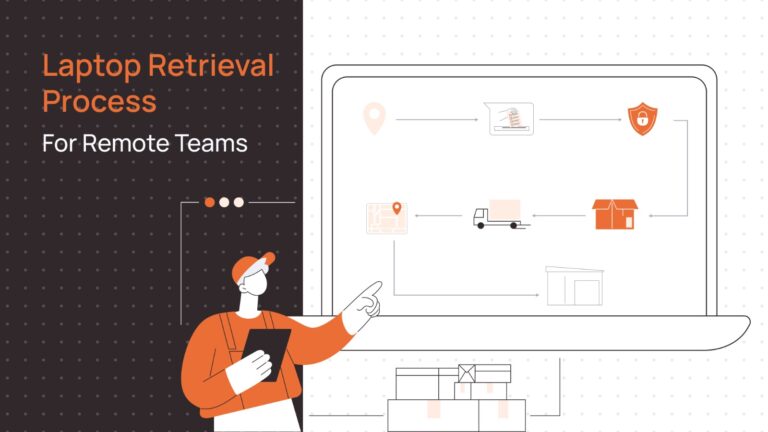
Step 3: Retrieve Every Laptop
Retrieval is where most bulk retirement projects lose control. Without a systematic process, devices trickle in over months and some never return at all.
For remote teams, retrieval requires more than an email asking employees to send their laptops back. Employees are busy. Without clear instructions, a deadline, and a prepaid return kit, returns stall.
What a good retrieval process looks like:
Send retrieval kits
Padded return boxes with prepaid labels remove all friction for the employee. Include clear packing instructions. Don’t assume employees know how to safely pack a laptop for shipping.
Set a clear deadline with a reason
“Please return your device by [date] so we can prepare your replacement” is more motivating than an open-ended request. Employees respond to deadlines tied to outcomes that affect them.
Use automated reminders
One email isn’t enough. Build an escalating reminder sequence: initial request, reminder at day 7, escalation at day 14 involving manager. Automate this where possible.
Document chain of custody
Record when the retrieval kit was sent, when tracking confirms it was picked up, and when the device arrived at your processing location. Note serial number and visible condition on arrival. This documentation matters if condition disputes arise later.
Handle accessories consistently
Define what comes back with the device: charger, USB hub, any issued peripherals. Make this explicit in the retrieval instructions. Accessories disappear when expectations aren’t set clearly.
Step 4: Inspect and Grade Every Device
This step is what makes the difference between good retirement decisions and expensive ones. If you skip grading and route everything to recycling, you throw away significant value.
Use a four-grade system applied consistently to every returned device:
| Grade | Condition | What It Means |
| A: Excellent | No visible damage, battery above 80%, fully functional | Ready for immediate redeployment after wipe and reimage |
| B: Good | Minor wear, battery 65-80%, fully functional | Minor refurbishment (cleaning, possible battery swap) then redeploy |
| C: Fair | Cosmetic damage or component wear, functional but degraded | Evaluate repair cost vs. remaining useful life before deciding |
| D: Poor | Significant damage, major component failure, functionally impaired | Compare repair cost against replacement cost; likely ITAD or recycle |
Every device gets graded immediately on arrival, before anything else happens. Record the grade in your project tracker alongside serial number and arrival date.
Grading consistency matters. If different people are grading devices differently, your retirement decisions become inconsistent and your asset records become unreliable. Define what each grade means in concrete terms and train the team running inspections.
Step 5: Choose the Right Retirement Path
Grading makes this decision straightforward. The grade drives the outcome, not assumptions or default routing.
| Device Condition | Recommended Action |
| Grade A: Excellent condition | Wipe, reimage, and redeploy to next hire |
| Grade B: Good with minor issues | Refurbish (battery, keyboard, cleaning) and redeploy |
| Grade B/C: Functional, no internal demand | ITAD for remarketing and resale |
| Grade C: Fair, repair cost under 40% of replacement | Evaluate repair, then redeploy or sell |
| Grade C/D: Significant damage | Compare repair cost against value; likely ITAD or recycle |
| Grade D: End of useful life | Certified recycling after data destruction |
| Employee buyback candidate | Functional device, employee interest, clear data wipe process |
A few important points on each path:
Redeployment
Grade A and B devices going back into internal use represent the highest-value outcome. A configured, wiped device assigned to a new hire costs $150-200 to prepare versus $1,500 for a new purchase.
Refurbishment
Battery replacements, SSD upgrades, and keyboard repairs on Grade B devices extend useful life by 2 years for $100-200. Worth doing for devices under 4 years old.
Employee buyback
Many companies offer departing or current employees the chance to purchase their device at fair market value. This recovers cash, eliminates logistics for low-value devices, and employees often prefer keeping a device they know. Ensure certified data wipe happens before any buyback.
ITAD
Grade C devices with resale value go to certified ITAD providers for data destruction, assessment, and remarketing. ITAD providers generate cash from devices that have no internal demand but still have secondary market value.
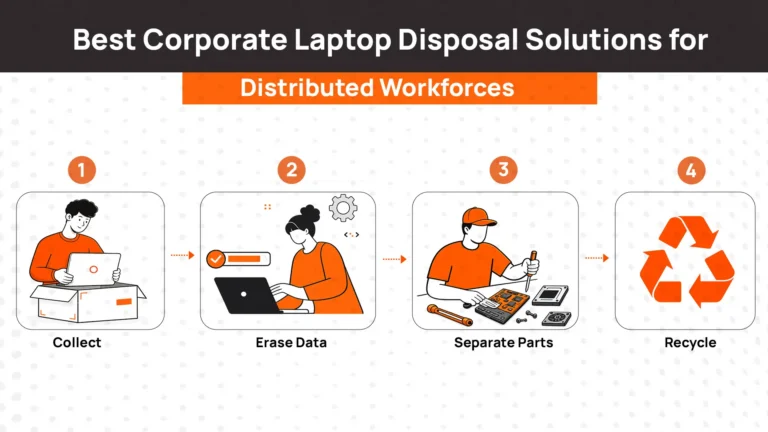
Recycle
Grade D devices with no productive life remaining go to certified recycling after data destruction. This should be the smallest category in a well-managed retirement project.
Common Mistakes During Bulk Laptop Retirement
Understanding what goes wrong helps you avoid it. These are the mistakes competitors don’t talk about.
1. Retiring everything at once
Processing 300 devices simultaneously overwhelms inspection capacity and creates storage problems. Stagger by department or location across 4-6 week windows.
2. Skipping the inspection step
When IT teams are under pressure to complete a refresh quickly, inspection gets compressed or skipped. The result is Grade A devices going to recycling that should have been redeployed. This is where real money gets lost.
3. Poor employee communication
Employees who don’t understand why they’re returning their device, what they’re getting instead, or when it’s happening become resistant. One vague email generates dozens of individual questions. Invest time in clear upfront communication.
4. Replacing devices too early
Not every device in a refresh window actually needs replacing. Running a condition-based evaluation prevents unnecessary procurement spend on devices that still have productive life.
5. Weak inventory records going into the project
If your asset register doesn’t reflect reality before the project starts, you’ll spend weeks reconciling devices that appear in records but can’t be located, or discovering devices that weren’t tracked at all. Clean up your asset data before retrieval begins.
6. No documented process
When the retirement project ends, the process should be documented so the next refresh runs faster. Most teams complete a bulk retirement and document nothing, recreating the same confusion two years later.
How RemoAsset Helps Simplify Laptop Retirement Projects
Retirement decisions become significantly easier when every stage of the device lifecycle is already tracked.
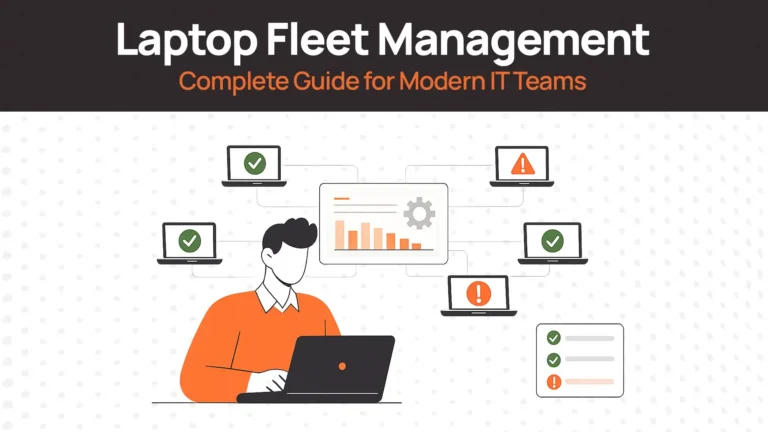
If you know exactly where every laptop is, who has it, when it was purchased, and what repairs it has had, the retirement project starts from a position of clarity rather than discovery. You’re not spending the first three weeks building a device inventory from scratch.
RemoAsset provides the lifecycle visibility that makes this possible. Every device is tracked from procurement through deployment, maintenance, and into retirement. When a bulk refresh is planned, the identification stage becomes a filter on existing data rather than a from-scratch audit.
Retrieval workflows are triggered automatically from the platform. Inspection results are logged against device records. Condition grades inform routing decisions. Redeployable devices go back into available inventory. Devices routed to ITAD or recycling are tracked through final disposition with documentation on file.
The result is a retirement project that runs from existing data and documented workflows, rather than improvised coordination across spreadsheets and email chains.
Related Reads
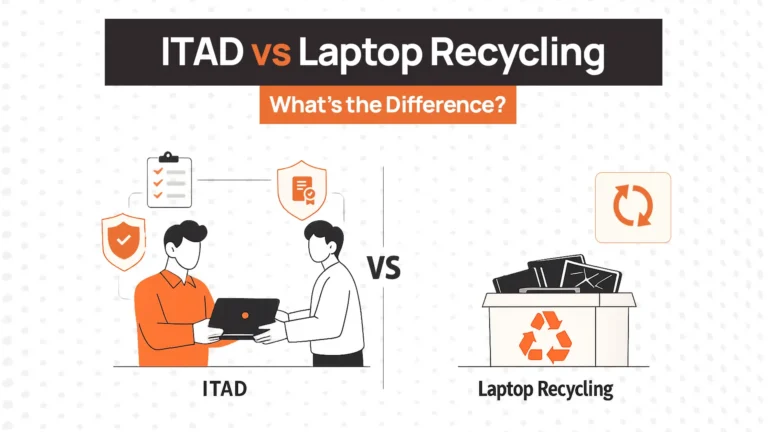
- ITAD vs Laptop Recycling: What’s the Difference?
- Corporate Laptop Disposal: Complete Guide to Secure, Compliant, & Sustainable Device Retirement
- Best Corporate Laptop Disposal Solutions for Distributed Workforces
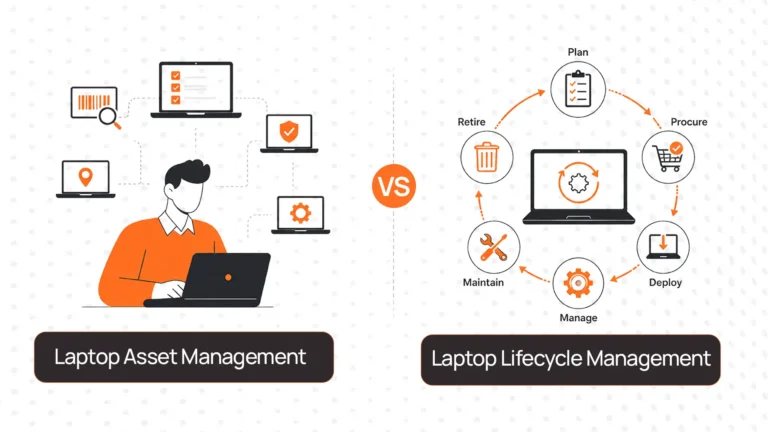
- Laptop Lifecycle Management: The Complete Guide
- Best Data Destruction and Device Disposal Tools
FAQs
How often should companies refresh employee laptops?
Most companies use 3-4 year refresh cycles for standard roles. High-performance roles (engineering, design, video production) often justify 3 years. Administrative and light-use roles can run comfortably to 4-5 years. Condition-based evaluation at each refresh point catches devices that could run longer, preventing unnecessary procurement spend.
How do you decide which laptops to retire first?
Prioritize devices with the highest repair history, lowest battery health, oldest age, or specifications that can no longer run your current software stack. Devices assigned to high-turnover roles or sitting idle in storage are also strong candidates for the first retirement wave.
Can retired laptops be reassigned to other employees?
Yes, and they should be whenever condition allows. Grade A and B devices that go through data wipe, reimage, and any minor refurbishment are functionally equivalent to new devices for most users. Internal redeployment is the highest-value outcome of a retirement project.
Should companies allow employees to buy retired laptops?
Employee buyback programs work well for Grade B and C devices that have no internal demand but still have functional life remaining. Set a fair market price, ensure certified data wiping before transfer, and document the transaction. Employees often want the device they already know, and it eliminates return logistics for low-value hardware.
What’s the difference between laptop retirement and laptop disposal?
Retirement is the point at which a device leaves active use. Disposal is one of several possible outcomes after retirement. Many retired laptops should be redeployed or refurbished, not disposed of. Treating retirement and disposal as the same thing is what leads to organizations unnecessarily buying new hardware while functional devices get recycled.
How long does a bulk laptop retirement project usually take?
For 100-300 devices, plan on 8-12 weeks from project kick-off to completion. This includes identification, retrieval across all locations, inspection, disposition routing, and asset record updates. Rushing any stage typically creates problems in the next one.
Can businesses retire laptops in phases instead of all at once?
Yes, and phased retirement is usually the better approach. Retiring by department, location, or device age cohort keeps the project manageable. It also lets you learn from early waves and adjust the process before processing the full fleet.
How do remote companies manage large laptop refresh projects?
Remote teams need systematic retrieval workflows with prepaid return kits, automated reminders, and real-time tracking. Inspection and grading happen centrally. Replacement devices ship directly to employees from procurement or available inventory. The entire project needs to run without relying on employees visiting an office.