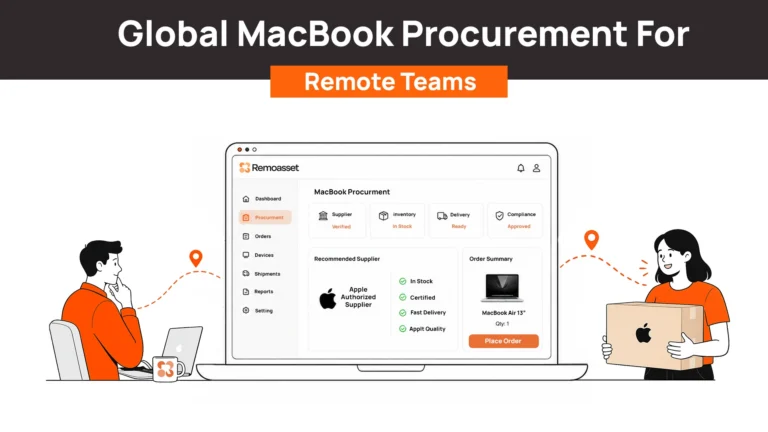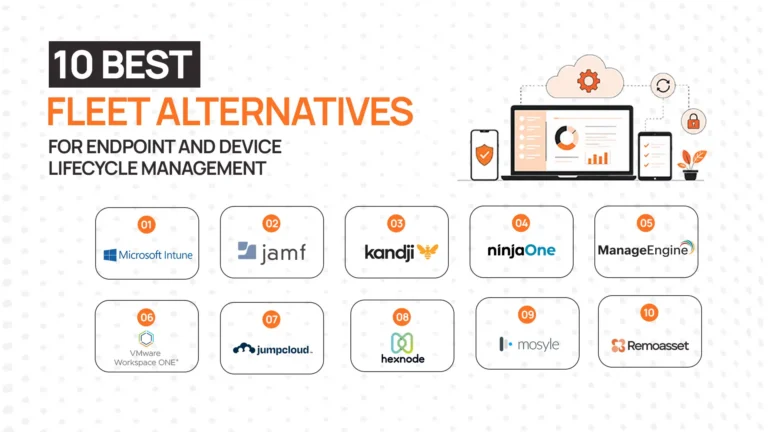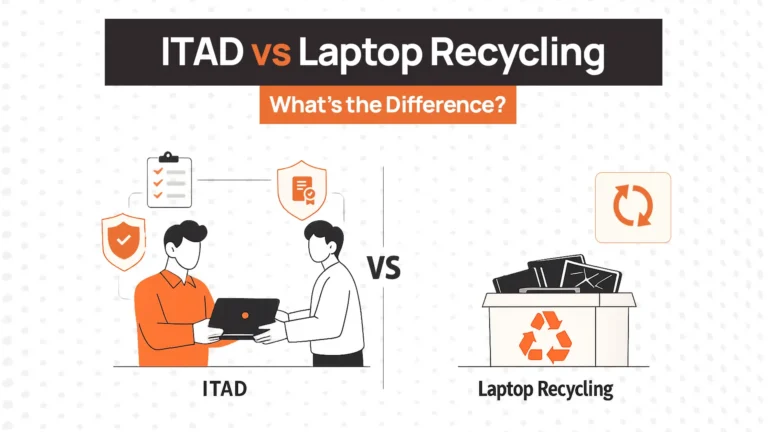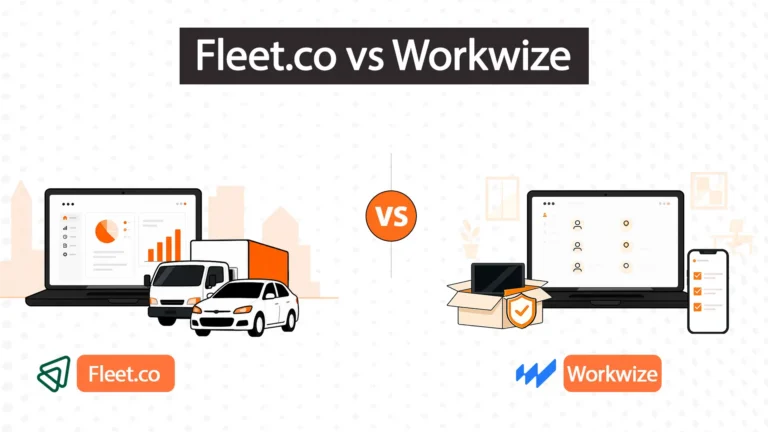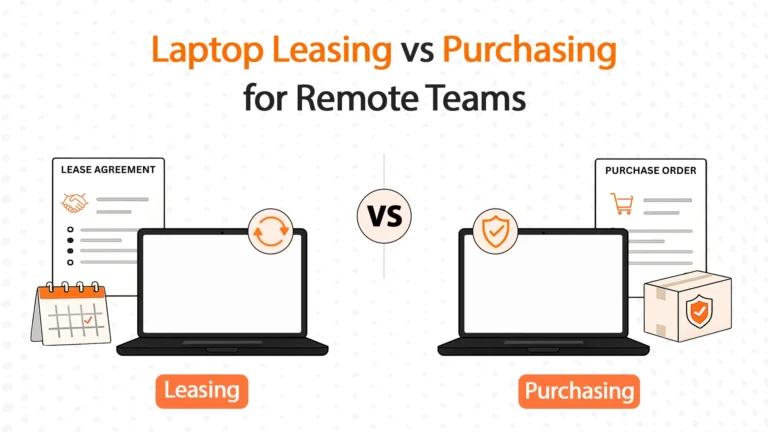
Devices get offboarded, shipped back, maybe wiped and somewhere in that workflow, visibility disappears. A laptop sits in storage for months before erasure. A remote employee returns a device, but IT has no proof the data was securely destroyed. During an audit, missing certificates and incomplete records suddenly become compliance risks.
The best data destruction and device disposal tools now combine retrieval, certified erasure, audit trails, remote wipe, and redeployment into one connected lifecycle workflow.
This guide covers the best platforms IT teams are using in 2026 to manage secure, compliant, and scalable device disposal.
What Is Data Destruction & Device Disposal?
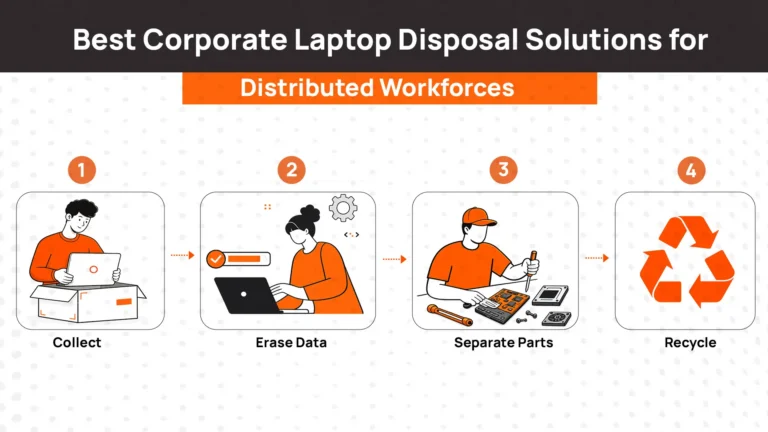
Data destruction and device disposal refers to the process of securely erasing, retiring, recycling, or redeploying IT assets. In a proper workflow, it covers everything from physically retrieving a device from an offboarded employee, through certified erasure using a recognized standard, to generating auditable proof that the process was completed.
Why Factory Reset Is Not a Disposal Strategy
A factory reset tells the operating system to mark disk sectors as available. The underlying data stays intact. With widely available forensic tools, most of it can be recovered in under an hour.
The same is true for simply deleting files, reformatting drives, or relying on BitLocker encryption without properly destroying the decryption key. These aren’t obscure edge cases; they’re documented recovery scenarios that auditors and regulators are fully aware of.
The NIST 800-88 standard defines the specific methods Clear, Purge, and Destroy matched to different media types. DoD 5220.22-M adds a multi-pass overwrite protocol originally built for classified government data. When a vendor says their process is “NIST-compliant,” it means the erasure follows these standards and can be independently verified.
The output of a real erasure process is a tamper-proof certificate tied to the device’s serial number, timestamped, and permanently stored. That certificate is what compliance teams, auditors, and legal counsel actually need to see.
The Remote Work Variable Nobody Planned For
Traditional ITAD assumed devices came back to a central location. You’d collect hardware, run it through an on-site erasure process, document everything and the device is now ready.
Offboarding a single remote employee can involve shipping logistics, customs documentation, regional data protection regulations, and a device that may or may not still have MDM enrollment active. If MDM was removed which happens more often than IT teams acknowledge remote wipe capability disappears with it.
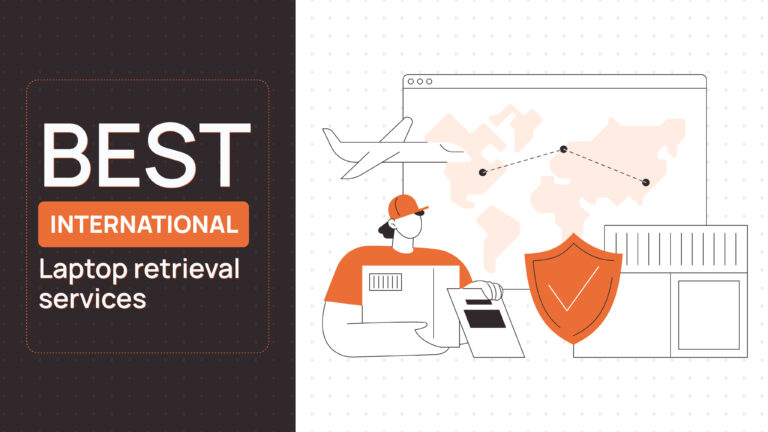
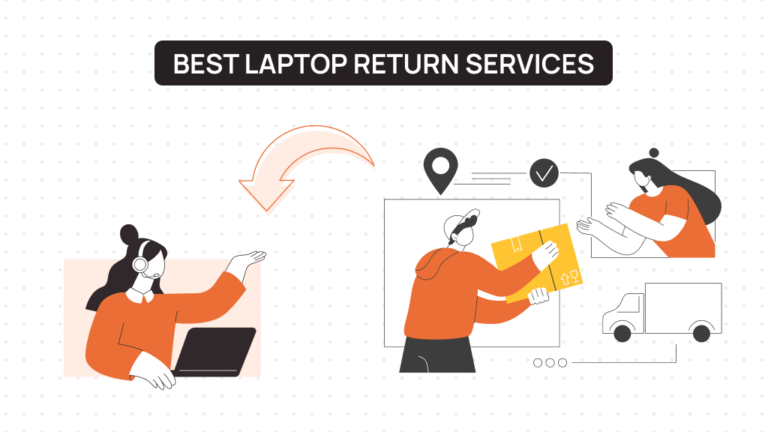
This is why enterprise device retrieval is now a core part of any serious disposal workflow. Getting the device back with a documented chain of custody before erasure begins isn’t optional; it’s the prerequisite that everything else depends on.
How Modern IT Teams Automate Device Disposal
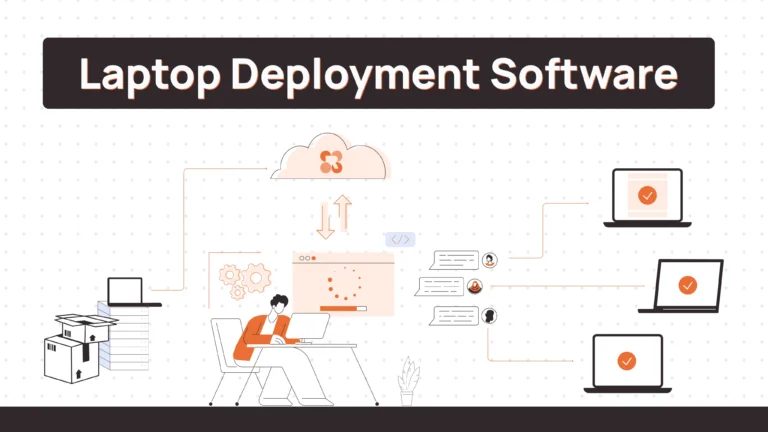
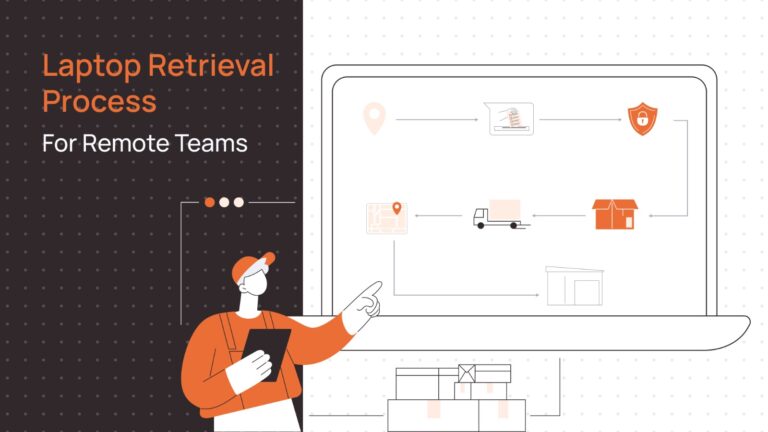
The best-run IT teams aren’t manually tracking offboarding tickets or chasing down laptops after employees leave. They’ve automated the disposal pipeline end to end:
1. HRIS-triggered offboarding
When HR marks an employee as leaving, a retrieval ticket is automatically created. No manual handoff needed.
2. Retrieval initiated
Shipping logistics kick off, prepaid labels go to the employee, and the device’s location is tracked through the return journey.
3. Device received and audited
Upon check-in, a hardware audit is logged: condition, serial number, OS version, enrollment status.
4. MDM lock and remote wipe
If the device goes dark before returning, it’s locked and wiped remotely from the dashboard.
5. Certified erasure performed
The checked-in device goes through NIST 800-88 compliant multi-pass overwriting. The process is verified, not just run.
6. Certificate generated
A tamper-proof Certificate of Erasure is issued, linked to the serial number, and stored permanently in the asset record.
7. Redeployment routing
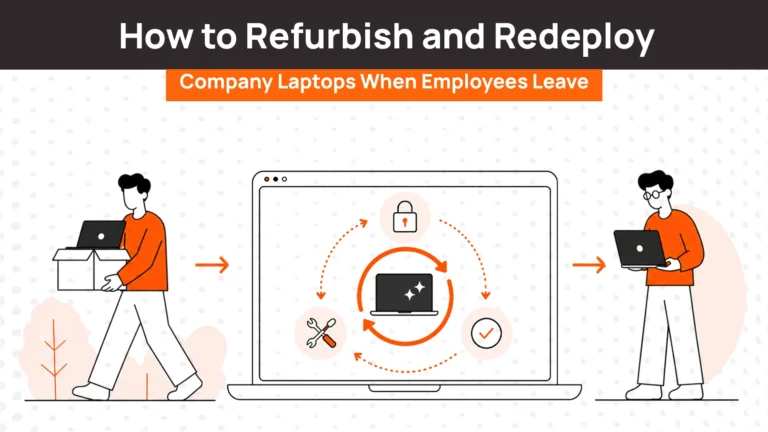
The device is graded, refurbished if needed, and re-entered into inventory for the next hire or deployment cycle.
That full chain is what separates a lifecycle platform from a standalone erasure tool.
The 10 Best Data Destruction & IT Asset Disposal Tools
1. Remoasset
Remoasset is an all-in-one remote Laptop management platform that handles the full device lifecycle procurement, deployment, tracking, retrieval, certified erasure, refurbishment, and redeployment from a single dashboard..
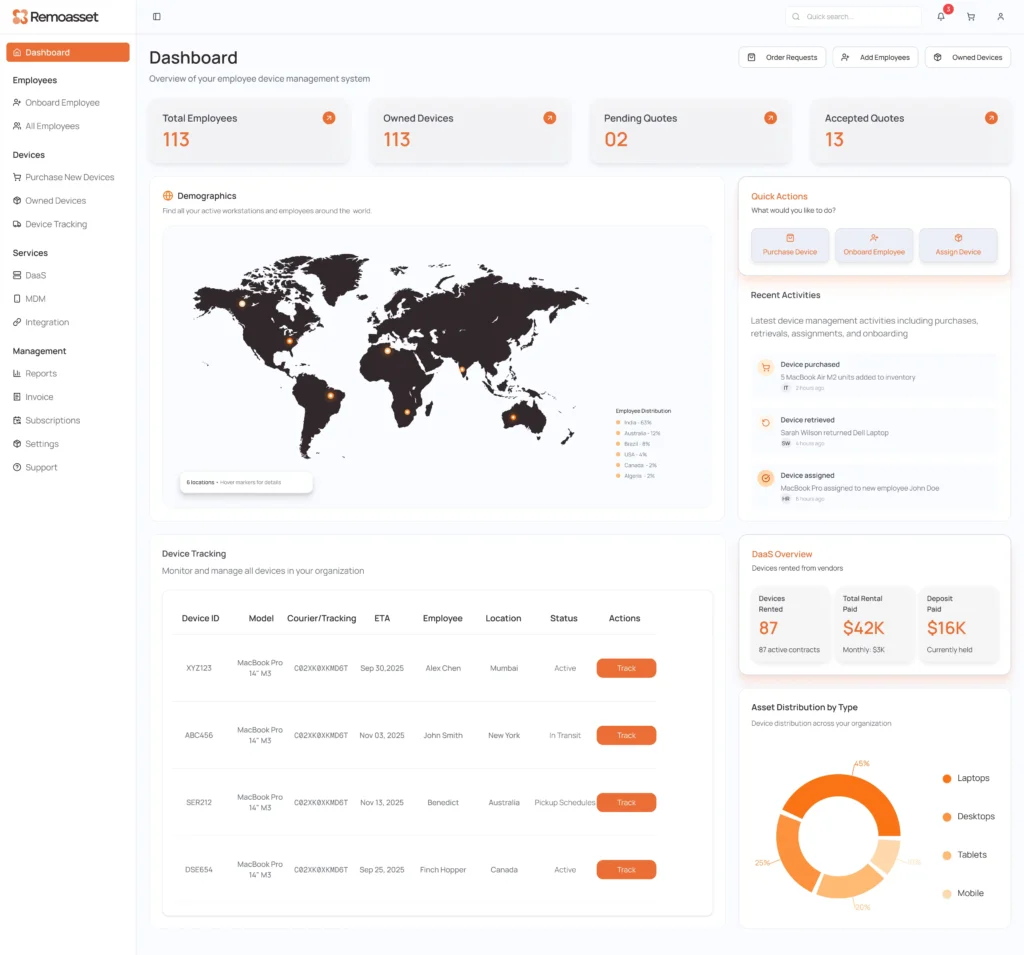
Procure, deploy and retrieve laptops in 80+ countries — compliant, localised and delivered in days.
The erasure process follows NIST 800-88 and DoD 5220.22-M standards across macOS, Windows with BitLocker, iOS, and Android.
Post-erasure, Remoasset handles refurbishment and redeployment assets, re-enter inventory, get graded, and are assigned to new hires or held in reserve. For IT teams managing distributed fleets globally, this eliminates the coordination overhead that accumulates quickly across multiple vendors.
Best for:
Remote-first and global companies that need end-to-end laptop device lifecycle management, not just a wipe tool.
Limitations:
Pricing is on request; not publicly listed, which can slow initial evaluation for teams comparing vendors.
Pricing:
Available on request. Designed for mid-market and enterprise teams. Request a demo
2. Blancco
Blancco is the most widely recognized name in certified data erasure software and is used by ITAD vendors, enterprises, and government agencies worldwide. The platform supports 25+ globally recognized erasure standards, including NIST 800-88, DoD 5220.22-M, IEEE 2883, and BSI standards. Many third-party ITAD vendors run Blancco’s engine under the hood.
Best for:
- Organizations that need standalone,
- Software-based certified erasure at scale particularly for mixed hardware environments,
- Data centers,
- ITAD operations.
Limitations:
- Blancco does not manage the logistics around the wipe no retrieval workflow
- No HRIS integration,
- No redeployment pipeline.
- It erases infrastructure, not lifecycle management.
- Some users report that licenses are consumed even when an erasure job fails
- Four tiers Starter, Essentials, Power, and Enterprise
- A 14-day free trial is available for core products
- Enterprise pricing requires a direct quote.
3. Iron Mountain
Iron Mountain is an ITAD provider in North America, operating in 30+ countries. The company entered the ITAD space in 2021 through acquisitions including IT Renew, Regency Technologies, and Wisetek, building out a broad portfolio that covers data sanitization, physical destruction, e-waste recycling, and asset remarketing.
Their ITAD services include NIST 800-88 compliant data sanitization, DIN 66399 compliant media shredding, GPS-tracked secure transportation, and a Secure ITAD Management System portal for tracking assets through the full disposition process. Data destruction certificates are issued at completion.
Best for:
Large enterprises and regulated organizations (finance, healthcare, government) that need physical destruction infrastructure, chain-of-custody documentation, and global scale.
Limitations:
Iron Mountain’s model is optimized for bulk enterprise disposal programs rather than continuous employee offboarding. It is less suited for remote-first companies managing individual device retrievals across distributed teams.
Pricing:
Standardized fees are communicated upfront through their online portal. Contact Iron Mountain directly for a quote.
4. Securis
Securis offers mobile on-site destruction services they come to you. For industries where data cannot leave the premises before destruction, this operational capability matters significantly. Services include on-site shredding, degaussing, and software erasure, all paired with NAID AAA certification and detailed destruction documentation.
Best for:
Federal contractors, healthcare organizations, and companies with strict on-premises chain-of-custody requirements.
Limitations:
The on-site model is both the value proposition and the constraint. It doesn’t scale for organizations managing continuous device offboarding across hundreds of distributed employees.
Pricing:
Project-based. Contact Securis for pricing based on volume and service type.
5. ERI
ERI claims to be the largest fully integrated IT and electronics asset disposition provider in the United States. The company maintains NAID AAA, R2v3, and e-Stewards certifications and operates through a US facility network with a 46-country partner reach. Services cover data destruction, asset tracking, repair and reuse, parts harvesting, recycling, and device remarketing.
Best for:
Organizations that need to demonstrate both data security and environmental compliance in their disposal program.
Limitations:
Facility-based processing model not built for remote workforce device management or continuous offboarding workflows.
Pricing:
Project-based. Contact ERI directly for volume pricing.
6. Workwize
Workwize is a global IT hardware lifecycle management platform covering procurement, deployment, management, retrieval, and disposal across 100+ countries. The platform’s core strength is logistics enabling fast, local deliveries and returns for distributed teams, with HRIS integration for automated onboarding and offboarding workflows.
Best for:
HR and IT teams at globally distributed companies that need automated procurement-to-retrieval workflows with solid logistics coverage.
Limitations:
Data wiping capabilities are present but not the platform’s primary strength. Organizations with strict certified erasure requirements may need a supplementary solution. API expansion is reportedly still in progress as of early 2025.
Pricing:
Tiered per-user pricing. View plans on Workwize.
Related Read: Best Workwize Alternatives & Competitors
7. GroWrk
GroWrk specializes in IT equipment logistics for distributed teams in Latin America and emerging markets. Their established logistics networks in Mexico, Colombia, Brazil, and similar markets address a real operational gap most ITAD vendors have limited coverage in these regions.
Best for:
Distributed teams concentrated in LATAM and emerging markets where local logistics networks are the deciding factor.
Limitations:
Data destruction is not the primary differentiator. Companies that need deep erasure certification paired with regional retrieval may need to layer in a specialist for compliance purposes.
Pricing:
Available on request through GroWrk.
Read Also: Best Growrk Alternatives & Competitors
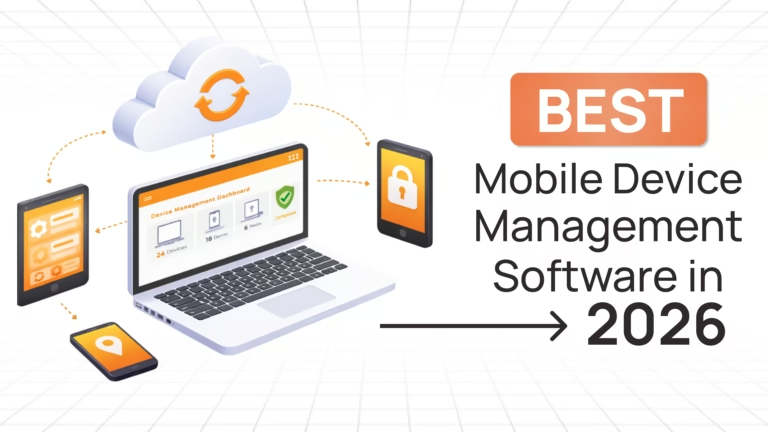
8. IBM MaaS360
IBM MaaS360 is a Unified Endpoint Management (UEM) platform. Not an ITAD tool but it belongs in this list because remote wipe capability is a critical first line of defense when devices are lost, stolen, or unreturned.
MaaS360 supports policy-based wipe and lock across iOS, Android, macOS, Windows, Chrome OS, and IoT devices. Watson AI powers behavioral threat detection and risk scoring. It’s available on IBM.com and AWS Marketplace.
Best for:
Enterprise security teams using MDM as the primary enforcement layer for remote endpoint control and active fleet management.
Limitations:
Not an ITAD or disposal platform. Remote wipe from MaaS360 does not satisfy NIST 800-88 certified erasure requirements for compliance purposes. Pricing note: older reseller listings cite plans starting at $8/user/month; current enterprise pricing should be confirmed directly with IBM, as tiers and bundling have changed.
Pricing:
Subscription-based, per device/user. Contact IBM or purchase through AWS Marketplace for current pricing.
Comparison Table
| Tool | Certified Erasure | Remote Wipe | Device Retrieval | HRIS Integration | Certificate of Erasure | Redeployment | Best Company Size |
| Remoasset | Yes, NIST + DoD | Yes | Global | Yes | Tamper-proof | Yes | Mid-market → Enterprise |
| Blancco | Yes, 25+ standards | No | No | No | Signed PDF/XML | No | Mid-market → Enterprise |
| Iron Mountain | Yes, Physical + software | No | Partial | No | Yes | No | Enterprise |
| Securis | Yes, On-site | No | No | No | Yes | No | Enterprise / Gov / Health |
| ERI | Yes | No | No | No | Yes | No | Enterprise |
| Workwize | Basic | No | Yes,100+ countries | Yes | Limited | Partial | SMB → Enterprise |
| GroWrk | Basic | No | Yes, LATAM | No | Limited | Partial | SMB → Mid-market |
| IBM MaaS360 | No, MDM only | Yes | No | Partial | No | No | Mid-market → Enterprise |
What Compliance Actually Requires
The audit question IT teams inevitably face isn’t “did you wipe the devices?” It’s “can you prove it for every device, with a timestamp and a serial number?”
GDPR Article 5 requires personal data not to be retained beyond its purpose. HIPAA’s Security Rule mandates that ePHI be rendered unreadable when disposed of. SOC 2 Type II auditors will ask for documented evidence of your data destruction process. A verbal answer doesn’t pass any of these.
The chain-of-custody requirement is equally important. From the moment a device leaves an employee’s hands to the moment it’s certified as wiped, every step needs documentation who received it, when, what condition it was in, what erasure method was applied, and what the verification result showed. That’s the full audit trail a certificate of erasure captures. It’s not a nice-to-have; for regulated industries it’s a legal obligation.
The ESG Case for Certified Erasure Over Physical Destruction
One angle IT teams often miss: certified software erasure is better for sustainability than shredding. Physical destruction makes hardware permanently unusable and sends it to a recycling stream that, while responsible, still requires energy and raw material processing.
Certified erasure, when properly verified, meets the same regulatory requirements while leaving the device functional. That means it can be redeployed internally, remarketed, or donated extending its lifecycle and reducing the e-waste burden.
Organizations with active ESG reporting will find that tracking device reuse rates alongside data destruction compliance gives them a more complete sustainability picture. Some tools, including Blancco’s Sustainability Dashboard and ERI’s downstream reporting, make this data available directly.
Simplify Secure Device Disposal with Remoasset
A missing audit trail, an unreturned laptop, or an undocumented wipe process can create compliance exposure long after an employee leaves. At the same time, physically destroying every retired device creates unnecessary hardware costs and e-waste.
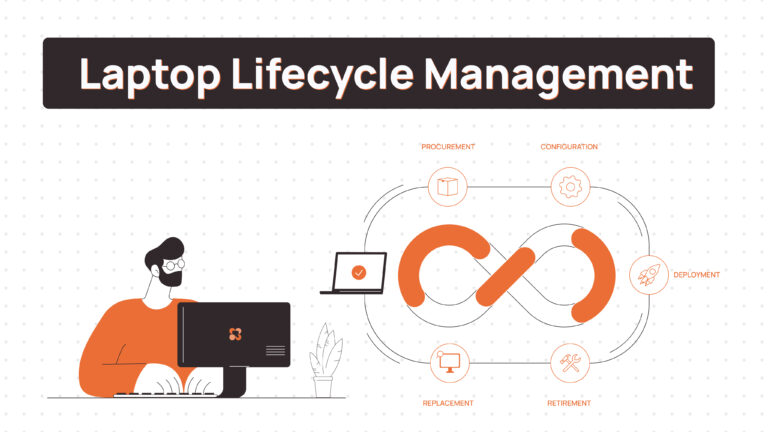
Modern IT teams need systems that can securely retrieve devices, verify erasure, maintain audit records, and return usable hardware back into circulation. Remoasset helps companies manage that process end to end from retrieval and certified NIST 800-88 erasure to refurbishment, redeployment, and lifecycle tracking across global teams.
For organizations scaling remote or distributed operations, that shift from isolated disposal workflows to connected lifecycle management is becoming the new standard.
FAQ
1. What’s the difference between data wiping and data destruction?
Data wiping (erasure) uses software to overwrite all storage sectors, leaving the hardware functional and reusable. Data destruction is physical shredding, degaussing, incineration and makes the device permanently unusable.
2. Can deleted files be recovered after a factory reset?
Yes. A factory reset marks storage sectors as available without actually overwriting the data. Freely available forensic tools can recover most files from a factory-reset device.
3. Is NIST 800-88 the same as DoD 5220.22-M?
No. NIST 800-88 is the current US government standard, defining Clear, Purge, and Destroy methods based on media type. DoD 5220.22-M is an older multi-pass overwrite protocol from the Department of Defense.
4. Is remote wipe alone enough for compliance?
No. MDM-based remote wipe is a security response to an immediate threat of a lost or stolen device. It does not produce a Certificate of Erasure meeting NIST 800-88 or DoD standards, and it won’t satisfy compliance requirements under GDPR, HIPAA, or SOC 2.
5. What is the difference between ITAD and device lifecycle management?
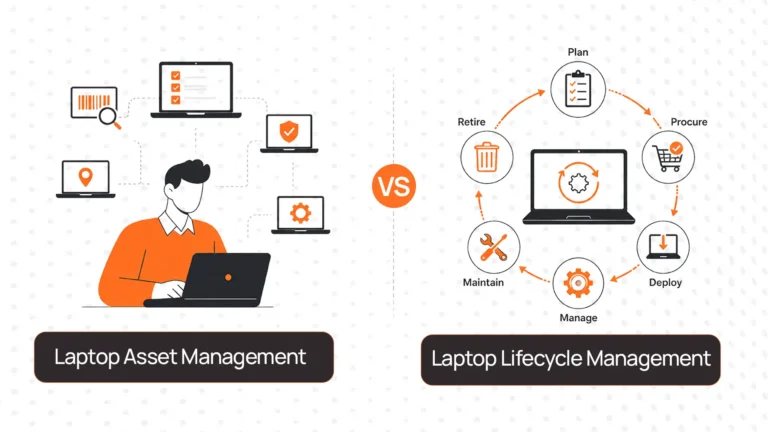
ITAD (IT Asset Disposition) refers specifically to the end-of-life phase of secure disposal, erasure, recycling, and remarketing. Device lifecycle management covers the entire journey of an asset from procurement and deployment through maintenance, tracking, and eventual retirement.
6. How long should companies retain certificates of erasure?
Retention requirements vary by regulation. HIPAA requires audit documentation to be retained for a minimum of six years. GDPR doesn’t specify a fixed period but requires documentation sufficient to demonstrate compliance. SOC 2 auditors typically review at least 12 months of evidence.