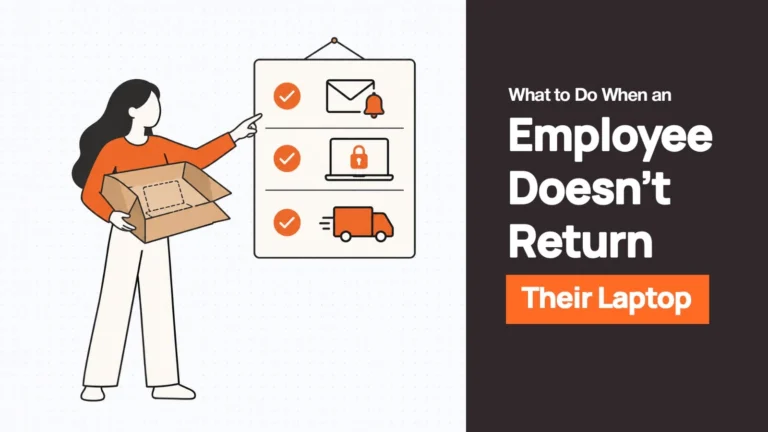

HR marks an employee as offboarded. Two weeks later, the laptop shows up. Good.
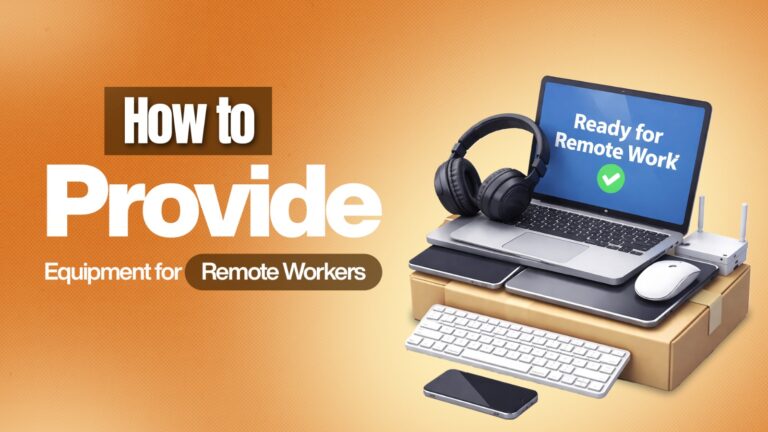
But what about the charger? The monitor sitting on their home desk? The docking station? The headset they used daily for sales calls? The security key sitting in a drawer somewhere?
Most companies discover this the hard way. They retrieve the laptop, close the offboarding ticket, and move on. Three months later, finance flags a missing $400 monitor that nobody tracked. Or worse, a security key with active access to internal systems is still sitting at a former employee’s apartment.
The problem is that a laptop is just one item in an equipment kit, and most “retrieval services” only think about the laptop. What companies actually need is an employee equipment return service, one that recovers everything a departing employee was issued, not just the device with the highest price tag.
Employee Equipment Return Services at a Glance
Before diving into individual reviews, here’s a quick shortlist to help you narrow down options based on what matters most to your team.
| Provider | Best For | Global Coverage | Supports Full Equipment Returns | Lifecycle Features | Pricing |
| Remoasset | Full lifecycle + complete equipment kits | 150+ countries | Yes | Procurement, deployment, repairs, redeployment | Custom |
| Workwize | Mid-market and enterprise lifecycle management | 100+ countries | Yes | Full lifecycle with redeployment | Subscription, $8/seat/month+ |
| GroWrk | Fast-growing startups hiring globally | 150+ countries | Yes | Logistics-focused, limited redeployment | Custom |
| Allwhere | Employee experience priority | Global | Partial (laptop-focused) | Limited lifecycle support | Custom |
| Firstbase | Companies already using Firstbase for deployment | Global | Yes | Procurement, deployment, retrieval | Per-seat |
| Retriever | Simple, retrieval-only needs | US, Canada, UK, EU | No (laptops and monitors only) | Retrieval only | Per device, $95+ |
If your company issues more than just a laptop, which most do, narrow your list to providers that explicitly support full equipment kits, not just devices.
How Employee Equipment Return Services Work
Understanding the actual workflow makes it easier to evaluate whether a provider handles the full process or just part of it.
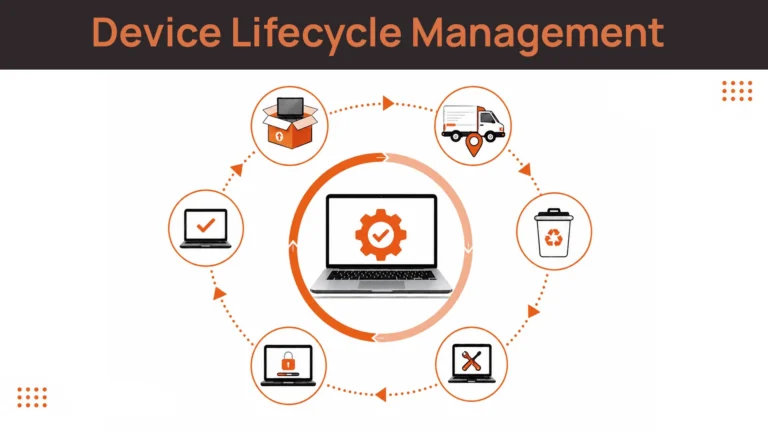
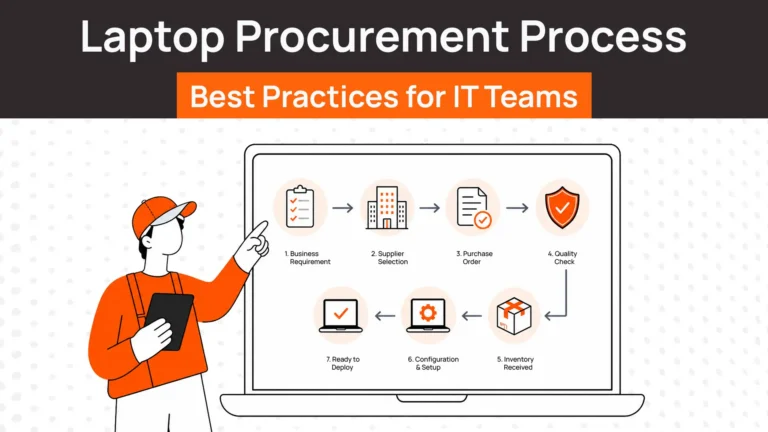
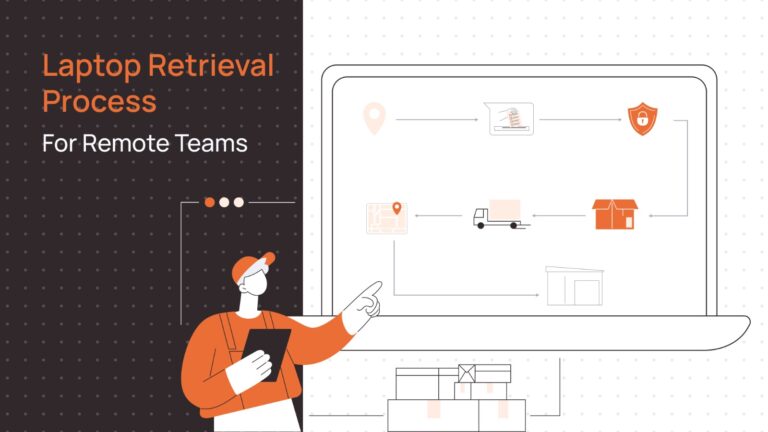
HR offboarding
An employee’s exit is recorded in your HRIS. This should be the trigger point for everything that follows.
Return trigger
The return process initiates automatically, ideally without anyone in IT manually starting it.
Employee receives instructions
A return kit, or scheduling link, arrives with clear guidance on what to pack and ship.
Pickup scheduled
Either the employee drops off the package or a pickup is scheduled at their location, depending on the provider.
Equipment retrieved
The full kit, not just the laptop, ships back with tracking visible to your team.
Inspection
Every item is checked on arrival. Condition, completeness, and serial numbers get logged.
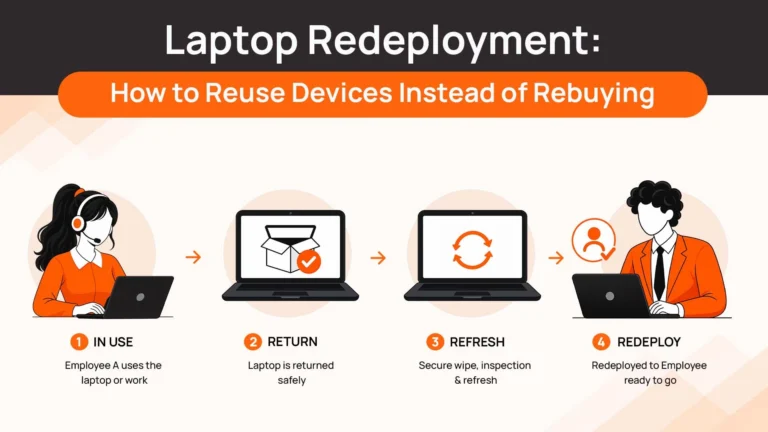
Repair, redeploy, or retire
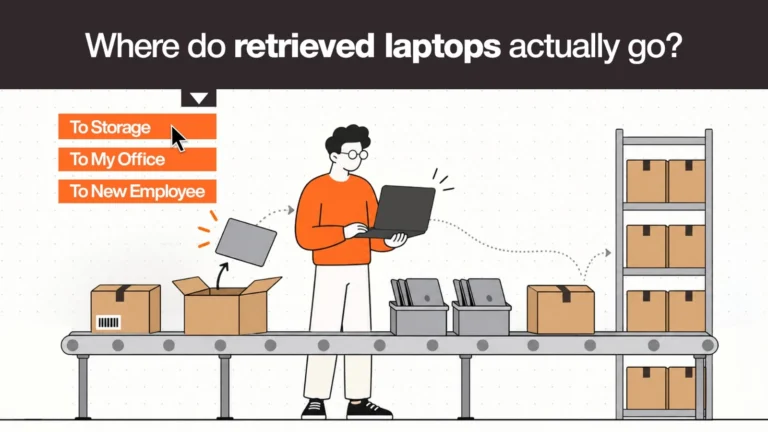
Each device gets routed based on condition. Functional gear goes back into inventory. Damaged gear goes to repair. End-of-life gear goes to ITAD or recycling.
The providers worth considering handle this entire chain. The ones to be cautious of stop after step five and call it done.
Related Read: Best Laptop Retrieval Services
What Matters When Choosing an Equipment Return Service
Most comparison articles list generic features like “global coverage” and “good support.” Those matter, but they don’t tell you whether a service will actually solve your problem. Here’s what to look for instead.
Supports complete equipment kits, not just laptops
This is the single biggest differentiator. Ask any provider directly: does your service retrieve monitors, docking stations, headsets, and security keys, or just the laptop? Many retrieval services are built around a single device and treat everything else as an afterthought.
Self-service scheduling for employees
A departing employee should be able to schedule their own pickup or request a kit without IT manually coordinating each step. Self-service reduces delays and removes IT from the bottleneck.
Automatic HRIS-triggered workflows
When HR marks someone as terminated, the return process should start without anyone remembering to kick it off manually. Integration with BambooHR, Workday, Rippling, or similar systems is what makes this possible.
Tracking and chain of custody
You need visibility into where every item is at every stage, plus documentation proving when it was shipped, received, and inspected. This matters for both operational tracking and security audits.
Global pickup coverage
If your team is distributed across multiple countries, confirm the provider has actual local logistics partnerships, not just a claim of “global coverage.” Customs handling and regional carrier relationships matter here.
Inspection and redeployment support
Getting equipment back is only half the value. What happens next matters just as much. Does the provider inspect condition, support refurbishment, and help you redeploy functional gear to the next hire?
Pricing transparency
Per-device pricing, subscription models, and bundled lifecycle pricing all work differently. Know what you’re actually paying for, including whether accessories and peripherals cost extra.
Integration with the broader device lifecycle
A return service that only does returns leaves you managing procurement, deployment, and disposal separately. A service that connects retrieval to the full lifecycle saves significant coordination overhead.
Learn More:
- Laptop Procurement for Distributed Teams
- Laptop Management for a Global Workforce
- Global Laptop Retrieval for Distributed Teams
The Best Employee Equipment Return Services for Remote Teams
When you’re ready to compare specific providers, here’s how the major players stack up.
1. Remoasset
Remoasset manages employee laptop returns as part of complete device lifecycle management across 80+ plus countries. Unlike retrieval-only services, it handles full equipment kits including laptops, monitors, docking stations, and peripherals, then routes each item through inspection, repair, or redeployment.
Key Features
- Automated return triggers via HRIS integration
- Full equipment kit retrieval, not just laptops
- Real-time tracking with chain-of-custody documentation
- Inspection, repair coordination, and redeployment infrastructure
- Global logistics across 150+ countries
Best For
Companies managing complete equipment kits across distributed teams who want returns connected to the rest of the device lifecycle, including procurement and redeployment.
Pricing
Pricing is custom based on device volume and lifecycle services needed. You can request a quote or go for the subscription model.
2. Workwize
Workwize provides IT asset lifecycle management with strong equipment return capabilities across 100 plus countries. Subscription pricing covers unlimited retrievals as part of a broader lifecycle platform.
Key Features
- Zero-touch retrieval with prepaid kits
- HRIS integrations including BambooHR and Workday
- NIST 800-88 compliant data wiping
- Asset redeployment and resale support
Best For
Mid-size to enterprise companies wanting predictable subscription pricing and mature lifecycle workflows rather than per-device costs.
Pricing
Check their pricing page for current rates.
Related Read: 7 Best Workwize Alternatives & Competitors
3. GroWrk
GroWrk specializes in global IT logistics, including equipment returns, across 150 plus countries with strong local carrier partnerships. Built for companies dealing with genuinely complex international shipping.
Key Features
- Local logistics partnerships in 150+ countries
- Prepaid return kits with real-time tracking
- Certified data wiping and environmental compliance
- 24/7 platform support
Best For
Fast-growing startups hiring across many countries who need reliable international logistics more than deep lifecycle features.
Pricing
Pricing is custom. They have a free A La Carte model and a paid Flex model. You’ll need to request a demo for specific numbers.
4. Allwhere
Allwhere focuses heavily on employee experience during the return process, with clear instructions and respectful communication. Coverage is global, though the service is more laptop-centric than full equipment kit focused.
Key Features
- Employee-friendly return instructions and support
- Global logistics with real-time tracking
- HRIS integrations including BambooHR and Okta
- Custom retrieval timelines
Best For
Companies that prioritize employer brand and a smooth employee experience during offboarding, where most equipment is laptops rather than full kits.
Pricing
Custom pricing available by contacting their team directly.
5. Firstbase
Firstbase connects HR and IT systems to automate equipment return workflows, primarily for companies already using Firstbase for device deployment.
Key Features
- Global logistics for laptops and accessories
- Real-time asset tracking
- API integration with HR and IT platforms
- Bundled per-seat pricing
Best For
Teams already using Firstbase for procurement and deployment who want consistent returns through the same platform.
Pricing
Bundled per-seat pricing. Reach out to their sales team for specifics.
6. Retriever
Retriever offers simple, pay-per-use laptop and monitor retrieval focused on the US, Canada, UK, and EU. No subscription required, and the service is intentionally narrow in scope.
Key Features
- Padded boxes with prepaid shipping labels
- Automated employee reminders
- Real-time tracking
- Optional refurbishment or recycling
Best For
Smaller teams or companies needing occasional, simple laptop retrieval without full equipment kit support or subscription commitments.
Pricing
Starts at $95 per laptop. Their pricing page has the full breakdown by device type.
Which Equipment Return Service Is Right for Your Team?
The right answer depends less on company size and more on what you’re actually trying to solve. Use this to narrow things down quickly.
| If your team is… | Consider… | Why |
| A startup hiring globally with fast headcount growth | GroWrk | Strong international logistics without heavy lifecycle complexity |
| Mid-market with predictable, subscription-based needs | Workwize | Mature lifecycle workflows at predictable monthly cost |
| Enterprise needing structured governance and automation | Workwize or Remoasset | Both offer HRIS automation and audit-ready documentation |
| Only needing simple laptop retrieval, low volume | Retriever | Pay-per-use, no subscription, narrow but reliable scope |
| Prioritizing employee experience during offboarding | Allwhere | Built around smooth, respectful employee communication |
| Managing full equipment kits with redeployment needs | Remoasset | Covers laptops, monitors, peripherals, and connects returns to the broader lifecycle |
If your equipment kit goes beyond a laptop, which is true for most companies issuing monitors, docking stations, or headsets, prioritize providers explicitly built for full kit returns over laptop-only retrieval services.
What’s Usually Included in an Employee Equipment Return?
This is the part most retrieval articles skip entirely, and it’s exactly why so many companies underestimate what they need to recover.
| Equipment | Usually Returned? | Notes |
| Laptop | Yes | The primary asset, almost always tracked |
| Charger | Yes | Frequently forgotten by employees and rarely tracked separately |
| Docking station | Yes | Common for hybrid employees, often overlooked in retrieval planning |
| Monitor | Sometimes | Depends on company policy and whether it was company-issued |
| Keyboard and mouse | Sometimes | Often bundled with monitor setups for desk configurations |
| Headset | Usually | Especially important for sales and support teams using daily calls |
| Company phone | Yes | If company-issued, this carries the same security risk as a laptop |
| Security keys | Yes | Often the most overlooked item despite carrying active account access |
If your equipment return process only tracks the laptop, you’re likely losing visibility on several of these items every time someone leaves. A proper equipment return service accounts for the entire kit from day one, not just the most expensive piece of it.
How Remoasset Simplifies Employee Equipment Returns
Returns are only one part of managing company equipment. The real challenge is what happens before and after the return itself.
Remoasset triggers returns automatically when an employee is marked as offboarded in your HRIS, covering the full equipment kit rather than just the laptop. Devices and accessories are tracked from pickup through arrival, with chain-of-custody documentation throughout.
On arrival, every item gets inspected, and condition determines what happens next: repair, redeployment to the next hire, or routing to ITAD and certified recycling. Book a demo and simplify your equipment returns for your team.
FAQs
What happens if an employee doesn’t return company equipment?
Most companies start with automated reminders, escalating to manager involvement if equipment isn’t returned within a set window. Some withhold final pay where legally permitted, though laws vary significantly by state and country. A few companies charge the replacement cost against the employee’s final settlement. Whatever the policy, it should be documented in the employment agreement before issues arise.
Should companies retrieve monitors and accessories as well?
Yes, if they were company-issued. Monitors, docking stations, and headsets carry real replacement costs, often $200 to $500 per item. Beyond cost, untracked accessories make asset audits unreliable and can leave gaps in your inventory records that are hard to reconcile later.
How long should an equipment return process take?
For domestic returns, 5 to 10 business days from initial request to receipt is reasonable. International returns typically take 2 to 3 weeks depending on customs and local carrier availability. If returns are regularly taking longer, that’s usually a sign the process lacks automation or clear employee instructions.
Can employees schedule pickups themselves?
The better providers offer self-service scheduling, where employees choose a pickup time or print a prepaid label without IT coordinating each step manually. This significantly reduces delays compared to processes that require back-and-forth emails to arrange logistics.
Do equipment return services include secure data wiping?
Most established providers include certified data wiping, typically following NIST 800-88 standards, as part of the return process. Always confirm this explicitly rather than assuming it’s included, since some lower-cost retrieval-only services treat data wiping as a separate add-on.
What’s the difference between an equipment return service and an ITAD provider?
An equipment return service focuses on getting devices back from employees, including logistics, tracking, and initial inspection. An ITAD provider specializes in what happens at end-of-life: certified data destruction, resale, and compliant recycling. Many lifecycle platforms, including Remoasset and Workwize, combine both functions, while standalone ITAD companies typically only handle the disposition side.
Can returned equipment be redeployed?
Yes, and this is where the real cost savings happen. A laptop or monitor that comes back in good condition can be wiped, reconfigured, and assigned to the next new hire instead of purchasing new equipment. Providers with redeployment infrastructure built in make this significantly easier than managing it manually.
How do global companies standardize equipment returns?
The most effective approach is connecting the return trigger directly to HRIS offboarding events, using a single provider with genuine local logistics coverage rather than stitching together different regional vendors, and applying a consistent inspection and grading process regardless of where the device is returning from.