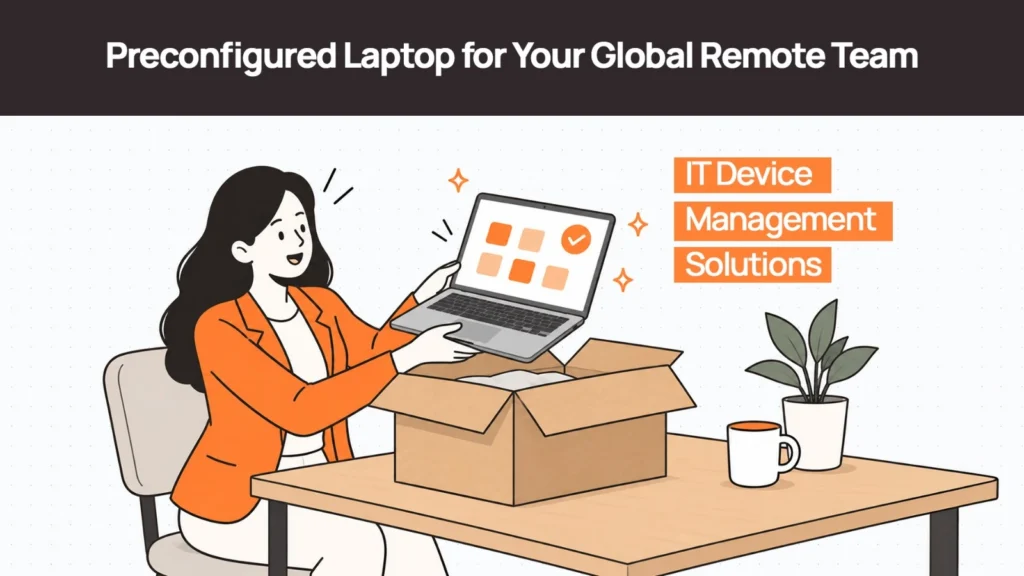
“Pre-configured laptop” sounds straightforward. The device arrives at the employee’s home, they switch it on, sign in, and start working.
But technically, a laptop being pre-configured can mean very different things.
One organization might simply install a few applications before shipping the device. Another might deploy a custom operating system image, configure security policies, and manually create a user profile. A modern IT team might do almost none of that — instead using the OEM-installed operating system together with a device management platform and a defined deployment profile, allowing the laptop to configure itself when the employee starts it for the first time.
These approaches can all be described as “pre-configured.” Operationally, they are very different.
For a distributed team, that distinction matters because there may be no IT desk waiting for the employee at the other end. The device has to arrive with the right management, security, and application policies already defined, while still leaving room for role-specific requirements.
So what should a pre-configured laptop for a remote team actually contain? The answer starts with understanding how modern zero-touch provisioning differs from the older imaging model.
Golden Image vs. Modern Zero-Touch Provisioning
For years, IT teams used a relatively straightforward approach to standardizing computers: create a master configuration, capture it as an image, and deploy that image to other machines. This is commonly referred to as a golden image.
The golden image contains a customized operating system environment with applications, settings, and other configurations already included. When a new laptop is provisioned, the image is applied to the device so that multiple machines start from essentially the same software state.
This approach can provide strong consistency, but it also creates another thing for IT to maintain. The image itself has to be updated as operating system versions change, applications are patched, drivers change, and security requirements evolve. The organization also needs the infrastructure and process required to apply that image to devices. That becomes increasingly inconvenient when employees are distributed geographically.
A modern zero-touch approach takes a different route. Instead of replacing the OEM’s operating system with a custom image, platforms such as Microsoft Windows Autopilot with Intune or Apple Automated Device Enrollment through Apple Business Manager use the device’s existing operating system and apply organizational policies during setup.
The laptop can be associated with the organization’s management environment before it reaches the employee. During first boot, the employee authenticates, and the device receives the policies, applications, and configurations defined for that deployment profile.
The difference is important. With traditional imaging, IT creates and maintains a complete software image that is applied to the device. With modern zero-touch provisioning, IT defines how the device should be configured, while the OEM-installed operating system remains the starting point.
For a distributed organization without a central IT warehouse, this can eliminate a significant amount of physical handling. There is less reason to have every laptop shipped to headquarters, manually imaged, and then shipped again to the employee. The configuration becomes a policy-driven process rather than a physical imaging exercise. For a deeper look at how this fits into a broader deployment model, see the zero-touch deployment guide.
What Actually Goes Into a Configuration Baseline?
A configuration baseline is the defined state that an organization’s laptops should reach during provisioning. It should answer a practical question: what must be true about this laptop before an employee is expected to use it for work?
1. Operating System and Deployment Profile
The first layer is the operating system environment and the deployment method. For Windows devices, this might involve Windows Autopilot and Microsoft Intune. For Apple devices, Apple Business Manager and Automated Device Enrollment can be used with a compatible MDM platform. The objective is to establish how the device should join the organization’s management environment during setup, and what the employee sees during first boot.
2. MDM Enrollment
Mobile Device Management (MDM) is one of the most important components of a modern device baseline. The laptop should be enrolled into the organization’s management system as part of provisioning rather than relying on the employee or an IT administrator to complete enrollment manually after delivery. Once enrolled, the organization can apply policies, manage applications, enforce security requirements, and maintain visibility into the device. For a remote workforce, this matters because the device may never physically pass through an IT department.
3. Security and Endpoint Protection
A laptop should not reach an employee with security controls treated as a future task. The baseline can include endpoint detection and response software, antivirus or endpoint protection, firewall settings, and other organizational security policies. Encryption should also be part of the baseline where required — for Windows environments, this commonly means configuring BitLocker; for Apple devices, FileVault. If encryption is expected for company laptops, the organization should not depend on an employee remembering to enable it. The policy should be built into the provisioning process.
4. BIOS or UEFI Configuration
The operating system is only one layer of the device. Enterprise configurations can also include hardware-level settings through BIOS or UEFI, depending on the laptop manufacturer and the organization’s requirements. These settings can include options related to boot security, virtualization, and external device access. The exact controls should be determined by the organization’s security architecture.
5. Application Packages
A standard employee laptop rarely needs every application the company uses. Software can be divided into a common baseline and role-specific packages. The common baseline might include:
- Microsoft 365 or Google Workspace applications
- Browser configuration
- Collaboration software
- VPN or secure access tools
- Endpoint security software
- Password or identity management tools
A developer may then receive additional development environments. A designer may require creative applications. A finance employee may need specific business applications. This is why a useful configuration baseline should be standardized without pretending every employee performs the same job.
Related Reads
Pre-configuration sits at the intersection of procurement, security, and device lifecycle management. These posts cover the surrounding decisions:
- Zero-Touch Deployment Readiness Checklist — assess whether your current fleet and tooling are ready for a zero-touch provisioning rollout.
- Laptop Redeployment Guide — how configuration standards apply when a returned device is repurposed for a new employee.
- Remote Device Offboarding Guide — what happens at the other end of the device lifecycle when an employee leaves.
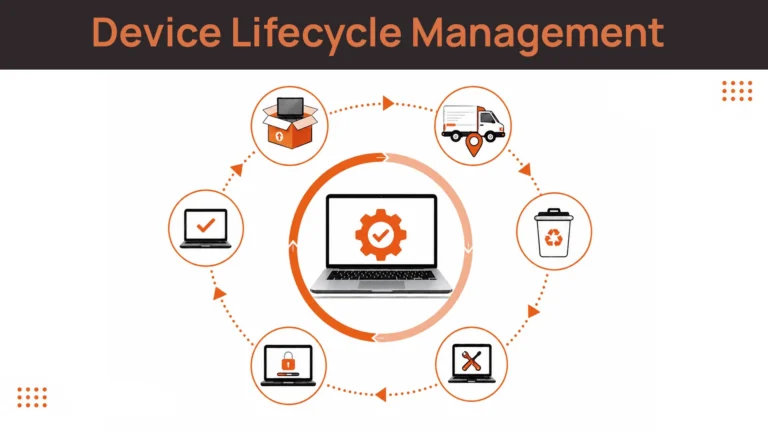
- Device Lifecycle Management Guide — how provisioning fits into the full lifecycle from procurement through retirement.
One Baseline vs. Many: The Real Trade-Off
There are two easy mistakes when building a laptop provisioning strategy.
The first is creating a completely custom configuration for every employee. That gives people exactly what they need, but every variation becomes another configuration to maintain, troubleshoot, patch, and document.
The second mistake is trying to force every employee onto exactly the same laptop configuration. That makes administration easier, but it can create unnecessary restrictions for specialist teams.
A better approach is usually a common baseline with a limited number of role-based profiles:
| Profile | Common Baseline | Additional Requirements |
| Standard Employee | MDM, encryption, EDR, core applications | Standard productivity tools |
| Developer | Same security baseline | Development environments and tools |
| Designer | Same security baseline | Creative and graphics applications |
| Executive | Same security baseline | Approved executive applications and peripherals |
The security and management foundation remains consistent. The applications and hardware specifications can vary where there is a legitimate business requirement. This approach also makes procurement planning easier — instead of maintaining dozens of device configurations, IT can define a smaller approved catalog that maps to the organization’s deployment profiles.
Why Misconfiguration Is a Security Problem
Configuration consistency is often discussed as an IT efficiency issue. It is also a security issue.
Consider two employees who receive laptops on the same day. One device is fully enrolled in MDM, encrypted, running the required endpoint security software, and configured with the organization’s access policies. The second device has the operating system installed and a few applications added, but MDM enrollment is still pending. Encryption has to be enabled manually. The employee is asked to install one security application after receiving the laptop.
Both devices may look “ready” from a procurement perspective. They are not at the same security baseline.
This is where manual steps create risk in a distributed environment. Every additional task completed after delivery creates another opportunity for something to be missed, delayed, or configured differently. The problem becomes harder to spot as the fleet grows. An IT administrator may complete every step consistently for the first ten laptops. Doing the same across hundreds of devices, different countries, and different hiring schedules is much harder.
That is why the configuration baseline should be defined before procurement and deployment, rather than treated as a checklist employees complete during their first week.
What a Pre-Configured Laptop Should Look Like for a Remote Employee
For the employee, the experience should be relatively simple. The laptop arrives at their home. They unpack it and switch it on. The device connects to the internet and begins the organization-defined setup experience. They authenticate using their work identity, and the appropriate management policies and applications are applied.
Behind that simple experience, several things may already have been established:
- The device is associated with the organization’s management environment.
- The appropriate deployment profile is assigned.
- Security policies are defined.
- Encryption is enabled or configured according to policy.
- Endpoint security software is deployed.
- Required applications are identified and installed.
- Device information is recorded in the organization’s asset management system.
- Access policies are applied according to the employee’s role.
The employee should not need to understand how any of this works. That is the point of the provisioning model.
Why Global Remote Teams Have an Extra Problem
For a company with a central office, the traditional process can still be workable. A laptop arrives at the IT department, someone configures it, and it ships to the employee. A global remote team may not have that physical checkpoint.
The employee could be in London while the laptop is sourced locally in the UK. Another could be in Singapore with a device sourced locally there. A third might be in the UAE. If every device has to travel back to a central IT location before deployment, shipping time and handling requirements increase, and the organization creates an unnecessary physical dependency in the provisioning process.
This is where local sourcing and centralized configuration standards become useful together. The device can be sourced in the country where the employee is located, while the configuration baseline remains centrally defined. The country of purchase can change. The configuration standard should not. That distinction allows a company to adapt procurement to local availability without allowing every region to invent its own IT baseline.
The Baseline Has to Travel With the Device
For global teams, this is the most important practical principle. Your laptop configuration should not depend on where the device was purchased or which local supplier fulfilled the order.
If one vendor buys the laptop, another vendor configures it, a third party ships it, and the internal IT team finishes enrollment after delivery, every handoff creates another opportunity for inconsistency.
A more streamlined model is to make the configuration part of the same workflow as sourcing:
- The laptop is sourced locally.
- The approved configuration profile is assigned.
- The required management and security controls are applied.
- The asset information is recorded in inventory tracking.
- The device is delivered to the employee.
For the employee, the experience remains simple. For IT, the process is repeatable.
Building a Pre-Configuration Standard for Your Fleet
Before rolling out a pre-configured laptop program, document the baseline itself. At minimum, define:
Device standards: which laptop models and hardware specifications are approved.
Operating system: which OS versions and editions are supported.
Management: which MDM platform manages the device.
Security: which encryption, endpoint protection, and access policies are mandatory.
Applications: which applications belong in the common baseline.
Role profiles: which employees require additional software or hardware.
Identity: how the device connects to the employee’s organizational identity.
Asset records: what device information needs to be captured at procurement and deployment.
Exceptions: who approves deviations from the standard.
The baseline should also have an owner. Operating systems change. Security requirements change. Applications change. A configuration that was appropriate twelve months ago may need revision today. A baseline that nobody owns eventually becomes a collection of old settings.
Making Pre-Configuration Work Across Countries
A global remote workforce does not require a global imaging warehouse. It requires a consistent operating standard. Remoasset can source laptops locally across multiple countries while applying a standardized configuration baseline as part of the procurement and deployment workflow — including the appropriate OS deployment profile, MDM enrollment, security controls, and role-based configuration before the device reaches the employee.
Local sourcing handles where the laptop comes from.
The configuration baseline defines how the laptop should work.
That separation means the device can be purchased in the employee’s local market without forcing IT to create a completely different provisioning process for every country. Book a demo to see how Remoasset applies a standardized configuration to devices sourced locally across multiple countries.
Frequently Asked Questions
What does it mean for a laptop to be pre-configured?
A pre-configured laptop has a defined set of management, security, and application policies applied before it reaches the employee. In a modern zero-touch model, this means the device is enrolled in MDM, assigned a deployment profile, encrypted, and loaded with required applications — so the employee only needs to authenticate at first boot, not complete IT setup tasks.
What is the difference between a golden image and zero-touch provisioning?
A golden image is a complete custom OS build that is applied to devices during provisioning, requiring imaging infrastructure and ongoing maintenance. Zero-touch provisioning builds on the OEM-installed OS and applies organizational policies through a cloud management platform at first boot. For distributed teams without a central IT hub, zero-touch is usually the more practical model.
What should be included in a standard laptop configuration baseline?
At minimum: MDM enrollment, endpoint security software, encryption (BitLocker or FileVault), an OS deployment profile, role-appropriate application packages, and asset record capture. The exact components depend on the organization’s security requirements and the MDM platform in use.
Do pre-configured laptops still need IT setup on arrival?
Usually, yes — but the nature of that setup changes. Zero-touch provisioning removes most of the manual physical setup required for each individual laptop. IT still defines and maintains policies, manages applications, monitors compliance, and supports users. The goal is to minimize the manual work required at the employee’s location, not to eliminate IT involvement entirely.