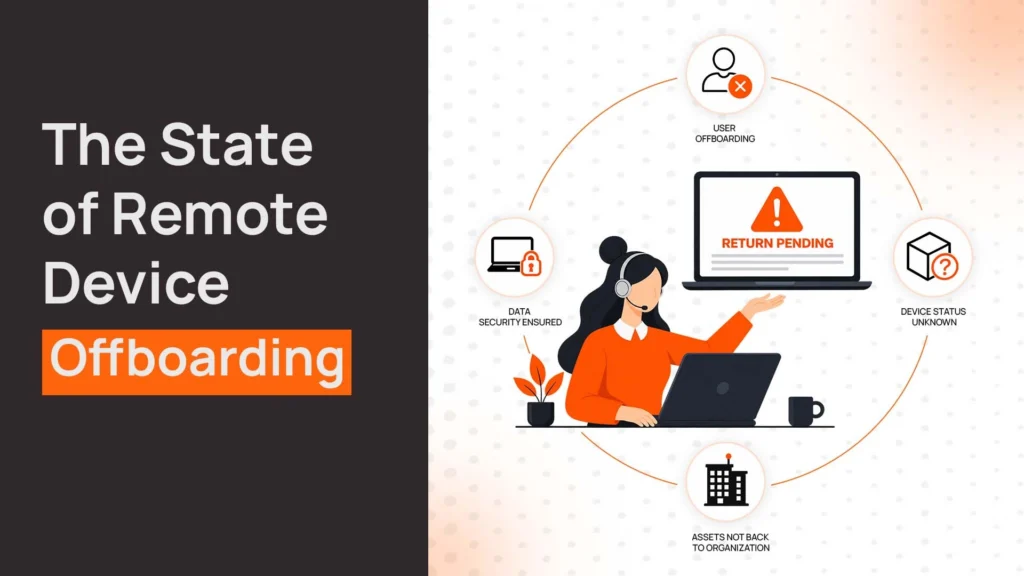
Remote employee offboarding has become a hardware problem as much as an HR or security problem.
When an employee leaves an office-based role, a company can usually recover equipment through a simple physical handoff. A laptop goes to IT, an access card goes to facilities, and the employee leaves with very little company property still in their possession.
Remote work changes that equation.
The laptop may be sitting in another city, another state, or another country. IT may be responsible for the asset while HR owns the employee workflow and Operations coordinates the physical return. Meanwhile, Security is concerned about the data on the device and Finance wants to know whether the hardware will be recovered, written off, or replaced.
The result is a process that can look straightforward in policy and become surprisingly difficult in practice.
The most widely cited benchmark on this problem comes from Capterra’s 2022 Employee Offboarding Survey. Among 287 HR professionals responsible for offboarding, 71% said at least one departing employee had failed to return company-owned equipment such as a laptop or smartphone. Capterra also found that hybrid and remote employees were 17% more likely to fail to return company equipment than employees working entirely on-site.
Those figures are useful, but they are now several years old.
This guide uses that benchmark alongside current asset-visibility research and current data-sanitization guidance to examine what organizations should measure in remote device offboarding today, where recovery processes tend to fail, and what a mature offboarding operation should look like.
Important research note: This is a benchmarking guide based on publicly available research, not a proprietary 2026 survey of Remoasset customers. No new recovery-rate figures are presented as original Remoasset research.
Key Findings
1. Device recovery is still a material offboarding problem
Capterra’s 2022 survey found that 71% of HR professionals who managed employee offboarding reported at least one case in the previous year where a departing employee failed to return company-owned equipment. The survey covered 287 HR professionals.
2. Remote and hybrid work increase the physical recovery challenge
Capterra found that hybrid and remote employees were 17% more likely to fail to return company equipment than employees working entirely on-site. The finding reflects the operational reality of remote work: company hardware is physically outside the organization’s workplace and therefore requires a deliberate retrieval process.
3. The value at risk is larger than the laptop’s resale price
In the same Capterra survey, respondents estimated that each incident involving unreturned company equipment represented an average of $1,963 in equipment value.
That figure should not be treated as a current universal replacement cost. It is a 2022 survey estimate. However, it illustrates why a recurring recovery problem can quickly become material for organizations with hundreds or thousands of employees, particularly once depreciation and residual value are taken into account.
4. Asset visibility remains a broader IT challenge
Flexera’s 2026 State of ITAM research found that only 36% of organizations reported complete visibility across their IT estate, while 62% reported partial visibility. The research surveyed 512 IT professionals globally.
That figure covers the broader technology estate rather than remote laptops specifically, but it highlights an important structural issue: organizations cannot optimize, secure, or recover assets they cannot reliably see.
5. Data sanitization should be treated as a formal lifecycle process
NIST’s current SP 800-88 Rev. 2, published in September 2025, frames media sanitization as an organizational program rather than simply a one-time deletion exercise. It focuses on appropriate methods and controls based on data sensitivity and includes stronger emphasis on validation and program-level governance.
6. Recovery and security are related, but they are not the same workflow
A company can remotely protect data on a managed device while still failing to recover the physical laptop. Conversely, a recovered laptop can still represent a security problem if the organization cannot demonstrate that its data was properly sanitized.
That means mature offboarding programs need to measure both physical recovery and data-security completion.
How Much Company Hardware Actually Comes Back?
The first mistake organizations make when measuring offboarding is treating “device returned” as a yes-or-no administrative field. It is more useful to think about recovery as a measurable funnel. A laptop can move through several states:
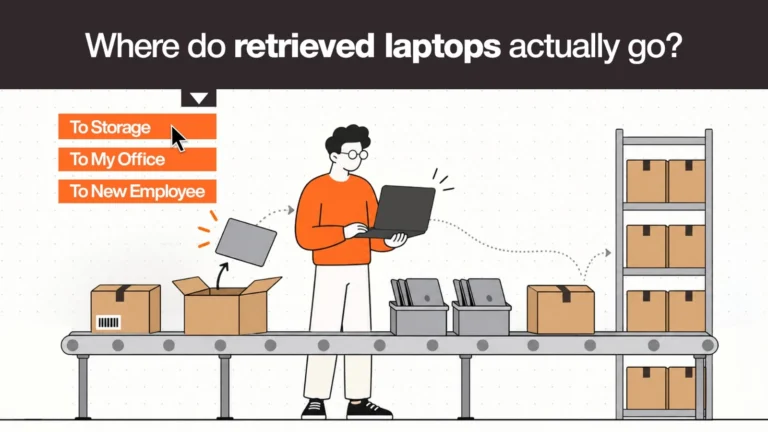
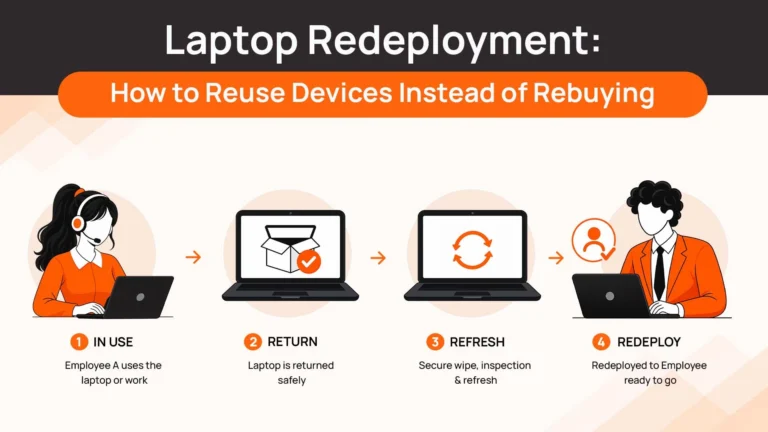
Employee departure → Return request → Return initiated → Shipment in transit → Device received → Device verified → Device sanitized → Device redeployed or retired
Every stage creates a potential failure point.
For example, an employee might agree to return a laptop but never ship it. Another employee might ship the laptop but forget the charger. A third might return the device successfully, but the organization may not update its asset record.
From a reporting perspective, all three situations are different.
The benchmark that exists today
Capterra’s 2022 survey provides one of the most frequently cited data points in this category: 71% of surveyed HR professionals said at least one departing employee had failed to return company equipment during the previous year.
The survey also found a difference by work arrangement. Hybrid and remote employees were 17% more likely to fail to return company equipment than employees working entirely on-site.
However, this data has an important limitation. It measures whether respondents experienced at least one non-return incident. It does not mean that 71% of all company laptops go missing.
That distinction matters.
A company with 500 employees could have one unreturned laptop and still fall into the survey’s “at least one incident” category. Therefore, organizations should avoid turning the Capterra figure into a misleading “71% laptop loss rate.”
A better internal metric is: Recovery Rate = Devices Physically Recovered ÷ Devices Due for Recovery × 100
This gives an organization a number it can actually manage.
The Metrics IT Teams Should Track
A mature remote device offboarding program should go beyond asking whether a laptop eventually came back.
Recovery Rate
This is the most obvious metric. If 100 laptops become due for return during a quarter and 94 are recovered, the quarterly recovery rate is 94%. Track it by:
- Country
- Employee type
- Voluntary vs. involuntary departure
- Remote vs. hybrid
- Domestic vs. international retrieval
- Device type
- Retrieval method
The goal is not simply to publish a high percentage. The value comes from identifying where recovery consistently breaks down.
Time to Recovery
A company should also know how long it takes to physically recover a device. Measure from:
Employee’s final working day → Device received
Do not rely only on average.
A small number of extremely delayed returns can distort the average, so median and 90th-percentile recovery times can provide a more useful operational picture.
For example:
- Median recovery: 5 days
- 90th percentile: 18 days
would tell an IT team something very different from simply reporting an average of 7 days. The 90th percentile is especially useful because it shows the long tail of difficult recoveries.
Recovery Funnel Drop-Off
Track how many devices reach each stage:
| Stage | Example Measurement |
| Devices due for return | 100 |
| Return request sent | 100 |
| Employee confirms return | 94 |
| Shipment initiated | 91 |
| Device received | 87 |
| Device verified | 86 |
| Device sanitized | 86 |
| Redeployed / retired | 84 |
This type of funnel can reveal where the process actually fails. If most devices reach “return request sent” but very few reach “shipment initiated,” the issue may be communication or logistics. If devices are received but remain unprocessed for weeks, the problem is internal. Without the funnel, both problems look like generic “device recovery delays.”
Why Device Recoveries Fail
A useful offboarding benchmark should not only ask how many devices are recovered. It should ask why the others were not recovered on time. The causes generally fall into several categories.
Employee Non-Response
Sometimes the employee simply stops responding.
This is particularly difficult when the employee has already left the organization and no longer has a reason to engage with internal processes. A good retrieval process therefore needs an escalation path rather than relying on unlimited email reminders.
No Defined Process
Some companies still treat device recovery as an informal task. HR tells IT that someone has left. IT sends an email. Someone remembers to follow up. A week passes. Then another person asks whether the laptop came back. The problem is not necessarily employee behavior. The process itself has no clear owner, deadline, escalation path, or status model.
HR-to-IT Handoff Gaps
Offboarding often starts in HR systems. Device recovery, however, usually sits with IT or Operations. If the HR event does not trigger the hardware workflow automatically, someone has to remember to initiate it. That creates a predictable failure point. The ideal workflow is closer to:
HRIS event → Offboarding workflow → Access controls → Retrieval request → Shipment → Verification → Lifecycle disposition
rather than:
HR email → IT remembers → Manual follow-up
Shipping and Logistics Problems
Even when the employee is cooperative, the return can fail because the physical process is poorly designed. Examples include:
- No prepaid return label
- Incorrect return address
- Packaging unavailable
- Courier does not service the location
- Shipment gets delayed
- Device becomes stuck in customs
- Employee moves before the pickup
- International return becomes more expensive than expected
This becomes more pronounced as the workforce becomes geographically distributed.
Cross-Border Complexity
International retrieval adds another layer of uncertainty. A company recovering a laptop from an employee in the same country can usually use a relatively simple domestic courier workflow.
Cross-border retrieval may involve:
- Customs documentation
- Import/export requirements
- Local courier availability
- Lithium-battery transportation rules
- Different tax treatment
- Regional return addresses
- Longer transit times
That is why recovery rate and recovery time should ideally be segmented by domestic versus cross-border retrieval. A single global average can hide significant regional differences.
The Peripherals Problem Nobody Measures
Laptops are usually the most visible company-owned device. They are also often the most carefully tracked. Peripherals are different. Consider what an employee may have received:
- Monitor
- Docking station
- Keyboard
- Mouse
- Headset
- Webcam
- Security key
- External storage
- Laptop stand
- Mobile phone
- Power adapters
If the asset register only tracks the laptop, an organization can technically have a 100% laptop recovery rate while still losing significant equipment value during every departure. This is why a mature device-recovery program should distinguish between:
Laptop recovery and Equipment recovery
The latter gives Finance and Operations a much clearer view of the actual value being recovered.
What should be measured?
At minimum: Peripheral Recovery Rate = Peripherals Recovered ÷ Peripherals Due for Return
Then track recovery by category. For example, a company may discover that laptop recovery is consistently strong while monitors are frequently left behind. That finding can change the return-kit design, equipment agreement, and retrieval workflow. The important point is not to assume that all company equipment behaves like laptops. Measure it.
Cross-Border Device Recovery: Where the Model Gets Harder
For global teams, device recovery cannot be evaluated only by asking whether a courier operates in a particular country.
The real question is: How many operational steps are required to recover one device from that country?
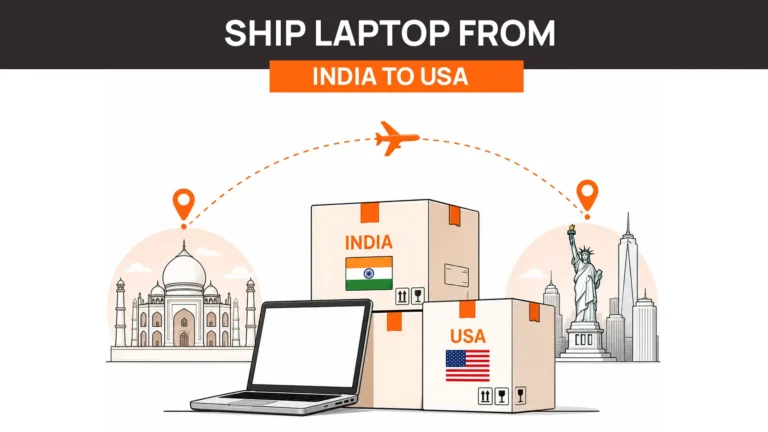
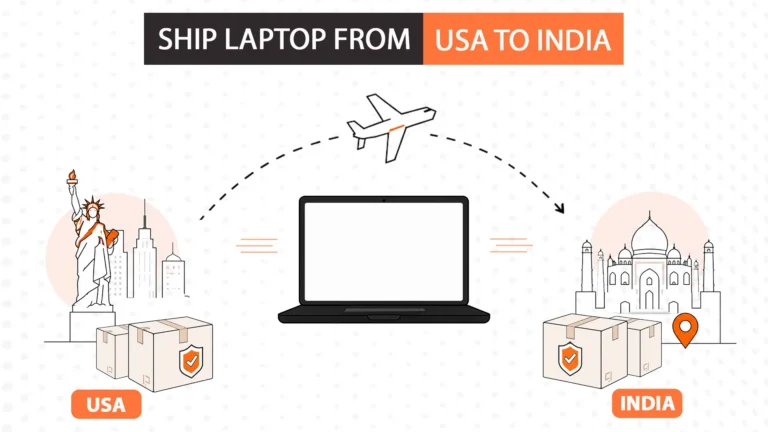
Suppose a US-based company has an employee living in India. A centralized process might involve:
- Employee receives international return instructions.
- The device is packaged.
- Export documentation is prepared.
- Courier collects the device.
- Shipment leaves India.
- Customs processes the shipment.
- The device arrives in the US.
- IT receives and verifies it.
- The device is sanitized.
- Device is reassigned or disposed of.
A local retrieval model can potentially reduce the physical distance involved by collecting the laptop locally and routing it to a regional storage, refurbishment, or redeployment point.
That is not automatically better in every country or scenario. It depends on the provider’s network, local regulations, device value, and what the company intends to do with the hardware afterward. However, it illustrates why retrieval geography matters.
For companies operating globally, recovery rate should ideally be segmented by region and retrieval model rather than reported as one worldwide number.
For a deeper look at the operational considerations, see Best International Laptop Retrieval Services for Remote Teams.
The Security Gap: Is Every Returned Device Actually Safe?
Physical recovery is only half of the problem. A company may know that a laptop has returned to its warehouse and still not have enough evidence to demonstrate what happened to the data stored on it.
This is where data sanitization becomes important.
NIST’s current SP 800-88 Rev. 2 defines media sanitization as a process intended to make access to target data infeasible for a given level of effort. The 2025 revision places greater emphasis on establishing an organizational sanitization program, selecting appropriate methods and controls, and validating sanitization effectiveness.
That has an important implication for remote offboarding. “IT wiped the laptop” is not the strongest possible record. A stronger process can answer:
- Was sanitization performed?
- When was it performed?
- Which device was sanitized?
- Which method was used?
- Was the process successful?
- Can the organization produce evidence?
For teams subject to security reviews or regulatory obligations, that documentation can matter as much as the physical return.
Our secure data wiping and device offboarding resources cover this part of the lifecycle in more detail.
Can You Actually See Where Every Device Is?
The broader asset-visibility picture suggests this is still difficult. Flexera’s 2026 State of ITAM report found that only 36% of organizations reported complete visibility across their IT estate, while 62% reported partial visibility. The research was based on responses from 512 global IT professionals.
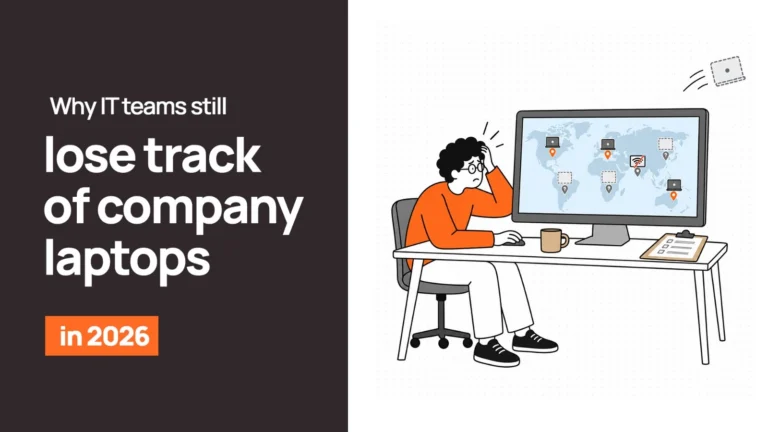
Again, this is not a laptop-retrieval statistic. It is broader than that. But it matters because remote hardware recovery depends on basic asset visibility. An organization should ideally be able to answer:
- Who has the device?
- Where is it?
- What is its current status?
- When is it due for return?
- Has the return started?
- Has the device arrived?
- What happened to it afterward?
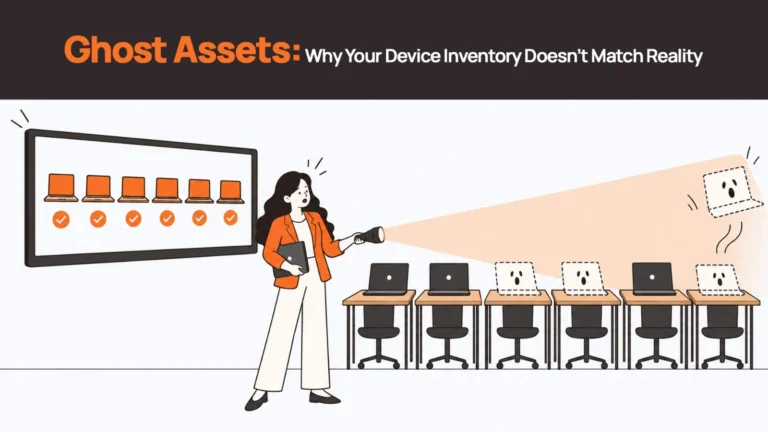
If answering those questions requires searching through an HRIS, an asset management system, a courier portal, email threads and spreadsheets, the organization has visibility scattered across systems rather than one operational record.
What Does Unrecovered Hardware Actually Cost?
The easiest mistake is to calculate only the replacement price. Suppose an employee leaves with a company laptop worth $1,500. The direct loss is obvious. But the true cost can include:
- Replacement hardware. The company needs another device for the next employee.
- Procurement time. Someone has to source and purchase the replacement.
- Shipping. The replacement device may need to be shipped to another location.
- Configuration. IT needs to enroll, configure and prepare the replacement.
- Employee downtime. If the next employee is waiting for hardware, productivity can be delayed.
- Lost redeployment value. The original laptop may have been suitable for another employee.
- Asset-record cleanup. Finance and IT need to account for the missing device.
- Security exposure. If the device contains corporate information and cannot be secured or sanitized, the risk is greater than the hardware value alone.
Capterra’s 2022 survey estimated the average equipment value involved in each reported incident at $1,963. Again, that is a historical survey estimate, not a current universal hardware replacement cost.
The more useful approach is to calculate the number for your own organization.
A simple annual recovery-loss model
Annual hardware loss = Unrecovered devices × average replacement cost
Then add:
Replacement procurement + IT setup + shipping + estimated redeployment value
For example, if a company has:
- 500 departures per year
- 5% unrecovered-device rate
- $1,500 average replacement value
then direct hardware exposure alone would be: 25 × $1,500 = $37,500
That does not include IT labor, shipping, downtime or security exposure. The point of this calculation is not to produce a universal benchmark. It is to make the company’s own number visible.
The Cost of Recovery Is More Than Courier Fees
There is another side to the equation. Companies sometimes compare a retrieval service with the price of a return shipment and conclude that retrieval is expensive. That comparison misses the operational cost of recovering a device internally.
Consider the people involved:
- HR sends the first reminder.
- IT checks the asset record.
- The manager follows up.
- Operations coordinates the courier.
- Finance asks about the missing asset.
- Security checks whether the device is still managed.
- IT follows up again when the employee misses the pickup.
None of those tasks necessarily appears as a “retrieval cost.” The labor still exists. For this reason, companies evaluating retrieval performance should measure:
Direct logistics cost + internal coordination time + unrecovered asset value + redeployment opportunity cost
That is a much more meaningful view of economics.
Related Reads
Each metric in this report has an operational guide behind it, if you are moving from measuring the problem to fixing it:
- The Remote Device Offboarding Checklist for IT Teams — the step-by-step sequence behind the recovery funnel above.
- Complete Guide to Remote Employees Laptop Return for IT Teams — the retrieval process in practical detail.
- Laptop Retrieval Cost: What Businesses Really Pay — the full cost model behind the courier-fee section.
- Best International Laptop Retrieval Services for Remote Teams — options for the cross-border cases that drag recovery times out.
- Best Employee Equipment Return Services for Remote Teams — the peripherals most asset registers never track.
- What Happens If You Keep a Company Laptop After Leaving? — the escalation and legal ground behind the non-response failure mode.
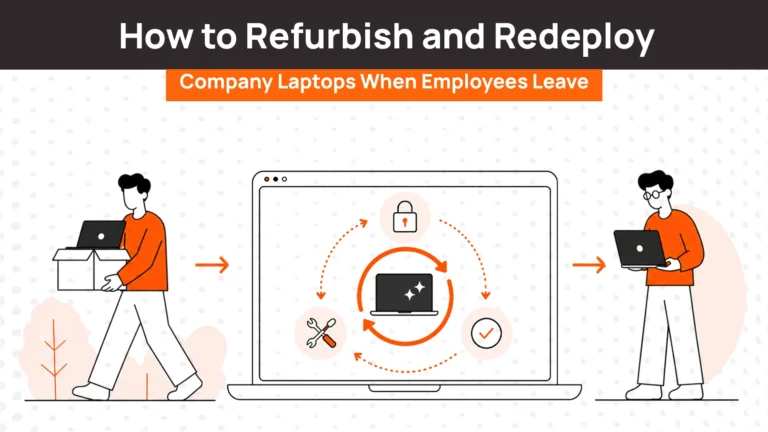
- How to Refurbish and Redeploy Company Laptops When Employees Leave — how to capture the redeployment value the cost model counts.
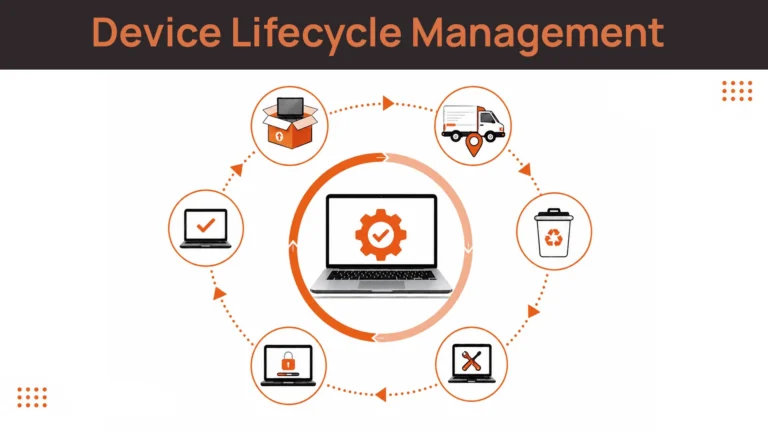
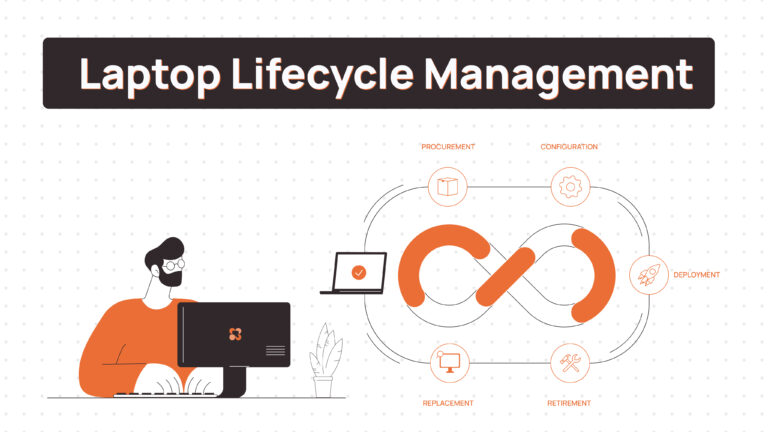
- Device Lifecycle Management: The Complete Guide for Distributed IT Teams — where offboarding sits in the wider lifecycle.
What Actually Improves Recovery?
The most useful benchmarking exercise is not simply identifying poor recovery. It is identifying which process characteristics are associated with better outcomes. Several operational practices are consistently logical starting points.
Trigger Retrieval Automatically
The retrieval workflow should start as close as possible to the confirmed offboarding event. That removes the dependency on someone remembering to send an email. Automation tools can then create the required tasks for IT, HR, Security and Operations.
Make the Return Easy
A former employee should not have to figure out how to return company equipment. Provide:
- Prepaid shipping
- Clear instructions
- Packaging where necessary
- A specific deadline
- A named support contact
- A tracking method
Every unnecessary decision adds friction.
Define Escalation Before You Need It
Do not create the escalation process after an employee has already ignored three reminders. Define it beforehand.
For example: Reminder → Second notice → Manager involvement → HR escalation → Formal recovery process. The exact steps should reflect company policy and applicable law.
Assign One Owner
Remote retrieval often fails because everyone assumes someone else is handling it. The process can involve multiple teams, but accountability should be clear. One person or team should own the retrieval status from initiation through completion.
Track the Asset, Not Just the Employee
HR systems answer questions about employees. Asset systems answer questions about equipment. The two need to connect. The organization should be able to move from:
Employee → Device → Retrieval status → Physical location → Final disposition
without reconstructing the relationship manually.
A More Useful Benchmarking Model for IT Teams
Rather than asking whether your organization is “good” or “bad” at offboarding, assess your process across the dimensions below.
| Dimension | Basic Process | Mature Process |
| Trigger | Manual notification | Automated offboarding trigger |
| Communication | Individual emails | Standardized return workflow |
| Retrieval | Employee-managed | Coordinated retrieval |
| Visibility | Spreadsheet or multiple systems | Central asset record |
| Security | Wipe when device arrives | Security controls initiated during offboarding |
| Documentation | Ticket notes | Verifiable audit trail |
| Disposition | Ad hoc decision | Defined redeploy / repair / resale / recycle path |
| Global recovery | Case-by-case | Regional retrieval workflows |
| Measurement | “Device returned?” | Recovery rate + time + failure reason |
This maturity model is more useful than comparing organizations purely by recovery percentage. A company with a 90% recovery rate and no documented security process still has a major gap. Likewise, a company with strong security controls but no reliable physical retrieval process is still losing hardware value. The objective is to build a process that performs across the entire chain, from retrieval through to final disposition.
Benchmark Yourself: The Numbers Your IT Team Should Know
If you want to establish an internal baseline, start with the following seven numbers.
1. Device Recovery Rate
What percentage of devices due for return were physically recovered?
2. Median Time to Recovery
How many days typically pass between the employee’s last working day and receipt of the device?
3. 90th-Percentile Recovery Time
How long do the slowest recoveries take?
4. Unrecovered Asset Value
What is the replacement or book value of devices that were not recovered?
5. Redeployment Rate
What percentage of recovered devices are suitable for another employee?
6. Sanitization Completion Rate
What percentage of recovered devices have documented, successful sanitization?
7. Cross-Border Recovery Rate
How does recovery performance differ when the employee and the company’s operating base are in different countries?
These numbers create a much stronger picture than a single “device recovery rate.” They also allow IT leaders to identify where investment will have the greatest impact.
What the 2026 Evidence Actually Tells Us
There is no responsible way to claim that one new recovery-rate benchmark represents the entire remote-work market without a properly designed 2026 survey or sufficiently broad primary dataset.
The available evidence does, however, point in a clear direction.
First, unreturned company equipment is not a theoretical edge case. Capterra’s 2022 research found that 71% of surveyed HR professionals had experienced at least one case of a departing employee failing to return company equipment, while remote and hybrid employees were 17% more likely to experience non-return than on-site employees.
Second, visibility remains a fundamental IT-management problem. Flexera’s 2026 research found that only 36% of organizations reported complete visibility across their IT estate.
Third, device security does not end when employment ends. NIST’s updated SP 800-88 Rev. 2 treats sanitization as a formal organizational process, reinforcing the need for appropriate controls and validation rather than informal deletion practices.
Together, these findings point to a broader conclusion:
Remote device offboarding is no longer just an HR checklist item. It is a measurable lifecycle operation spanning people, security, logistics, asset visibility and financial recovery.
What Mature Remote Offboarding Looks Like
The strongest organizations do not necessarily have the largest IT teams. They have fewer gaps between systems. A mature process connects the employee event to the device workflow.
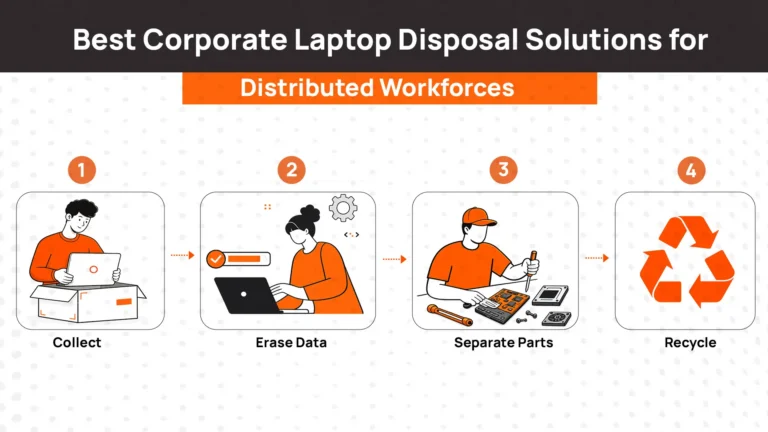
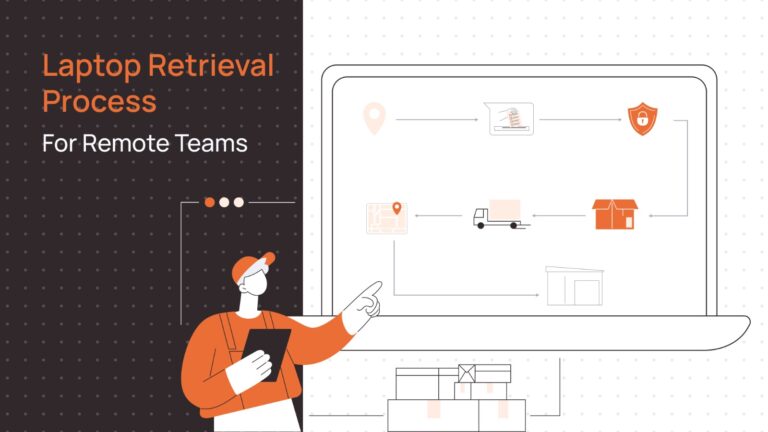
When HR confirms an employee’s departure, the appropriate access-control process begins. The company-owned device is identified. Retrieval instructions are generated. The employee receives a clear return process. The shipment is tracked. The device is verified when received. Sanitization is documented. Finally, the asset is either redeployed, repaired, resold or recycled.
Each stage has an owner.
Each stage has a status.
And each stage leaves a record.
This is particularly important as companies hire across borders. A domestic retrieval process may work perfectly for employees in one country and become inefficient once the organization starts managing hardware across several regions. That is where global device lifecycle operations become important.
Our remote laptop retrieval process covers the operational sequence in greater detail.
Where Remoasset Fits
The practical problem behind remote device offboarding is that physical hardware does not follow the same workflow as employee records.
Remoasset connects the physical device lifecycle to the offboarding process, helping organizations coordinate retrieval, track asset status and manage what happens after a device is recovered.
For distributed organizations, the value is less about adding another dashboard and more about connecting the steps that otherwise sit across HR, IT, Operations and logistics.
That can include retrieval workflows across multiple countries, asset visibility during the return process, secure data-handling workflows and routing recovered equipment toward its next lifecycle stage.
The broader principle is simple:
A device should not disappear from the organization’s operational view simply because the employee has left.
The Direction of Travel: From Offboarding Task to Lifecycle Discipline
The evidence available today does not justify pretending that there is one definitive 2026 global recovery-rate benchmark.
It does support something more useful.
Remote work has changed where company hardware lives. Asset-visibility research continues to show significant gaps. And modern data-sanitization guidance increasingly treats device disposition as a structured security process rather than an informal IT task.
That means companies should stop measuring offboarding only by whether HR completed the employee exit.
A stronger definition of success is:
The employee has left. Access is closed. The device is recovered or appropriately escalated. Its data is protected. Its location is known. Its final disposition is documented. Its remaining value is recovered wherever practical.
That is the standard a mature remote device offboarding process should aim for.
And as distributed hiring continues to expand, the organizations that measure these outcomes will have a significant advantage over those that simply assume their laptops are coming back.
Frequently Asked Questions
What percentage of company laptops are not returned when employees leave?
There is no reliable current global percentage for all company laptops. The most widely cited benchmark comes from Capterra’s 2022 Employee Offboarding Survey, in which 71% of 287 HR professionals said at least one departing employee had failed to return company-owned equipment during the previous year. This is an “at least one incident” measure, not a 71% laptop loss rate.
How long does it take to recover a laptop from a departing remote employee?
There is no sufficiently broad current dataset to establish one global recovery-time benchmark. Companies should measure their own median and 90th-percentile recovery time from the employee’s final working day to confirmed device receipt. International retrievals should be measured separately because customs, courier availability and cross-border logistics can materially affect timelines.
Why do device recoveries fail?
Common operational causes include employee non-response, unclear return instructions, weak HR-to-IT handoffs, missing prepaid shipping options, poor asset visibility, courier problems and cross-border logistics. The important point is that non-return is not always an intentional act; process design can create unnecessary friction.
How much does unrecovered hardware cost a company each year?
It depends on the number of departures, recovery rate and average device value. A simple calculation is:
Unrecovered devices × average replacement cost = direct hardware exposure
Organizations should then add replacement procurement, shipping, IT setup, lost redeployment value and other relevant operational costs. Capterra’s 2022 survey estimated an average $1,963 value of company equipment involved in each reported incident, but that should not be treated as a current universal hardware cost.
Is device recovery harder across borders?
It can be. Cross-border recovery introduces additional logistics considerations such as customs, export documentation, courier availability, battery transportation requirements and longer transit distances. Organizations should therefore track domestic and international recovery separately instead of relying on one global recovery metric.
Methodology and Limitations
This guide uses publicly available research and official guidance rather than presenting proprietary 2026 Remoasset customer data.
The primary benchmark cited for employee equipment non-return is Capterra’s 2022 Employee Offboarding Survey, which surveyed 287 HR employees responsible for offboarding. Because the research is several years old and measures whether respondents experienced at least one non-return incident, its figures should be treated as historical context rather than a current global recovery-rate benchmark.
Current asset-visibility context is drawn from Flexera’s 2026 State of ITAM research, based on 512 global IT professionals. Its visibility findings cover the broader IT estate rather than remote laptop recovery specifically.
Data-sanitization guidance is based on NIST SP 800-88 Rev. 2, published in September 2025. Rev. 2 superseded Rev. 1 and places greater emphasis on organizational sanitization programs, appropriate controls and validation.
Future editions of this report can become a true primary-research “State of” report if Remoasset collects sufficiently anonymized platform data and conducts a representative survey of IT and People Operations leaders. Until then, the responsible approach is to distinguish clearly between published industry evidence and original company data.
Sources
- Capterra, Employee Offboarding Survey, 2022, published January 2023. The survey covered 287 HR professionals responsible for employee offboarding.
- Flexera, 2026 State of ITAM Report, based on a global survey of 512 IT professionals.
- National Institute of Standards and Technology, SP 800-88 Rev. 2: Guidelines for Media Sanitization, September 2025.