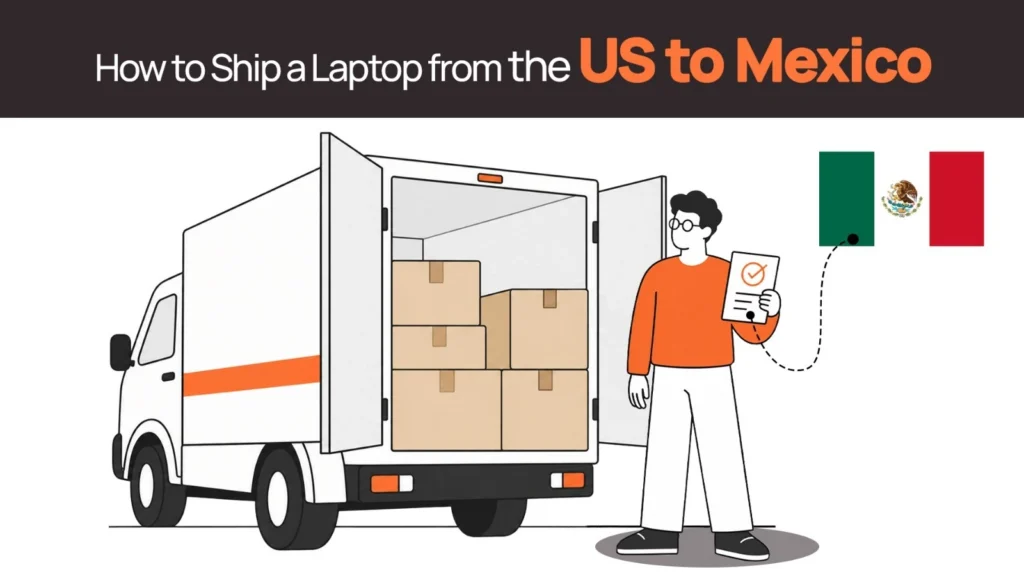
Ship one laptop to Mexico, and it’s easy to assume USMCA makes this simple: no tariffs between the US and Mexico, right? Not quite. Since August 2025, Mexico applies a flat rate to most courier shipments regardless of what the item actually is, and that rate depends on where the laptop was genuinely manufactured — not where it was shipped from. For most laptops, that’s not the US.
Here’s what actually determines your costs and what you need to get right.
Does USMCA Make Laptop Shipping to Mexico Duty-Free?
Not automatically — and this is the single biggest misconception about this route. USMCA preferential treatment applies to goods that genuinely originate in the US, Mexico, or Canada under the agreement’s rules of origin, not simply goods that happen to ship from a US address. A laptop assembled in China, Taiwan, or Vietnam — which covers the vast majority of laptops sold by US brands — doesn’t become USMCA-origin just because your US office is the one shipping it. That distinction matters more than usual right now, because of a change most existing guides haven’t caught up with. For a current picture of how Mexico’s customs and tariff rules apply to incoming shipments, the US government’s own Mexico Country Commercial Guide is the most reliable reference.
What changed on August 15, 2025
Mexico raised the tariff rate on courier and express shipments valued up to $2,500. Under the simplified courier regime, non-USMCA-origin goods now pay a flat 33.5% global rate, up from 19%. Goods that genuinely qualify as USMCA-origin, shipped with proper documentation, get a lower 19% rate — but only above a $117 threshold. This global rate applies regardless of what the item’s actual tariff classification would otherwise be. Laptops normally carry a 0% duty rate under Mexico’s standard tariff schedule for HS code 8471.30, but that 0% rate applies to a formal import processed against its real HS classification, not the simplified courier lane.
The RFC requirement you need before you ship
Since October 2024, Mexico requires the consignee’s RFC (Registro Federal de Contribuyentes — Mexico’s taxpayer ID number) on every import declaration using the simplified courier lane. Without it, the shipment can’t use that faster process and gets routed into standard customs procedures, which take longer and typically require a licensed customs broker (agente aduanal) regardless of value. Get the recipient’s RFC before you ship, not after the package is already in transit. This is the single most common, entirely avoidable reason a shipment to Mexico gets delayed.
What you’ll actually pay: IVA and the global rate
Illustrative example only. On a $1,000 laptop that doesn’t qualify as USMCA-origin, shipped via courier:
| Line item | Approximate amount |
| Declared customs value | $1,000 |
| Global rate (33.5%, non-USMCA-origin) | ~$335 |
| IVA (16%, on customs value) | ~$160 |
| Customs processing fee (DTA) | Varies by carrier |
| Approximate total tax burden | ~$495, on a $1,000 device |
If the same laptop genuinely qualified as USMCA-origin — with a proper certificate of origin — the tariff portion drops from 33.5% to 19%, cutting it by nearly half. For most branded laptops, though, that qualification simply isn’t there to claim.
IFT and NOM: the certification question
Mexico regulates wireless devices through the Instituto Federal de Telecomunicaciones (IFT), and electronics safety more broadly through NOM standards. Unlike some other countries, Mexico’s IFT homologation process doesn’t clearly exempt small personal-use shipments the way some countries do, and it explicitly does not recognize equivalent foreign certifications like FCC as a substitute. In practice, mainstream laptop models from major brands are typically already certified for the Mexican market, since manufacturers register their standard models for local retail sale anyway. But this is a murkier compliance area than on other routes, and worth confirming with your carrier or broker before a first shipment rather than assuming a personal-use exception applies.
The Shipping Process: Step by Step
- Get the recipient’s RFC before shipping. This determines whether your shipment uses the fast simplified lane or gets routed into standard procedures.
- Determine whether the laptop genuinely qualifies as USMCA-origin. If it does, have a proper certificate of origin ready. If it doesn’t, budget for the 33.5% global rate rather than assuming a lower one.
- Declare the real value. Under-declaring to dodge the tariff bracket risks delay or penalty for no real benefit, since the rate is based on the shipment’s actual value.
- Wipe or configure the device, and check the battery. A damaged or swollen battery isn’t accepted by any carrier, regardless of paperwork.
- Package it properly, battery installed. Use the original manufacturer box as an inner layer where possible, cushioned on all sides.
- Choose whether to prepay duties and IVA (DDP) or leave it to the recipient (DDU). Given the size of the tax bill here, prepaying is usually the better experience for the employee.
- Confirm certification status if asked. Have documentation on the laptop model ready in case customs requests it.
- Track it and respond fast. A quick response to a documentation request is often the difference between a short delay and a long one.
Choosing a Courier
| Courier | Notes for Mexico specifically |
| DHL | Established Mexico network; confirm current RFC and documentation handling |
| FedEx | Integrated clearance services; brokerage fees still apply |
| UPS | Broad Mexico coverage; standard international express handling |
All three route through the same simplified courier regime and the same global rate structure. The differentiation is service level and how much of the RFC and documentation handling they manage on your behalf — not the tax outcome itself.
Related Reads
If this shipment is part of a broader procurement or lifecycle conversation, these guides cover the surrounding decisions:
- Laptop Sourcing: Ship, Source Locally, or Use a Stipend? — when local sourcing removes the need for a cross-border shipment to Mexico entirely.
- Why You Shouldn’t Ship Laptops Internationally for Regular Procurement — the operational and cost case for local sourcing as the default.
- Remote Employee Laptop Return: A Guide for IT Teams — the reverse journey: recovering a laptop from an employee in Mexico.
- Best International Laptop Retrieval Services for Remote Teams — providers that manage cross-border device recovery as a service.
When Customs Holds Your Shipment
Deciding who owns each of these scenarios before you ship prevents a customs hold from turning into an onboarding delay.
| Situation | Who should own it |
| Missing or incorrect RFC | Sender/IT team — confirmed before shipping |
| USMCA origin questioned | Sender/IT team — have documentation ready |
| Declared value questioned | Sender/IT team |
| IFT/NOM certification requested | Sender/IT team — have model documentation on hand |
| Employee unavailable for delivery | HR/People Ops — coordinate ahead of time |
| Duties/IVA unpaid at delivery | Depends on DDP vs DDU — decide before shipping, not after |
Should You Ship or Source Locally in Mexico?
Given a typical laptop faces something close to a 50% combined tax load through the courier channel, the math tips toward local sourcing faster here than in lower-tax markets. For one employee with a specific, already-owned device, shipping still makes sense. For recurring hiring, sourcing laptops locally in Mexico avoids the global rate entirely — a device bought and sold within Mexico isn’t going through this import process at all — and sidesteps the IFT/NOM certification question, since locally sourced hardware from authorized distributors already carries the necessary compliance.
From One Shipment to a Repeatable Process
The RFC requirement, the USMCA origin question, and the IFT certification gap are all manageable for a single shipment. They become real operational overhead once you’re doing this every month for new hires across Mexico City, Guadalajara, Monterrey, or elsewhere. That’s the gap Remoasset’s Mexico operation is built to close: sourcing devices locally instead of routing every hire through customs, handling the compliance side directly, and connecting procurement to retrieval and secure data wiping when someone eventually leaves.
If you’re shipping one laptop, the process above should get you there. If Mexico is becoming a recurring hiring market, book a demo to see how recurring Mexico hiring is handled as one lifecycle rather than a series of individual customs decisions.
Frequently Asked Questions
Can I ship a laptop from the US to Mexico?
Yes, but USMCA doesn’t automatically make it duty-free. That depends on whether the laptop genuinely qualifies as USMCA-origin, which most laptops don’t, since they’re typically manufactured outside North America.
How much does it cost to ship a laptop to Mexico?
There’s no fixed number, but as of August 2025, non-USMCA-origin courier shipments face a flat 33.5% global rate plus 16% IVA. USMCA-origin shipments with proper documentation get a lower 19% rate above $117. On a $1,000 laptop, tax alone can approach half the device’s value.
Do I need the recipient’s RFC to ship a laptop to Mexico?
Yes, for any shipment using the simplified courier lane since October 2024. Without it, the shipment is routed into slower standard customs procedures that require a licensed customs broker.
Does a laptop need IFT certification to enter Mexico?
Technically yes — wireless devices fall under IFT’s telecom equipment rules. Unlike some countries, Mexico doesn’t clearly exempt small personal-use shipments or recognize foreign certifications like FCC as equivalent. In practice, mainstream branded laptop models are typically already certified for the Mexican market, but this is worth confirming directly rather than assuming.
Should I ship a laptop or buy one locally in Mexico?
For a single device, shipping still works despite the tax load. For recurring hiring, local sourcing in Mexico avoids the courier global rate entirely and sidesteps the certification question, since properly distributed local hardware already meets it.