Most businesses don’t think about depreciation when buying laptops. They see a hardware cost, approve it, and move on.
Here’s the reality. A company buys 100 laptops at $1,500 each. That’s $150,000 in hardware. Three years later, the picture looks like this:
- 12 laptops were never returned by departing employees
- 8 were damaged beyond cost-effective repair
- 15 are sitting in storage, unconfigured and idle
- 20 are still functional but nearing end of useful life
- 45 are in active use with varying remaining value
The original investment was $150,000. But the actual value remaining is impossible to track without a system. Lost devices, idle inventory, and untracked assets all erode value quietly over time.
This is where laptop depreciation becomes important, especially from a business perspective.
What Is Laptop Depreciation?
Once you look past the accounting terminology, depreciation is a straightforward concept.
Laptop depreciation is the reduction in a device’s value over time. When you buy a laptop for $1,500, it isn’t worth $1,500 next year. Hardware ages, technology advances, and market demand shifts. The device loses value whether you use it or not.
There are two types of depreciation worth knowing:
Book value depreciation: What your finance team records on the balance sheet. Calculated using a specific formula. Used for financial reporting and taxes.
Market value depreciation: What you’d actually get if you sold the device today. Often drops faster than book value. Especially for Windows laptops.
The gap between these two numbers becomes important if you’re making decisions about when to replace, resell, or redeploy devices.
Related Read:
- Best Laptop Retrieval Services
- Laptop Asset Management Software
- Best Laptop as a Service (LaaS) Providers
- Best Laptop Return Services for Remote Teams
- Laptop Inventory Management Software
- Laptop Lifecycle Management: A Practical Guide for Modern IT Teams
- Best Laptop Deployment Software for Remote Team
How Laptop Depreciation Works
Understanding how depreciation is calculated helps you use it as a planning tool.
Useful life is the starting point. This is how long you expect a laptop to remain productive in your business. Most companies use:
- 3 years for high-usage roles (engineers, designers, field employees)
- 4 years for standard office use
- 5 years for light administrative tasks
The IRS classifies laptops as 5-year property for U.S. tax purposes. But most IT teams apply a 3-4 year refresh cycle in practice, because devices often become functionally obsolete before they’re fully depreciated on paper.
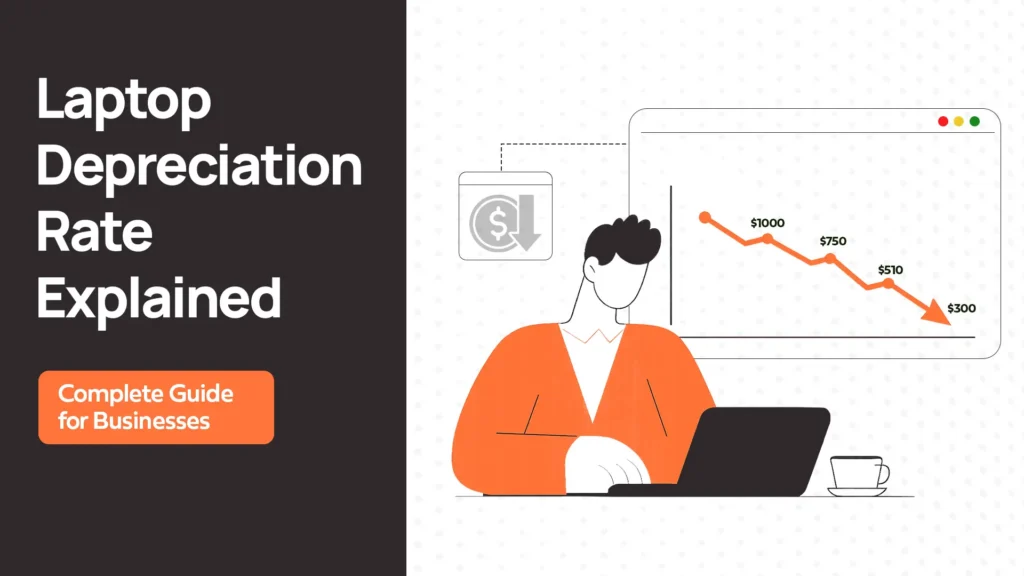
Annual depreciation rate flows from useful life. Spread over 4 years, a laptop loses approximately 25% of its value annually under the most common method. Over 3 years, it’s roughly 33% per year.
This directly affects your replacement budget planning, IT refresh schedules, and the residual value you can recover when devices are returned or retired. Laptop Lifecycle Management for for Distributed Teams
How to Calculate Laptop Depreciation for Your Business?
There are two methods most businesses use. Both are straightforward once you understand the logic.
Method 1: Straight-Line Depreciation
The simplest method. The device loses the same amount of value every year.
Formula: (Purchase Cost − Salvage Value) ÷ Useful Life = Annual Depreciation
A $1,500 laptop with $0 salvage value over 4 years: $1,500 ÷ 4 = $375 per year
Predictable, easy to budget around, and standard for financial reporting.
Method 2: Declining Balance Depreciation
Assumes the device loses more value in early years and less in later years, which better reflects real-world market value.
A fixed percentage is applied to the remaining book value each year, not the original cost. For laptops, 25-40% declining balance rates are common.
This method is useful when you want depreciation to reflect actual resale value decline, especially if you’re planning to sell or redeploy devices.
Laptop Depreciation Example
Here’s how both methods compare using a $1,500 laptop over 4 years, with 0 salvage value and a 40% declining balance rate:
| Year | Straight-Line Annual | Straight-Line Book Value | Declining Balance Annual | Declining Balance Book Value |
| Purchase | — | $1,500 | — | $1,500 |
| Year 1 | $375 | $1,125 | $600 (40% × $1,500) | $900 |
| Year 2 | $375 | $750 | $360 (40% × $900) | $540 |
| Year 3 | $375 | $375 | $216 (40% × $540) | $324 |
| Year 4 | $375 | $0 | $129 (40% × $324) | $195 |
Key takeaway: Straight-line is better for budgeting predictability. Declining balance better reflects actual market resale value, especially in years 1-2 when laptops lose the most market value.
For a fleet of 100 laptops at $1,500 each, straight-line depreciation means your $150,000 investment loses $37,500 in book value every year. At the 4-year mark, it’s fully written off.
What Causes Laptops to Lose Value Faster?
Depreciation isn’t always predictable. Several factors accelerate value loss well beyond standard rates.
Aging hardware and Outdated Specs
Every year a laptop doesn’t get refreshed, it falls further behind current specifications. A device that handled your workload in 2022 may struggle with newer software requirements in 2026.
Heavy daily use
Devices used 8+ hours daily in field environments accumulate wear faster than devices used for occasional tasks. IT teams often apply 3-year useful lives for heavy-use roles for exactly this reason.
Physical damage
Cracked screens, failing keyboards, damaged charging ports. Each incident reduces resale value and increases repair costs. Uninsured or unreported damage accelerates write-offs.
Poor maintenance
Unserviced batteries, outdated software, missed firmware updates. Devices in poor maintenance condition depreciate functionally faster than maintained equivalents—even if the hardware is the same age.
Warranty expiry
Most laptop warranties expire at 3 years. For businesses without extended coverage, this often becomes the practical refresh trigger. Repairs outside warranty cost more than the device’s remaining book value.
Employee loss or non-return
A device that walks out the door with a departing employee is a 100% loss. No residual value, no redeployment opportunity. Industry data suggests 71% of companies have experienced at least one employee failing to return equipment.
How Laptop Depreciation Affects IT Budgets
Depreciation directly affects four areas of IT financial planning:
Refresh planning
Depreciation schedules act as natural refresh timelines. When a device’s book value hits zero or falls below a threshold, it signals replacement time. Without tracking this, you react to failures instead of planning for them.
Replacement budgets
If you’re managing 200 laptops with a 4-year useful life, you’re replacing approximately 50 devices per year. That’s a predictable budget line. Most IT teams that don’t track depreciation consistently underestimate replacement costs and scramble when multiple devices fail simultaneously.
Total cost of ownership
The purchase price is just one part. Add repairs, IT support time, lost devices, and storage costs for idle inventory. Depreciation tracking surfaces the true TCO per device over its lifecycle—not just the upfront cost.
Forecasting
Finance teams need forward-looking data on when major hardware expenditures are coming. Depreciation schedules provide this. Without them, IT budgets become reactive rather than planned.
Both finance and IT teams should care about laptop depreciation—but for different reasons. Finance tracks it for reporting and tax purposes. IT should track it for operational planning and device lifecycle decisions.
MacBook vs Windows Laptop Depreciation
The accounting depreciation rate is the same regardless of brand. It’s set by company policy, not hardware. But where brands differ significantly is in real-world resale value and useful life—which directly affects what you recover when devices are retired.
| Factor | MacBook (M-series) | Windows Ultrabook (Dell XPS, ThinkPad) | Budget Windows |
| Typical useful life | 5-7 years | 3-5 years | 2-4 years |
| Recommended accounting life | 4-5 years | 3-4 years | 3 years |
| Resale value at year 2 | ~55-65% of original | ~30-40% | ~15-25% |
| Resale value at year 3 | ~40-50% | ~20-30% | ~10-15% |
| Salvage value assumption | Higher ($400-600) | Lower ($100-200) | Minimal |
| Annual straight-line depreciation ($1,500 device) | ~$225-275/year | ~$325-375/year | ~$375-500/year |
MacBooks retain more value for three reasons: stronger secondhand market demand, longer OS support cycles (Apple typically provides 7+ years of macOS updates), and build quality that holds up under regular use.
The practical implication: a higher salvage value assumption on a MacBook reduces annual depreciation expense.
A $2,000 MacBook with a $600 salvage value over 4 years costs $350/year in depreciation. The same $2,000 Windows ultrabook with $150 salvage generates $462/year.
Higher upfront cost doesn’t always mean higher total depreciation cost. For companies with strong redeployment programs, MacBooks often deliver better value per year of use.
How Businesses Can Reduce Laptop Depreciation Costs
Once you know how depreciation works, the next question is how to reduce its impact.
Extend Device Lifespan
Every additional year a device remains productive means one fewer replacement purchase. For a fleet of 100 laptops, extending average useful life from 3 years to 4 years reduces annual procurement by approximately 25 units. At $1,500 per device, that’s $37,500 in deferred spending per year.
Standardize on 2-3 device models that balance performance and longevity. Premium build quality costs more upfront but depreciates less aggressively.
Improve Maintenance
Proactive maintenance is cheaper than reactive replacement. Battery health is the leading indicator of enterprise device retirement—monitor it systematically. Keep software updated, apply security patches promptly, and catch minor hardware issues before they become expensive repairs.
Devices with solid maintenance histories retain higher market value at end of life, recovering more on resale or trade-in programs.
Repair Instead of Replace
A cracked screen or failing battery doesn’t have to mean full device replacement. Many repairs cost $150-300 and extend device life by 1-2 years. That’s significantly cheaper than a $1,500 replacement and preserves remaining book value.
Establish a repair policy with cost thresholds. If a repair costs less than 40% of replacement cost and extends life by 12+ months, it’s usually worth doing.
Track Devices Properly
You can’t manage what you can’t see. Real-time asset tracking shows which devices are deployed, in storage, in repair, or unaccounted for. This eliminates the phantom inventory problem where you buy new devices because you can’t find the functional ones already in storage.
Proper tracking also surfaces idle inventory—devices sitting in storage while depreciating on your books with no productive output.
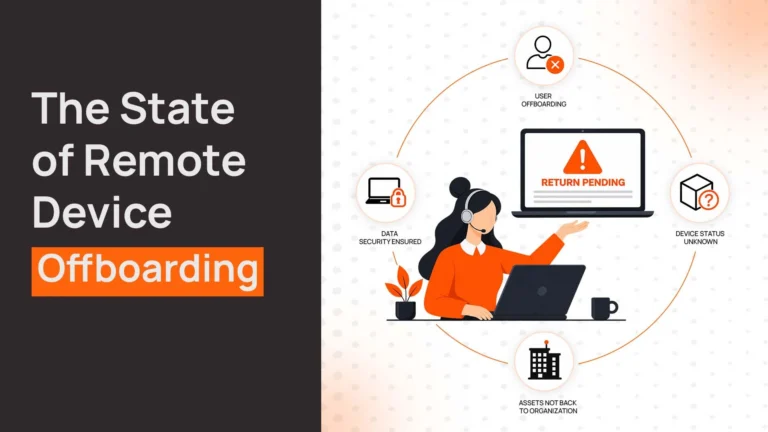
Recover Devices During Offboarding
A device not returned is a 100% loss. No residual value, no redeployment, no book value recovery. Systematic retrieval workflows—automated through HRIS integration, with prepaid return kits and escalating reminders—recover devices that would otherwise be written off entirely.
For a company with 50 annual departures and $1,500 average device value, improving retrieval rate from 60% to 90% recovers 15 additional devices per year. At $600 average remaining value per recovered device, that’s $9,000 in preserved asset value annually.
Redeploy Devices Internally
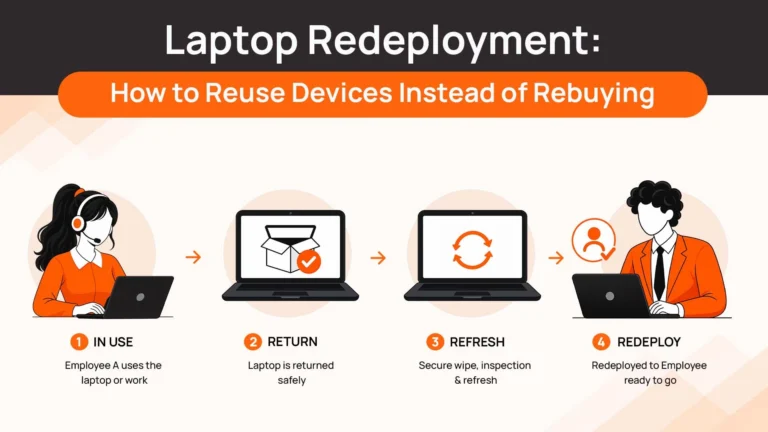
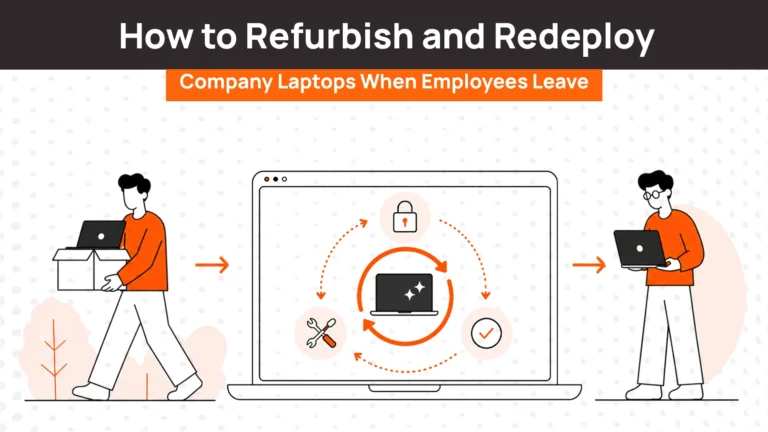
Retrieved and refurbished devices returning to active deployment is the highest-value outcome of good lifecycle management. A refurbished device redeployed to a new hire costs $100-200 to prepare versus $1,500 for a new purchase.
Build redeployment into your offboarding process systematically. Evaluate device condition on return, refurbish what’s viable, and add to available inventory before purchasing new.
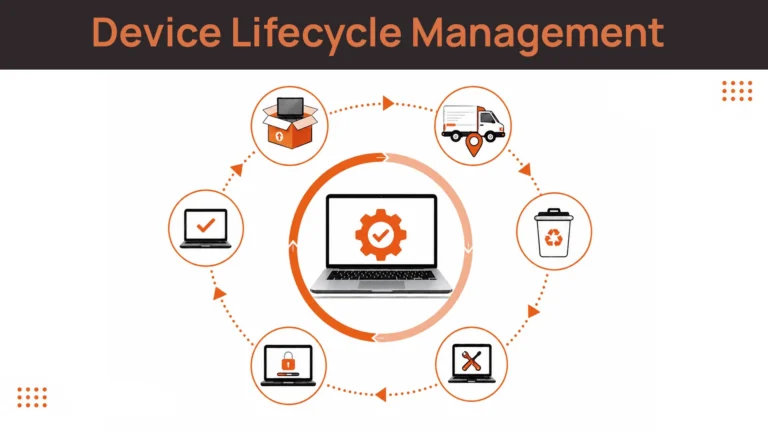
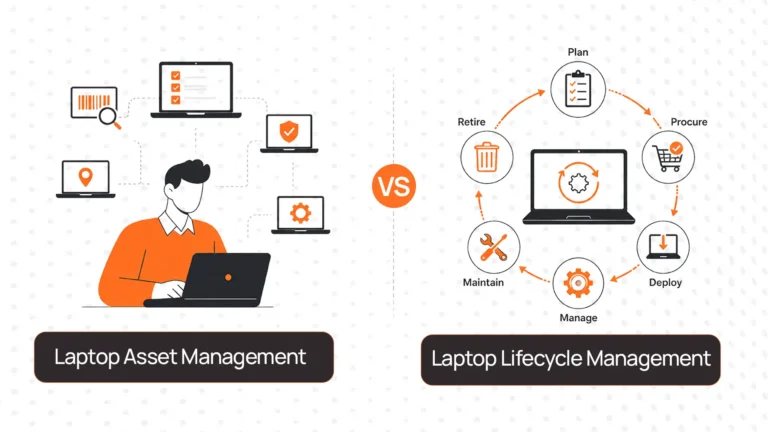
Why Device Lifecycle Management Matters
Most depreciation articles stop at accounting. This one shouldn’t.
Depreciation is ultimately an operational problem, not just a financial one. Every stage of the device lifecycle affects how much value you preserve or lose:
Procurement: Buying the right device for the right role affects useful life assumptions. Over-speccing for light users is wasteful. Under-speccing for heavy users accelerates obsolescence.
Deployment: Devices that reach employees late start depreciating before generating productivity. Pre-configuration before shipping, standardized setups, and zero-touch deployment reduce deployment time and ensure devices are productive from day one.
Maintenance and repairs: Proactive maintenance extends useful life. Repair programs prevent premature replacements. Each avoided replacement preserves capital.
Retrieval: Systematic offboarding retrieval prevents 100% asset losses. Retrieved devices re-enter the value chain instead of disappearing.
Redeployment: Refurbished devices given to new hires instead of new purchases represent the highest ROI outcome of good lifecycle management.
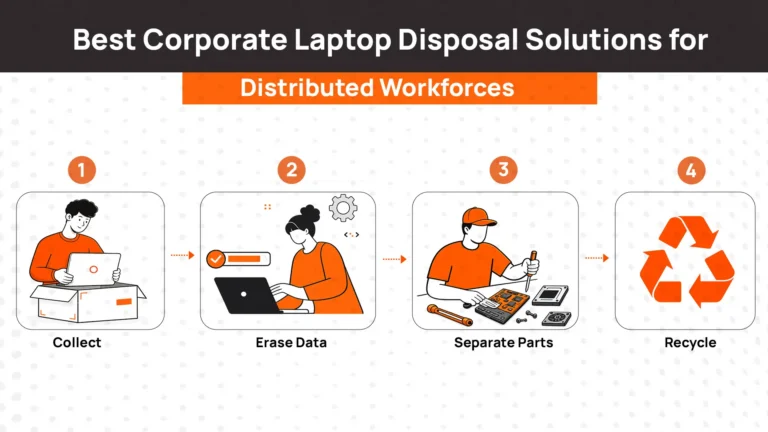
Disposal: Certified recycling and resale programs recover remaining value from fully depreciated assets instead of simply writing them off.
The companies that control depreciation costs aren’t necessarily buying cheaper laptops. They’re managing every transition in the device lifecycle systematically—minimizing losses at each stage.
How RemoAsset Helps Businesses Maximize Laptop Value
RemoAsset addresses the full device lifecycle that depreciation actually runs through. Procurement is tracked from the moment of purchase. When employees are onboarded, deployment workflows ensure devices reach them configured and on time, productive from day one.
When employees leave, retrieval workflows trigger automatically through HRIS integration. Devices are tracked back through the return process, inspected, and either refurbished for redeployment or routed for certified disposal.
The result: instead of writing off unreturned devices at full book value, companies recover and redeploy assets that would otherwise be losses. Instead of buying new devices for every new hire, refurbished inventory is deployed first.
Good lifecycle management doesn’t eliminate depreciation. What it does is ensure you recover maximum value from every device throughout its useful life, and minimize the losses that come from poor tracking, non-returns, and idle inventory.
FAQs
What is the average useful life of a business laptop?
Most businesses apply 3-4 years as their internal accounting useful life. The IRS classifies laptops as 5-year property for U.S. tax purposes. Heavy-use roles like engineering or field work often use 3 years. Administrative roles may extend to 4-5 years. The right answer depends on workload intensity and your organization’s refresh standards.
Should businesses replace laptops after 3 years or 5 years?
Neither answer fits every situation. Replace when the cost of ownership (repairs, lost productivity, security risk) exceeds the cost of replacement—not when an arbitrary calendar milestone hits. Track device performance, maintenance history, and condition. Some well-maintained MacBooks remain productive at 5+ years. Some budget Windows laptops need replacement at 2.5.
Is leasing better than buying when considering depreciation?
Leasing converts capital expenditure to operating expense and transfers depreciation risk to the lessor. If you return devices at lease end regardless of condition, you’re insulated from residual value risk. Buying makes more sense when you have strong redeployment programs—recovered devices can be refurbished and reissued, generating value that leasing doesn’t capture.
Can repaired laptops still retain value?
Yes. A well-maintained, repaired device retains higher market value than a neglected one of the same age. Battery replacement, screen repair, and general servicing extend both useful life and resale value. The key is cost-benefit analysis: repair costs should be weighed against remaining productive life and alternative redeployment value.
How does employee offboarding affect depreciation costs?
Directly and significantly. Unreturned devices are written off at full remaining book value—a complete loss. Each recovered device represents preserved asset value, reduced replacement purchases, and potential redeployment revenue. Companies with systematic retrieval programs significantly outperform those relying on manual follow-up.
Do refurbished laptops depreciate differently?
The depreciation method is the same, but the starting cost basis is lower. A refurbished device acquired for $600 depreciated over 2-3 years generates much lower annual depreciation than a new device at $1,500. Useful life assumptions may be shorter depending on the device’s history, but the math often favors refurbished deployment for cost-conscious IT teams.
What is the difference between accounting depreciation and market value?
Accounting depreciation is a formula-based calculation on your balance sheet. Market value is what a buyer would actually pay today. They often diverge significantly—especially for Windows laptops, which may carry $800 in book value at year 2 but only fetch $400 on the secondary market. MacBooks typically maintain stronger market value relative to book value.
How do companies track laptop depreciation at scale?
Spreadsheets work at small scale but break down past 50-100 devices. At scale, companies need asset management platforms that tag each device with its cost basis, assign depreciation schedules automatically, track location and assignment status, and alert IT teams when devices are nearing end of useful life or fully depreciated.
Can depreciation be reduced through maintenance programs?
Depreciation expense itself is formula-driven and doesn’t change based on maintenance. But maintenance directly affects useful life assumptions and salvage value—both of which reduce total depreciation expense over time. A device maintained to 5 years instead of 3 costs significantly less per productive year.
What happens to fully depreciated laptops?
Book value hits zero, but the device may still work. Fully depreciated laptops can be redeployed to lower-demand roles (storage, test environments, temporary workers), sold for whatever market value remains, donated for tax benefits, or recycled through certified ITAD providers. The mistake is treating “fully depreciated” as synonymous with “worthless”—they’re different things.