If you’re managing IT for a remote or distributed team, chances are you’ve wrestled with the leasing vs. purchasing question before.
Headcount changes, growth plans evolve, and what made sense six months ago may not make sense today. So when it comes to employee laptops, should you lease, buy, or do a bit of both?
A Remote Team Needs 50 Laptops. Should They Lease or Buy?
Imagine this. You’re scaling fast. You’ve just hired 50 people across 5 countries over the next 6 months. HR is excited. Leadership is excited. And then someone asks the question that sends the IT team into a quiet spiral:
“How are we getting them laptops?”
You start doing the math. Buying 50 MacBooks outright? That’s $100,000 sitting on a single line item. Leasing them? Monthly payments look manageable but add up fast. And somewhere in the back of your head, you’re also thinking about the important questions. What happens when someone leaves? Who chases the laptop? What if it gets damaged in Indonesia?
This is an operational one. And most articles on this topic treat it like an accounting exercise when it’s really a question about how your team actually works.
So let’s break it down properly.
Read Also: Laptop Inventory Management Software
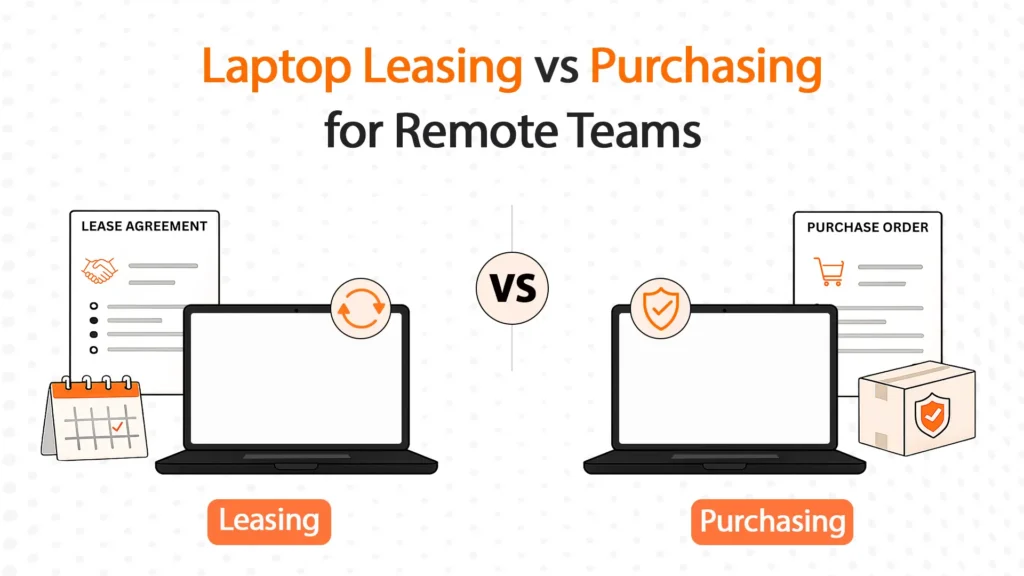
Laptop Leasing vs Purchasing at a Glance
Before we go deep, here’s a clear side-by-side so you can see where they fundamentally differ.
| Category | Leasing | Purchasing |
| Upfront Cost | Low or none | High, full device cost |
| Monthly Cost Predictability | Fixed and predictable | Irregular |
| Ownership | Vendor owns devices | You own devices |
| Maintenance Responsibility | Usually handled by vendor | Your IT team’s problem |
| Refresh Cycles | Built into contract | Whenever you decide |
| Flexibility During Growth | High | Slower |
| Long-Term Cost | Higher total cost over 3-5 years | Lower total cost |
| Asset Value | No residual value for you | Can resell or redeploy devices |
| Best For | Fast-growing, distributed, high-turnover teams | Stable teams, long employee tenure |
The short version: leasing is easier to manage and kinder to cash flow. Buying is cheaper in the long run and gives you more control.
But that table doesn’t tell the whole story. The real difference shows up in how you manage devices after they arrive.
How Laptop Leasing and Purchasing Work
The answer isn’t as straightforward as it seems, but the mechanics themselves are simple.
What is Leasing?
Leasing means you pay a monthly or annual fee to use devices owned by a vendor. At the end of the lease term (typically 2-3 years), you return the devices, upgrade to newer models, or buy them out. Repairs, replacements, and sometimes even setup are often bundled in. You’re essentially outsourcing the hardware headache.
What is Purchasing?
Purchasing means you pay the full cost upfront and own the devices outright. You control everything including what you buy, how long you use it, when you replace it, and what you do with it at the end. The operational burden falls entirely on your team.
The right choice depends entirely on your company’s situation right now.
The Real Stakes IT Teams Shouldn’t Ignore
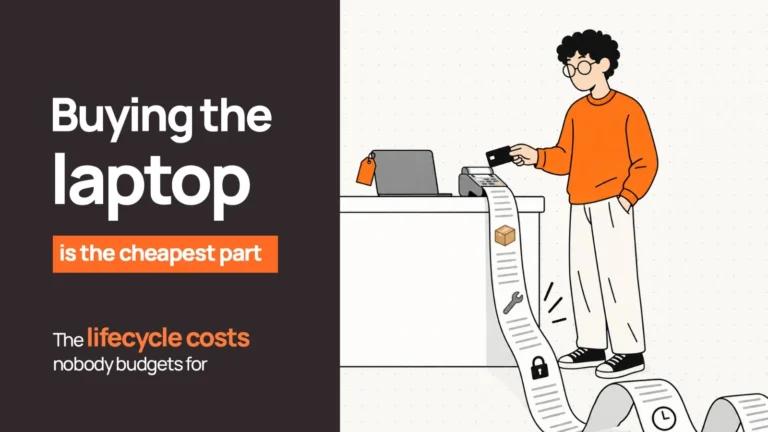
Cost is important, but it’s rarely the only factor. People compare the laptop price against the monthly lease payment. That math is simple. What’s not in that calculation is everything that happens after the device ships.
1. Deployment costs
Who configures the laptop? Who ships it? Who handles customs for the employee in Brazil or Poland? Even owned devices need someone to manage getting them there.
2. Maintenance and repairs
Devices break. Screens crack. Batteries die. If you own the devices, your team handles it. If you lease, it’s often the vendor’s problem. But “often” isn’t always. Read the contract carefully.
3. Replacements
When someone’s laptop fails and they can’t work, how fast can you get them a new one? With a lease, the vendor typically has a process. With owned devices, you need available inventory or a fast procurement system.
4. Retrieval
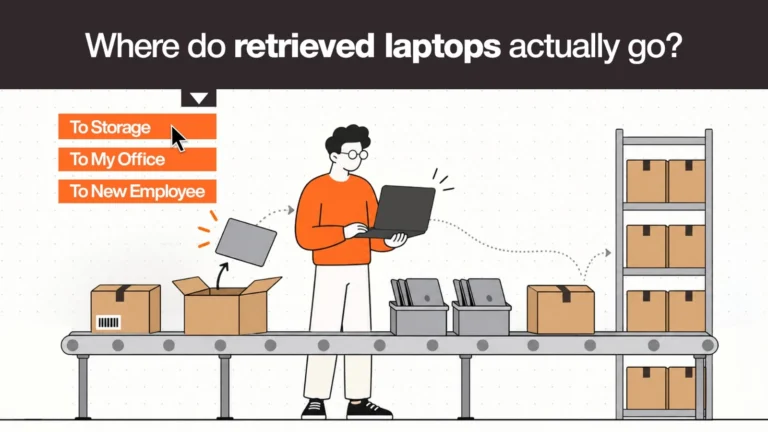
Someone quits. The laptop is in Cape Town. Who’s responsible for getting it back? Leasing companies handle retrieval as part of the contract. With owned devices, your team coordinates it, or pays someone else to.
5. Storage
Devices pile up between hires. Someone has to store them, and maintain them. If you own 20 idle laptops sitting in a warehouse, those are depreciating assets you’re paying to store.
6. Refresh cycles
Leasing builds this automatically. Every 2-3 years, devices get refreshed. Buying doesn’t. Which means you’re either using 5-year-old machines or writing a large check to refresh everything at once.
When you add these up, the gap between leasing and purchasing closes faster than a spreadsheet comparison suggests.
When Leasing Makes Sense for Your Team
Leasing isn’t for everyone. But for certain situations, it’s genuinely the smarter call.
1. Fast-Growing Startups
You’re hiring 10 people this month and 10 in the next. You don’t know exactly what hats they will wear, and half of them are in countries you’ve never shipped to.
Leasing works here because the vendor handles laptop procurement for distributed teams, shipping, and customs. You don’t need to build an Amazon level of logistics by yourself. You need laptops ready fast, wherever people are.
The tradeoff is that you’ll pay more per device over time. But the operational lift you avoid, especially during rapid scaling can be worth it.
Operator insight: If you’re in high-growth mode and lack dedicated IT staff, lean toward leasing while you scale.
2. Teams with Uncertain Hiring Plans
You think you’ll hire 30 people next quarter. Maybe it’s 15. Maybe it’s 45. Business and stakeholder interests change.
Leasing gives you flexibility without overcommitting capital. You scale up or down based on what actually happens, not what you projected in a spreadsheet three months ago. Buying 30 laptops for a team that ends up being 20 means 10 idle assets depreciating on your balance sheet.
Operator insight: If your headcount plan is unpredictable, leasing protects you from overspending and under-using inventory.
3. Companies Prioritizing Cash Flow
$125,000 upfront for 50 laptops is a real number. For some companies, that capital is better deployed elsewhere. Think product development, marketing, hiring.
Leasing turns a CapEx spike into predictable OpEx. It’s not free money, but it changes when you spend it and how it hits your budget.
Operator insight: If preserving working capital matters more than minimizing 5-year total cost, leasing is the right trade-off.
When Purchasing Makes Sense for Your Team
For many teams, buying is simply the better long-term decision.
1. Stable, Long-Tenure Teams
If your employees typically stay 3-5 years and your headcount doesn’t swing wildly, buying almost always wins on cost.
A $1,500 laptop owned for 4 years costs roughly $375/year. The same device leased at $100/month costs $4,800 over 4 years. That’s a $3,300 difference per device. Multiply by 50 employees and you’re looking at $165,000 in additional cost over four years.
When your team is stable, you don’t need the flexibility leasing provides but you’re paying for it anyway.
Operator insight: If your average employee tenure is 3+ years, buying almost always delivers better financial value.
2. Companies with Predictable Refresh Cycles
You know your devices need replacing every 4 years. You can plan for it. You can budget for it. You don’t need a leasing company to force the timeline.
Buying gives you control. You decide what to buy, when to refresh, and what to do with retired devices like resell, donate, or redeploy internally.
Operator insight: If your refresh cycle is predictable and you have the operational systems to manage it, ownership gives you more options and better economics.
3. Teams that Want Full Control
Some industries have strict data requirements. Some IT teams need custom configurations that leasing catalogs don’t offer. Some companies simply want to own their infrastructure.
With purchased devices, you decide everything including hardware specs, software configurations, data handling, disposal methods. Nothing is constrained by a vendor contract.
Operator insight: If customization, compliance, or control is non-negotiable, buying is the only real option.
Why Many Remote Teams End Up Using a Hybrid Model
Here’s what most articles won’t tell you: the majority of growing companies don’t choose one approach. They choose both and for the right reasons.
A common hybrid pattern we have noticed among different teams:
Buy laptops for core full-time employees
Engineers, designers, senior staff who will be around for years. These people need performance, customization, and consistency. The long-term economics favor ownership.
Lease for short-term hires and high-turnover roles
Interns, seasonal workers, short-term contractors. These roles cycle through quickly. The logistics of buying and retrieving devices for people who stay 6 months aren’t worth it.
Another common mode isl:
Buy during stable periods: When hiring is steady and predictable, own your devices.
Lease during growth spurts: When you’re scaling into 5 new countries in 6 months, let a vendor handle logistics while you stabilize.
The hybrid approach is a deliberate strategy that captures the advantages of both models where they’re strongest. The complexity is managing both alongside each other, which requires good asset tracking and visibility.
A Simple Decision Framework You Can Use Today
Before comparing options, it’s worth understanding what you’re actually optimizing for.
| If your situation is… | Consider… | Why It Makes Sense |
| Hiring rapidly | Leasing | Reduces upfront spending and helps scale device provisioning without large hardware purchases. |
| Stable workforce with low turnover | Buying | Ownership typically results in a lower long-term cost and better ROI over the device lifecycle. |
| Tight cash flow or limited capital | Leasing | Spreads costs into predictable monthly payments instead of large upfront investments. |
| Long refresh cycles (4–5 years) | Buying | The longer devices stay in service, the more value you extract from ownership. |
| Seasonal, project-based, or contractor-heavy hiring | Leasing | Avoids purchasing devices that may only be needed for a few months. |
| Mixed workforce (full-time employees + contractors) | Hybrid | Buy for permanent employees and lease for short-term or temporary workers. |
| High employee turnover (20%+ annually) | Leasing or Hybrid | Makes it easier to scale device inventory up or down without accumulating unused hardware. |
| Long employee tenure (3+ years average) | Buying | Devices are likely to remain in use long enough to justify the upfront investment. |
| Rapid growth with uncertain headcount forecasts | Leasing | Preserves flexibility while hiring plans and device needs are still evolving. |
| Mature company with established IT operations | Buying | Internal procurement, maintenance, and refresh processes often make ownership more cost-effective. |
| Lean IT team (fewer than 3 IT staff) | Leasing | Leasing providers often handle provisioning, refreshes, and support, reducing operational overhead. |
| Strong internal IT team and procurement processes | Buying | Existing infrastructure can support IT device management efficiently and lower total costs. |
| Security-sensitive environments requiring custom configurations | Buying | Provides greater control over hardware standards, configurations, and lifecycle policies. |
Use this as a starting point, not a rulebook. Most decisions involve more than one factor and the right answer often sits at the intersection of two or three rows.
How Device Lifecycle Management Changes the Equation
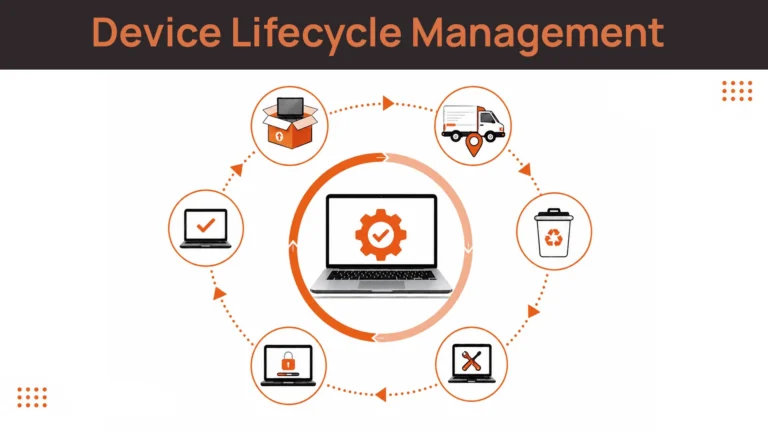
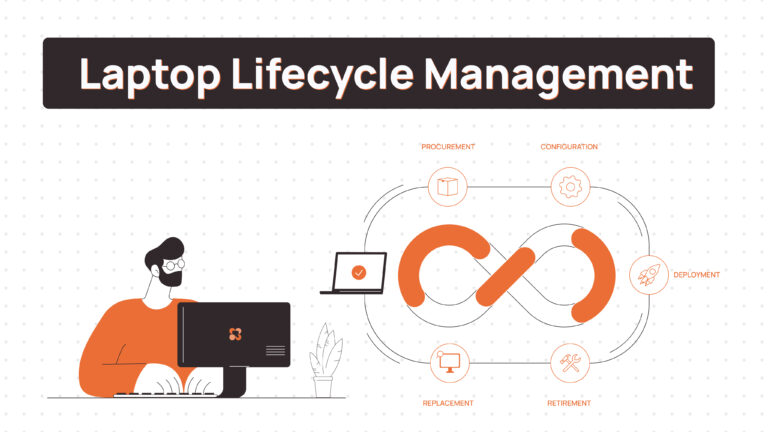
Most lease-vs-buy discussions stop at procurement. That’s where the decision starts. The real costs and operational complexity show up after the laptop is in an employee’s hands. Whoever you’re comparing, whatever model you choose, you still have to manage the same lifecycle:
Deployment
Getting configured devices to employees anywhere in the world, on time. Customs, shipping, configuration. It’s a real logistics operation at scale.
Maintenance and repairs
Devices break. Employees in remote locations can’t drop a laptop at your office. You need a process for remote repairs, loaner devices, and minimizing downtime.
Retrieval
When employees leave. They might resign, be terminated, or finish a contract, their devices need to come back. Without a systematic retrieval process, devices disappear. Industry data puts unreturned equipment rates at 71% for companies without formal retrieval workflows.
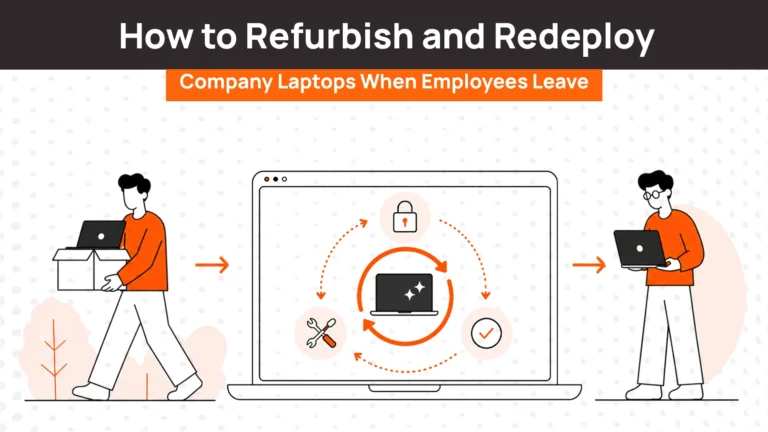
Redeployment
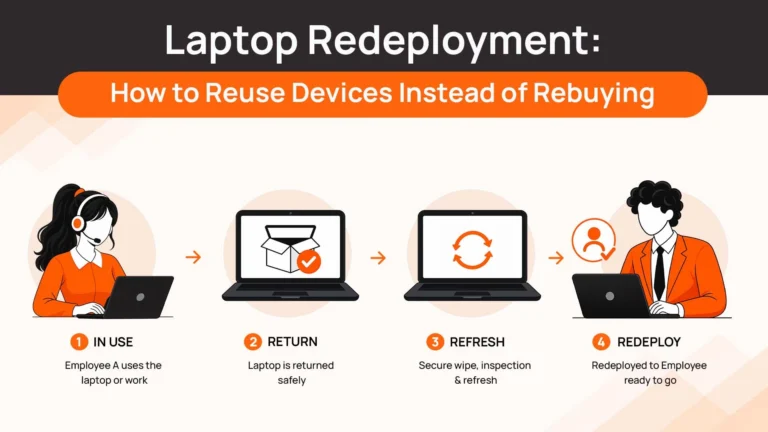
Retrieved, refurbished devices returning to active use instead of sitting in storage. This is where purchasing delivers its strongest advantage. A $1,500 device redeployed to a new hire at $150 in refurbishment costs is significantly cheaper than buying new.
Disposal
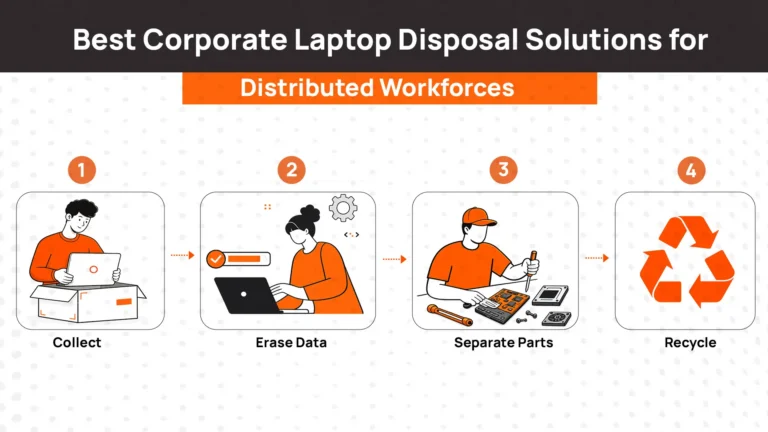
When devices truly reach end of life, certified data wiping and responsible recycling matter both for compliance and environmental responsibility.
Leasing bundles many of these with the vendor. Purchasing puts them on you. But here’s the thing. Either way, these problems exist. The question is who’s solving them and how.
Related Read:
- Laptop Lifecycle Management: A Practical Guide for Modern IT Teams
- Laptop Asset Management Software
- Best Laptop Return Services for Remote Teams
How RemoAsset Supports Laptop Procurement and Lifecycle Management
Whether you lease or buy, the operational challenge remains the same: getting devices to employees, keeping them productive, and managing those assets throughout their lifecycle.
For companies that choose to buy laptops, RemoAsset helps streamline procurement, deployment, retrieval, and redeployment from a single platform. Devices can be ordered, configured, shipped to employees, tracked throughout their lifecycle, and recovered when employees leave.
Buying the laptop is only the first step. The real challenge is knowing where devices are, keeping them in good condition, getting them back when employees leave, and reusing them whenever possible. The better a company handles those day-to-day processes, the more useful life it gets out of every laptop it purchases.
FAQs
Is leasing cheaper than buying laptops?
In the short term, yes. Leasing has lower upfront costs. Over 3-5 years, buying is typically cheaper—especially for stable teams—because you pay once, can reuse devices, and recover resale value. Leasing finances are usually 30-50% more expensive over the full term when you account for financing margins.
Should startups lease or buy employee laptops?
Early-stage startups with unpredictable headcount and limited capital often benefit from leasing. It preserves cash and removes logistics burden. As the team stabilizes and headcount becomes more predictable, shifting toward a hybrid or buying model usually makes financial sense.
Can companies mix leased and purchased devices?
Absolutely—and many do. A common approach is buying devices for stable long-term employees and leasing for contractors, seasonal hires, or teams in countries where logistics are complex. The hybrid model captures cost efficiency where tenure is long and operational flexibility where turnover is high.
What happens when a leased laptop is damaged?
Depends on the lease terms. Most commercial leases include normal wear and tear. Significant damage (cracked screens, liquid damage) may incur repair charges or affect end-of-lease options. Always read what “fair wear and tear” means in your specific contract before signing.
How often should businesses refresh employee laptops?
Most businesses use 3-4 year refresh cycles for standard roles. Heavy-use roles (engineering, design, field work) sometimes justify 3 years. Administrative roles with lighter workloads often run comfortably to 4-5 years. The right answer depends on your workloads, not a universal rule.
Do leased laptops include maintenance and repairs?
Often yes—but “included” varies significantly. Some leases include everything: repairs, loaner devices, warranty coverage. Others include only basic maintenance. Clarify exactly what’s covered before signing. A lease that seems affordable can become expensive if repairs aren’t included.
How does laptop depreciation affect buying decisions?
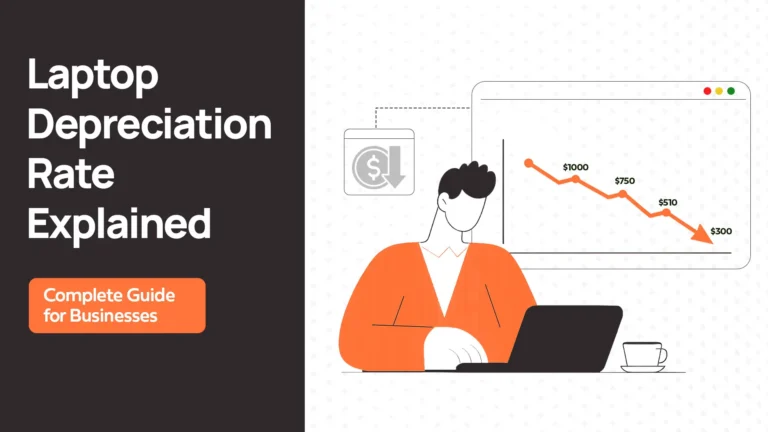
Depreciation is the annual reduction in book value. A $1,500 laptop with a 4-year useful life loses roughly $375/year in book value. This affects when replacement budgets hit and what residual value you recover at end of life. Strong lifecycle management—tracking, maintenance, and redeployment—slows the practical rate of value loss even if accounting depreciation is fixed.
What are the biggest risks of leasing laptops?
Vendor lock-in during the contract term. Higher total cost if employees stay longer than expected. Limited customization options from vendor catalogs. Early termination penalties if team size changes unexpectedly. And dependency on vendor service quality for repairs and support.
What are the biggest risks of buying laptops?
Large upfront capital commitment. Operational responsibility for the full lifecycle—procurement, maintenance, retrieval, refurbishment, disposal. Devices going missing during offboarding without systematic retrieval processes. And the risk of carrying idle inventory when headcount dips.
Is a hybrid procurement model common?
More common than most articles suggest. Companies with mixed workforces—some permanent, some contract—naturally gravitate toward hybrid approaches. It’s not a compromise. When done deliberately, it’s often the most cost-effective and operationally sustainable approach for remote teams operating at scale.
Checkout others blog by Remoasset: How to manage company laptops?