Employee onboarding is one of the most talked-about areas in HR.
And yet, it’s one of the most misunderstood.
Every company claims to “care about onboarding.” Many invest in welcome kits, presentations, and structured programs. But despite this, onboarding still breaks and when it does, the impact is immediate.
New hires feel lost. Productivity drops. First impressions weaken. In some cases, employees disengage within weeks.
The reason is simple:
Most onboarding strategies are designed as experiences but fail at execution.
This guide goes deeper than typical “best onboarding examples” articles.
Instead of surface-level inspiration, we break down:
- What actually defines the best employee onboarding experiences
- Real company examples and what makes them work
- The operational gaps most teams overlook
- A practical framework to build onboarding that scales
What Makes an Employee Onboarding Experience “Great”?
Most onboarding frameworks revolve around the well-known 5 C’s model:
- Compliance → paperwork, policies, legal requirements
- Clarification → role expectations and responsibilities
- Culture → values, mission, company identity
- Connection → relationships with team and stakeholders
- Check-back → feedback loops and progress tracking
This model is useful. It gives structure to onboarding. But it only explains half the system.
The Missing Layer: Operational Readiness
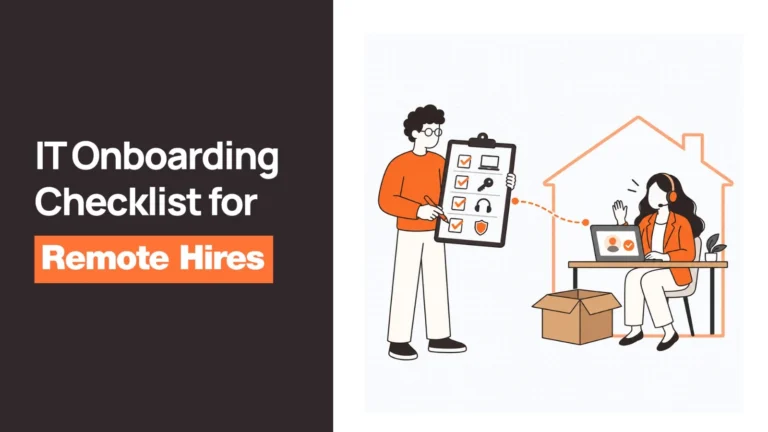
What the 5 C’s don’t address is the execution layer, the part where onboarding actually succeeds or fails.
Operational readiness includes:
- Device availability
- Tool access
- Account provisioning
- System setup
- Workflow coordination
These are not minor details. They determine whether a new hire:
- Starts contributing on Day 1
- Or spends their first week waiting
Why This Matters
A company can:
- Have a great culture session
- Assign a buddy
- Share documentation
But if:
- The laptop arrives late
- Access credentials are missing
- Tools are not configured
The experience collapses.
Key Insight
Great onboarding = Experience (HR) + Execution (IT & Ops)
The best companies do not treat onboarding as a “program.” They treat it as a system that must work end-to-end.
10 Best Employee Onboarding Experiences (What They Actually Do Differently)
Let’s go beyond inspiration and understand what top companies are doing at a system level.
1. Google — Structured, Measurable, and Iterative
What they do:
Google doesn’t rely on intuition. Their onboarding process is data-driven.
They:
- Assign onboarding buddies
- Use detailed checklists
- Track onboarding success metrics
Why it works:
Google found that employees who met with their managers in the first week were significantly more productive.
They continuously refine onboarding using behavioral insights.
What you can replicate:
- Create structured onboarding workflows
- Assign clear ownership
- Measure onboarding outcomes, not just completion
2. Airbnb — Designing Emotional Connection Early
What they do:
Airbnb focuses heavily on storytelling.
New hires:
- Learn the company’s origin story
- Understand the mission deeply
- Experience the brand, not just the role
Why it works:
People don’t connect to processes. They connect to purpose.
Airbnb ensures employees feel like they belong before they start working.
What you can replicate:
- Go beyond orientation
- Make onboarding emotionally engaging
3. Netflix — Trust and Ownership from Day One
What they do:
Netflix minimizes structured onboarding.
Instead, they:
- Give employees context
- Set expectations
- Trust them to perform
Why it works:
High performers prefer autonomy over rigid processes.
Netflix aligns onboarding with its culture of responsibility.
What you can replicate:
- Avoid over-engineering onboarding
- Give meaningful responsibility early
4. Shopify — Learning Through Execution
What they do:
Shopify uses a “learning by doing” model.
Instead of passive sessions, employees:
- Work on real problems
- Build and test ideas
- Get feedback quickly
Why it works:
Learning becomes practical, not theoretical.
Employees ramp faster because they are already contributing.
5. Microsoft — Manager-Led Onboarding
What they do:
Microsoft shifted onboarding ownership to managers.
They:
- Define 30-60-90 day plans
- Conduct regular check-ins
- Provide role clarity early
Why it works:
Managers are closest to the employee’s success.
When managers own onboarding, outcomes improve significantly.
6. HubSpot — Documentation and Transparency
HubSpot’s onboarding is built on clarity.
They provide:
- Detailed onboarding documentation
- Transparent processes
- Clear expectations
This reduces ambiguity and empowers employees to self-serve information.
7. Atlassian — Built for Distributed Teams
Atlassian’s onboarding reflects remote-first operations.
They focus on:
- Async documentation
- Self-paced onboarding
- Structured knowledge systems
This ensures consistency across locations.
8. Zappos — Culture Over Everything
Zappos famously offers employees money to quit after onboarding.
Why?
Because they prioritize long-term cultural alignment over short-term hiring success.
9. Slack — Clarity Over Complexity
Slack simplifies onboarding by:
- Defining clear expectations
- Breaking work into milestones
- Reducing ambiguity
Clarity reduces anxiety and improves performance.
10. Stripe — Technical Readiness as Priority
Stripe ensures:
- Systems are ready
- Environments are configured
- Engineers can start immediately
This is where many companies fail.
The Hidden Layer Most Companies Miss
After analyzing these examples, one thing becomes clear: The difference is not just culture. It is execution quality.
Where Most Onboarding Breaks
- Device delays
Employees don’t receive laptops before Day 1. - Access gaps
Accounts are not provisioned. - Manual IT processes
Setup depends on internal coordination. - Lack of ownership
HR, IT, and Ops operate separately.
The Real Problem
Onboarding fails when systems are disconnected.
Even companies with strong HR programs struggle because:
- IT workflows are manual
- Logistics are fragmented
- There is no central system
8 Proven Patterns Behind the Best Onboarding Experiences
Across companies, consistent patterns emerge.
1. Preboarding Starts Before Day 1
Employees are engaged before joining. This reduces anxiety and increases readiness.
2. Buddy Systems Reduce Friction
New hires always have someone to turn to. This improves confidence and accelerates learning.
3. Manager Ownership Drives Outcomes
Onboarding is not HR’s job alone. Managers must lead.
4. Real Work Happens Early
Employees should contribute within days, not weeks.
5. Clear 30-60-90 Day Plans
Structure removes confusion.
6. Feedback Loops Improve Systems
Onboarding improves when feedback is captured continuously.
7. Automation Reduces Operational Load
Manual onboarding does not scale.
8. Seamless IT Readiness
This is the biggest differentiator. Research shows that strong onboarding improves retention by up to 69% over three years.
The 3-Layer Onboarding Model
To build a scalable onboarding system, think in layers:
1. Experience Layer (HR)
Focus:
- Culture
- Engagement
- Communication
2. Execution Layer (IT + Operations)
Focus:
- Devices
- Access
- Tools
- Setup
3. Outcome Layer (Manager)
Focus:
- Productivity
- Performance
- Role clarity
Most companies only optimize Layer 1. The best companies optimize all three.
How to Build a Best-in-Class Onboarding System
Step 1: Preboarding
- Send welcome communication
- Share onboarding plan
- Prepare accounts and tools
Step 2: Day 1 Readiness
This is critical.
Ensure:
- Laptop is delivered
- Tools are configured
- Access is ready
Step 3: Week 1 Structure
- Training sessions
- Introductions
- Clear goals
Step 4: 90-Day Ramp
- Defined milestones
- Feedback cycles
- Performance tracking
Where Most Teams Struggle
For distributed teams, the biggest challenge is not culture.
It is logistics:
- Shipping devices globally
- Configuring systems
- Coordinating IT workflows
Platforms like RemoAsset help solve this by ensuring:
- Devices arrive ready to use
- Deployment is automated
- Tracking is centralized
This removes operational friction and improves onboarding consistency.
Common Onboarding Mistakes (Real Feedback)
From real employee experiences:
“I spent my first three days waiting for access.”
“No one had a plan for me.”
“I had a laptop, but nothing worked.”
Common mistakes include:
- Lack of structure
- Poor communication
- No Day 1 readiness
- Overwhelming information
- No ownership
Final Take: What the Best Onboarding Experiences Get Right
The best onboarding experiences are not accidental. They are designed systems.
They:
- Align HR, IT, and operations
- Focus on execution, not just experience
- Ensure Day 1 productivity
- Scale across teams and regions
As companies grow globally, onboarding becomes more complex. And the operational layer becomes the deciding factor.
If your onboarding challenges involve:
- Device delays
- Setup issues
- Global coordination
Then improving onboarding requires more than better HR programs. It requires better infrastructure.
Platforms like RemoAsset help connect procurement, deployment, and recovery enabling onboarding that is not just well-designed, but actually works.
Want to fix onboarding at the operational level?
Explore how modern teams streamline onboarding → Book a Demo