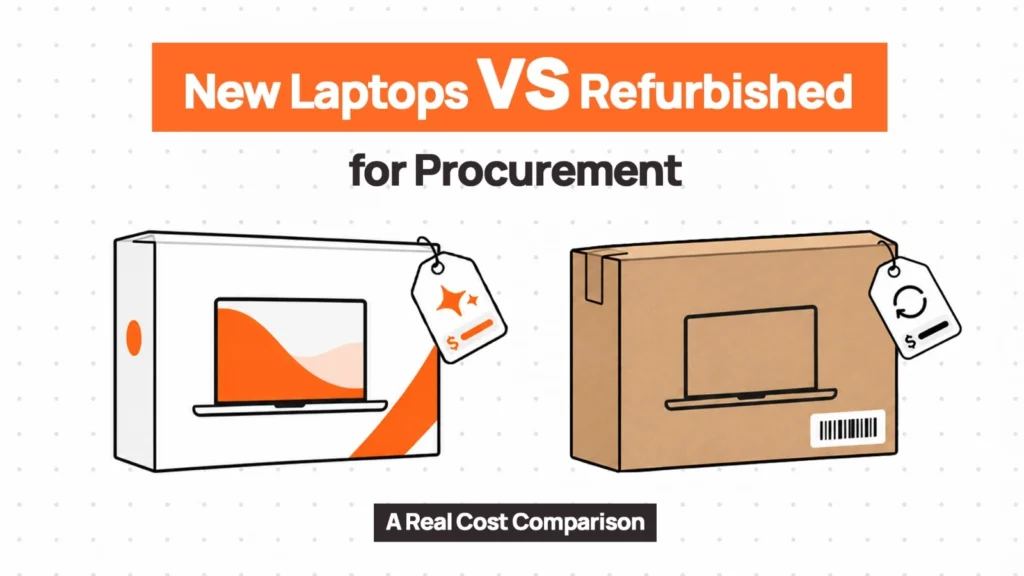
A new business laptop quote can look surprisingly expensive once you multiply it across 20, 50, or 200 employees. That is usually when the refurbished option enters the conversation.
The immediate question is simple: Can we really give employees refurbished laptops instead of buying new?
The better question is more specific.
You are rarely comparing a premium new business laptop with an identical refurbished model sitting on a shelf. More often, the procurement decision comes down to a reputable refurbished business-class laptop versus a new, lower-tier machine at roughly the same budget. That changes the calculation considerably.
A refurbished ThinkPad, Latitude, EliteBook, or similar business-class device may have been designed for a higher workload, better repairability, stronger materials, and longer enterprise use than a new entry-level laptop selling at a similar price. At the same time, refurbished hardware has already consumed part of its useful life, and warranty coverage, battery condition, component availability, and remaining OS support all matter. The question is not whether refurbished is automatically cheaper. It is whether the lower acquisition cost still holds up once you account for the full cost of owning and supporting the device.
The Real Cost Difference Upfront
The biggest advantage of refurbished hardware is also the easiest one to see. Refurbished business laptops can often be priced substantially below equivalent new configurations, particularly when the comparison is between current new hardware and recent enterprise machines coming off corporate leases or refresh cycles.
But purchase price is only the first line in the calculation. A laptop that costs $500 instead of $800 has saved the company $300 only if the additional $300 does not come back through higher repair costs, shorter usable life, downtime, weaker warranty coverage, or an earlier replacement. That is why procurement teams should run both options through the same total-cost-of-ownership model rather than comparing sticker prices alone. A useful framework is: TCO = Acquisition Cost + Operational Cost + Risk/Downtime Cost − Residual Value. The numbers will vary by organization, but using the same formula for both options makes the comparison much more useful than looking at the initial quote.
Running the TCO Formula on New vs. Refurbished
Consider a simple three-year deployment for a standard knowledge worker:
| Cost factor | New budget laptop | Refurbished business laptop |
| Acquisition | $800 | $500 |
| Support and operating costs over 3 years | $270 | $270 |
| Expected repair / warranty reserve | $60 | $120 |
| Residual / redeployment value | −$250 | −$120 |
| Illustrative 3-year TCO | $880 | $770 |
These are illustrative procurement numbers, not a universal market benchmark. The refurbished laptop starts $300 ahead on acquisition. It gives some of that advantage back through a larger repair reserve and lower residual value, but it can still finish with a lower three-year cost. Now change the assumptions: if the refurbished device has a weak battery, only a short warranty, cannot run the organization’s current operating system, or needs to be replaced after two years instead of three, the economics can quickly reverse. That is why saying ‘refurbished is cheaper’ is not enough for a business procurement decision.
Acquisition cost
This is where refurbished hardware almost always has the clearest advantage. A business that needs 100 laptops can potentially reduce the initial hardware outlay substantially by sourcing suitable refurbished devices — particularly relevant for startups, rapidly growing teams, or organizations that need large numbers of standardized devices without committing the entire hardware budget upfront.
Operational cost
Once both devices are configured, enrolled in MDM, patched, secured, and supported through the same IT environment, the day-to-day management cost can be relatively similar. IT does not necessarily spend less time managing a laptop simply because it is new. This is why procurement should compare devices based on the actual configuration and intended workload rather than assuming that new hardware automatically has a lower operating cost.
Warranty and downtime risk
This is where the refurbished option needs more scrutiny. A new laptop normally comes with manufacturer warranty coverage appropriate to the product line. A refurbished laptop may have seller-backed or refurbisher-backed coverage, and the length and terms can vary considerably. A six-month warranty is not equivalent to a three-year business warranty simply because both listings say ‘warranty included.’ For a developer, designer, or employee whose laptop is central to their work, a higher warranty and support requirement may justify buying new. For a standard administrative role with a predictable workload, a well-tested refurbished business device may make much more sense.
Residual and redeployment value
New hardware starts with more remaining useful life. After three years, a relatively recent business laptop may still have meaningful resale or internal redeployment value. A refurbished device that was already several years old when purchased will generally have less remaining life at the end of the same holding period. That does not make refurbished a bad investment — it simply means procurement should account for the shorter remaining runway. Our guide on how laptop value declines over time covers how to estimate residual value at different ages and condition grades.
The Comparison That Actually Matters: Refurbished Business vs. New Budget
This is the comparison that gets missed most often. Imagine a company has a $600-per-employee laptop budget. One option is a new entry-level laptop at approximately $600. The other is a refurbished enterprise-class laptop that originally cost considerably more but can now be purchased for approximately the same amount.
On paper, the new device wins because it is new. From a practical IT perspective, that tells you very little. The refurbished business laptop may offer a stronger chassis, better keyboard and trackpad, more upgradeable components, better port selection, a higher-quality display, stronger enterprise management features, and a configuration with more RAM or storage.
That does not mean every refurbished business laptop is better than every new budget laptop. It means the device category and original design intent matter alongside its age. A procurement team comparing only ‘new’ and ‘refurbished’ misses that distinction. The more useful question is: what can we get for the same budget, and how long can each device reliably perform the job we need it to do?
What to Check Before Buying Refurbished
The word ‘refurbished’ does not describe one consistent quality standard. A device sold as refurbished could have undergone extensive testing, component replacement, cleaning, imaging, and quality control. Another could simply have been wiped and resold. That means procurement needs to evaluate the refurbisher as carefully as the laptop itself.
1. Understand the grading system
Ask what the supplier’s grades actually mean. An A/B/C or similar grading system is commonly used in refurbished hardware, but those labels are not a universal technical standard. Ask what condition is guaranteed, whether the screen has specific defect tolerances, whether ports are tested, and whether batteries are replaced when they fall below a defined threshold.
2. Look at the warranty, not just the word “warranty”
Find out the length of coverage, what components are covered, who pays for shipping, how repairs are handled, and whether a replacement device is available if a repair takes too long. For business procurement, the operational response to a failure can matter more than the headline warranty period.
3. Verify Windows 11 compatibility
Microsoft’s current Windows 11 requirements include a compatible processor, TPM 2.0, UEFI/Secure Boot capability, at least 4 GB of RAM, and at least 64 GB of storage. For refurbished procurement, the exact processor and configuration should be checked before purchase. A cheap laptop that cannot remain on the organization’s supported OS standard is not a bargain.
4. Ask how the device was sanitized
A refurbished laptop should not arrive with uncertainty about its previous user’s data. Ask the supplier what data-sanitization process is used before the device is resold, and what evidence is available that the process was completed. This becomes particularly important when buying devices that previously belonged to another organization. What a compliant erasure record should contain covers the documentation standards that verify a genuine wipe.
5. Check the remaining useful life
Two refurbished laptops can have the same price and specifications while offering very different economics. A two-year-old business laptop with a supported processor, healthy battery, available replacement parts, and a strong support ecosystem may be a better procurement choice than a cheaper five-year-old machine. The question is not simply how much it costs — it is how much useful, supportable life you are buying.
Related Reads
Each angle of this comparison has a deeper guide:
- Laptop Total Cost of Ownership: The Full Lifecycle Math — the TCO formula used in this post, in full detail.
- Laptop Depreciation: Cost, Rate and What It Means for Your Fleet — how residual value erodes across new and refurbished hardware at different ages.
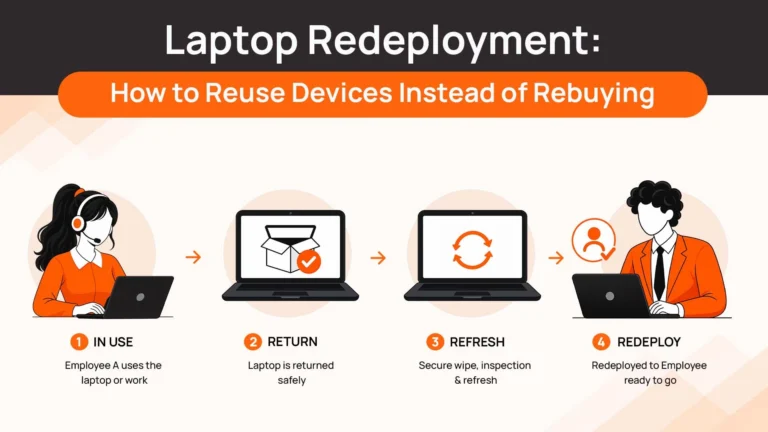
- Laptop Redeployment: How to Reuse Devices Instead of Rebuying — the third option: hardware you already own, at no new acquisition cost.
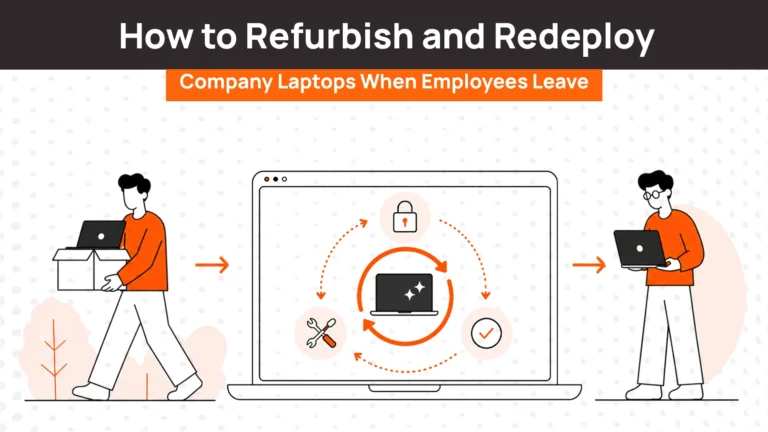
- How to Refurbish and Redeploy Company Laptops When Employees Leave — the grading, wiping, and inspection process that turns a returned device into redeployable inventory.
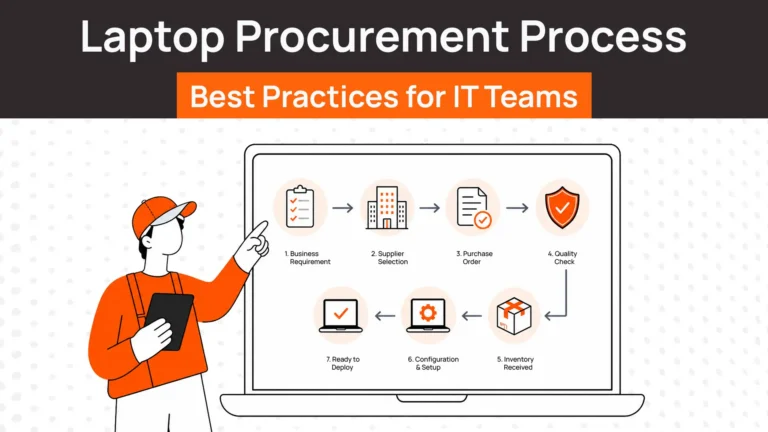
- Laptop Procurement Process Best Practices — building a repeatable procurement baseline that accounts for new, refurbished, and redeployed devices.
The Option Neither New Nor Refurbished Covers: Redeployment
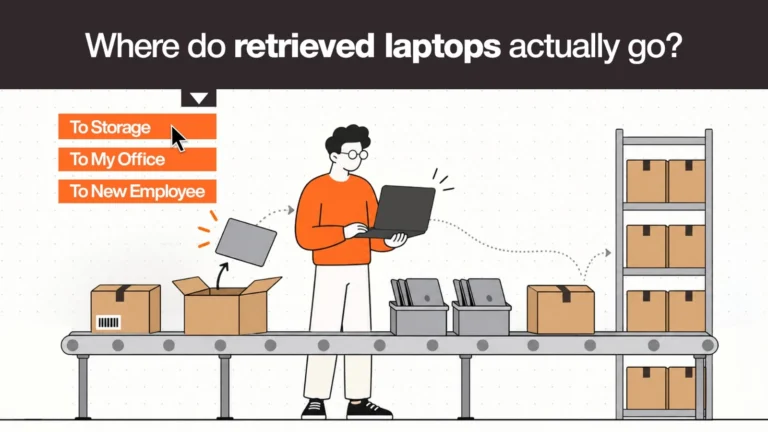
There is another option that is often left out of the comparison entirely: use the hardware you already own. If an employee leaves and their laptop is returned, wiped, inspected, and assigned to the next employee, the organization does not have to purchase another device at all. That makes internal redeployment fundamentally different from buying refurbished hardware: a refurbished laptop has a lower acquisition cost because someone else previously owned and used it. A redeployed laptop can have zero new acquisition cost because the organization already owns the asset.
The economics therefore look like this:
New → highest acquisition cost
Purchased refurbished → lower acquisition cost
Internally redeployed → no new acquisition cost
Of course, redeployment still has processing costs. The device may need inspection, data wiping, repairs, reconfiguration, and shipping before it reaches its next user. But when the existing device is in good condition, those costs can be substantially lower than purchasing another laptop. This is why redeployment deserves to sit alongside new and refurbished when procurement teams are calculating their actual hardware requirements.
How Remoasset Fits Into the New vs. Refurbished Decision
The decision between new and refurbished does not have to be treated as a binary purchasing exercise. Remoasset helps organizations manage new procurement alongside existing device inventory and redeployment, so procurement teams can ask a more useful question before placing any hardware order: how many employees need devices, what do their roles require, and how much of that demand can be met from inventory the company already owns?
For refurbished and redeployed devices, the important controls remain the same: the device should be assessed for condition, securely wiped, checked against the required configuration, and recorded as an asset before it is assigned to another employee. Sometimes the answer will be new hardware. Sometimes it will be a quality refurbished business laptop. And sometimes the cheapest laptop to buy is the one the company already owns.
Book a demo to see how procurement, condition grading, secure wiping, and internal redeployment can work together so your team makes the new-versus-refurbished decision using the full lifecycle cost, not just the price on the quote.
Frequently Asked Questions
Is it worth buying refurbished laptops for a business?
Yes, when the device comes from a reputable refurbisher and meets the organization’s requirements for performance, OS compatibility, condition, warranty, and expected lifespan. The financial benefit comes primarily from the lower acquisition cost, but procurement should evaluate that saving against warranty coverage, repair risk, remaining useful life, and residual value.
Do refurbished laptops fail more often than new ones?
There is no simple failure-rate rule that applies to all refurbished laptops. The quality of the refurbishing process matters considerably. For procurement, the more useful questions are what components were tested or replaced, what condition standards were applied, and what warranty and support the supplier provides.
What warranty should you expect on a refurbished laptop?
There is no single standard. Business buyers should compare the actual coverage rather than relying on the presence of a warranty alone — look at duration, parts and labor coverage, battery treatment, repair turnaround, return shipping, and replacement policies. The appropriate warranty also depends on the employee’s role and how costly device downtime would be.
Can a refurbished laptop run Windows 11?
Many can, but eligibility needs to be checked against the specific hardware. Microsoft requires Windows 11 devices to meet minimum hardware requirements including a compatible processor, TPM 2.0, Secure Boot capability, at least 4 GB of RAM, and 64 GB of storage. Processor support is also model-specific. Verify the exact processor and configuration before purchase rather than assuming an older business laptop is automatically supported.
The Best Value Is the Device That Makes Sense Across Its Full Life
The new-versus-refurbished decision becomes much clearer once procurement stops treating the purchase price as the whole story. A new laptop can offer a longer support runway and stronger manufacturer warranty. A quality refurbished business laptop can provide substantially better hardware for the same budget. And a device already sitting in the company’s inventory may offer the lowest acquisition cost of all when it can be safely redeployed.
The right choice depends on the role, expected lifespan, warranty requirements, condition, supportability, and total cost over the period the organization actually plans to use the device.
Before buying another laptop, it is worth checking whether the best option is one you already own.