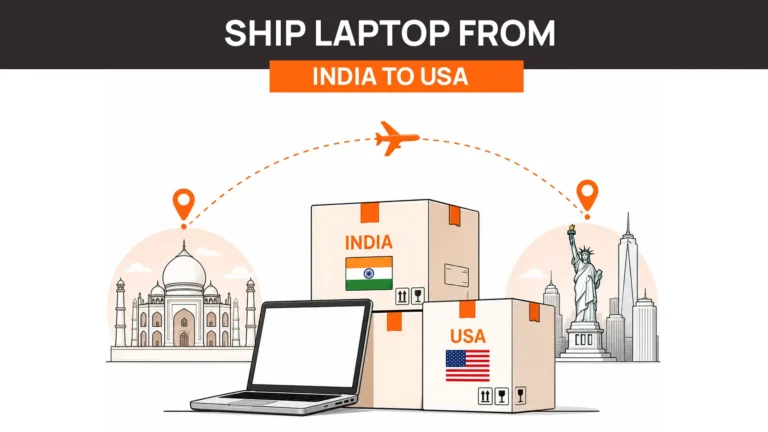
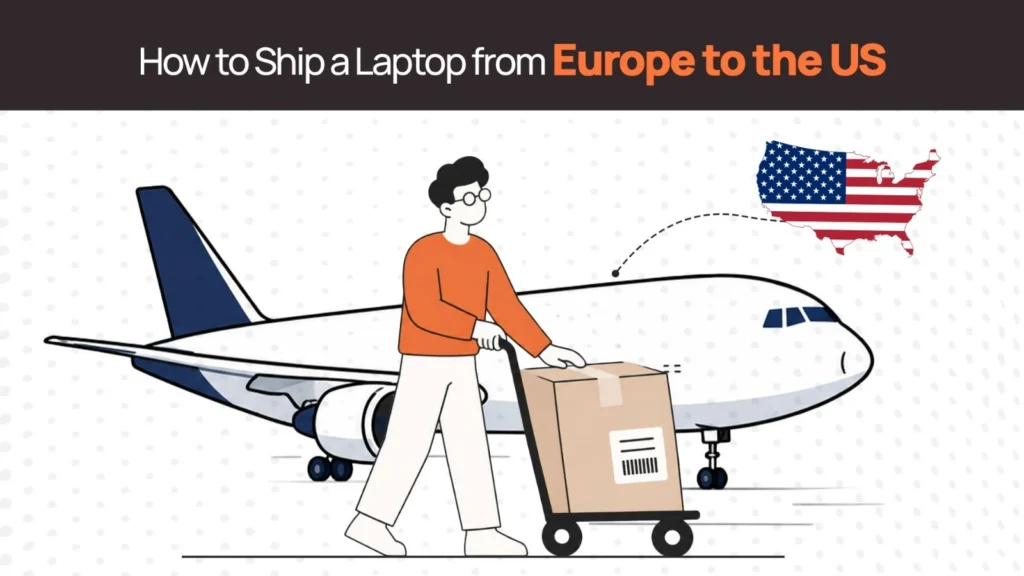
Yes, you can ship a laptop from Europe to the US, and duty is not the hard part. Laptops enter the US at a 0% import rate, and a genuine business export from the EU is normally VAT-free too. The part that actually trips companies up changed in 2025 and 2026: the US suspended the customs exemption that used to let small shipments skip formal paperwork, so every laptop shipment now needs a proper commercial invoice, a named importer, and correct customs entry, regardless of value.
Here’s what that means in practice, and what else to get right before you ship — whether you’re sending one laptop to a new hire or setting up a repeatable process for a growing US team.
Can You Ship a Laptop from Europe to the US?
Yes. Laptops fall under HS code 8471.30, and the US charges 0% import duty on this category under the WTO Information Technology Agreement — a global trade deal that the US, the EU, and most major economies follow. This isn’t a loophole or a temporary exemption. It’s the standard rate, and it applies regardless of which EU country the laptop ships from, as long as the laptop actually originates there rather than being a re-export of goods manufactured elsewhere. The tax bill isn’t the risk of a normal shipment. The paperwork is, and that’s where the 2025–2026 changes matter.
What Changed in 2025–2026: The De Minimis Suspension
For years, shipments under $800 could enter the US under Section 321 ‘de minimis’ with almost no formal paperwork. That’s no longer true, and it happened in stages worth knowing precisely:
- May 2025: The exemption was suspended for China and Hong Kong first.
- August 29, 2025: Executive Order 14324 suspended the exemption for every remaining country. From this date, no shipment under $800 could enter duty-free under Section 321, regardless of origin.
- June 24, 2026: US Customs and Border Protection made the suspension indefinite by regulation for non-postal shipments (courier and freight), removing the exemption’s dependency on the executive order being periodically renewed. A parallel rule covers postal shipments starting July 24, 2026.
- July 1, 2027: The suspension becomes permanent by statute, once the repeal in the One Big Beautiful Bill Act takes effect.
What this means for you: every laptop shipment now goes through formal or informal customs entry, no matter its value. Shipments valued at $2,500 or under generally use the simpler informal entry process; above that, formal entry applies, with its own filing requirements.
How to Ship a Laptop from Europe to the US: Step by Step
1. Confirm the HS code and duty rate
Laptops classify under HS 8471.30 at 0% US duty under the WTO ITA, so there’s no tariff to plan around — only the paperwork below.
2. Get an EORI number
If your company doesn’t already have one, register for an EORI number. It’s a one-time registration on the EU side, required for any commercial export.
3. Decide who is the importer of record
If you’re shipping to a US employee and have no US legal entity, this is usually a customs broker or third-party IOR service — not the employee.
4. Prepare the commercial invoice and export declaration
Accurate declared value, correct HS code, and a clear description — plus proof of export to support VAT zero-rating on your records.
5. Check FCC and battery compliance
A mainstream-brand laptop is already FCC-authorised. Keep the battery installed in the device and follow standard lithium-battery packaging practices.
6. Choose a courier and shipping terms
DHL, FedEx, or UPS all handle this route well. Use DDP terms so the employee receives the laptop without having to deal with customs themselves.
7. Pack, ship, and track
Use the original manufacturer box as an inner layer where possible, insure the shipment at replacement value, and track it through to customs clearance and delivery.
Documents You Need Before You Ship
- Commercial invoice with an accurate declared value, a description of the device, and HS code 8471.30.
- A named importer of record on the US side. This is now expected on every shipment, not only large ones.
- EORI number on the invoice, if shipping from an EU-registered company. This identifies your company to EU customs for any commercial export, and it’s a one-time registration, not something you apply for per shipment.
- Export declaration and proof of shipment, to support VAT zero-rating on your records.
Since duty is 0% either way, there’s no upside to underdeclaring the laptop’s value. It only risks a customs hold for no benefit, and it undermines the export paperwork you need on the EU side anyway.
Who should be the importer of record?
The importer of record (IOR) is whoever is legally responsible for the entry, for the accuracy of the paperwork, and for any duties or fees that do apply. Three realistic options:
- The employee acts as consignee: Workable for a single occasional shipment, but it puts a compliance role on someone who didn’t sign up for it, and it gets messy fast if anything is misclassified or held for review.
- A US-based customs broker or third-party IOR service files on your behalf. This is the standard fix if your company has no US legal entity.
- A US entity you control acts as IOR directly, giving you the most control but also the most ongoing compliance responsibility.
For a one-off hire, a broker-handled entry paired with DDP shipping terms is usually the simplest path. For a company doing this regularly, IOR becomes one more recurring administrative task to own — which is exactly the kind of thing worth handling through a coordinated procurement and delivery process rather than re-solving per shipment.
Does a Laptop Need FCC Approval to Enter the US?
Technically, laptops fall under FCC rules for wireless devices, but in practice this is rarely an issue: any laptop from a mainstream brand already carries valid FCC equipment authorisation as a condition of being sold legally in the US in the first place. That’s the operative rule — not the separate ‘three or fewer devices for personal use’ exemption some guides point to, which is intended for individuals bringing in unauthorised devices for themselves rather than a company shipping a company-owned asset. There’s also no paperwork to file. The FCC eliminated its import declaration (Form 740) as of November 2, 2017. For a standard branded laptop going to one employee, this genuinely isn’t something to plan around.
Lithium Battery and Packaging Rules
- Keep the battery installed in the laptop. Don’t ship it separately, and don’t pack spare batteries in with it unless they’re specifically declared and packaged to the applicable rules.
- Never ship a laptop with a swollen, damaged, or recalled battery.
- Use the original manufacturer box as an inner layer where possible, with padding on all sides, and protect the screen and ports separately.
One update worth knowing for 2026: IATA’s Dangerous Goods Regulations, 67th Edition (effective January 1, 2026), extended mandatory 30% state-of-charge limits to batteries packed with equipment. For batteries already installed inside a device — which is how a laptop is classified — a reduced charge isn’t mandatory, but IATA now recommends shipping below full charge where practical. Carriers do update battery and labelling requirements periodically, so it’s worth a quick check with whichever courier you’re using before a first shipment.
Related Reads
If this shipment is part of a broader device procurement or lifecycle conversation, these guides cover the surrounding decisions:
- Why You Shouldn’t Ship Laptops Internationally for Regular Procurement — when recurring cross-border shipping creates more operational drag than it looks like upfront.
- Laptop Sourcing: Ship, Source Locally, or Use a Stipend? — the sourcing model decision that sits before the customs question.
- Remote Employee Laptop Return: A Guide for IT Teams — when the laptop needs to come back from a US employee to Europe.
- Best International Laptop Retrieval Services for Remote Teams — providers that handle cross-border device recovery as a service.
- How to Ship a Laptop from the USA to India — the companion corridor post for the other major Europe-to-US hiring direction.
Choosing a Courier and Shipping Terms
| Courier | Good to know |
| DHL | Strong European network, standard commercial customs handling |
| FedEx | Good documentation tools — useful now that formal entry applies to every shipment |
| UPS | Broad coverage across both Europe and the US |
None of these change your duty outcome, since it’s 0% regardless of courier. What matters more is the shipping term. DDP (Delivered Duty Paid) means the shipper handles customs and any fees upfront, so the employee just receives the laptop. DAP or DDU leaves the recipient to sort out clearance themselves — which usually means delays, unexpected paperwork requests, and a rough first week for a new hire. For company-owned equipment, DDP is almost always the better default, even though the duty itself is zero either way.
Insist on tracking and insurance as a baseline, not an add-on. A laptop is high-value, low-weight cargo — exactly the profile that makes it worth insuring properly rather than relying on a carrier’s default liability coverage, which is usually far below the device’s replacement cost.
Personal vs. Company-Owned, New vs. Used
- New company laptop to a US employee: the standard case. Ship it at full declared value.
- Used or redeployed laptop: still needs to be declared, just at a fair, depreciated value rather than the original price.
- Replacement laptop: treated the same as a new shipment, regardless of why it’s being sent.
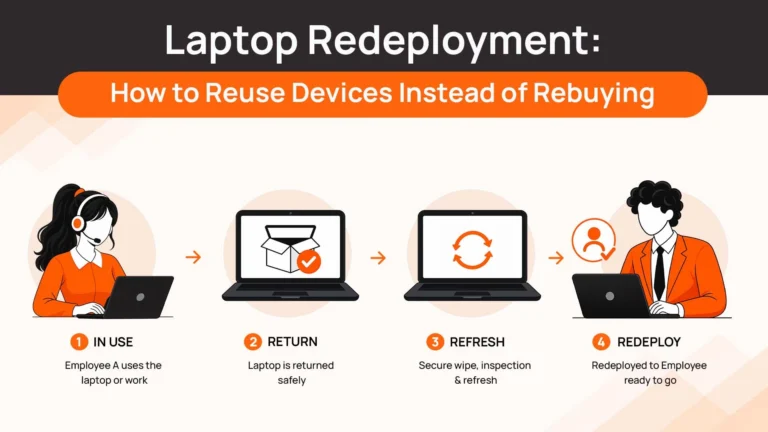
None of this changes the duty outcome — it stays at 0% either way. If the device is coming back from an employee who’s leaving rather than going out to a new one, that’s a different workflow worth planning for separately. A returning company asset should be documented as such, with proof of prior export where possible, rather than treated as a fresh import. Our guide on getting laptops back from US-based remote employees covers that process.
Should You Ship from Europe or Buy Locally in the US?
Since there’s no duty and no import tax to worry about, the usual ‘just buy it locally’ advice doesn’t apply as strongly here as it does on more expensive shipping routes. For one employee, shipping from your European office is often the simplest option. The case for sourcing locally in the US instead is about speed and predictability rather than cost: one less shipment to track, no dependency on getting EORI or export paperwork right, and no exposure to the customs-clearance delays that have become more likely since formal entry now applies to every shipment. For a company hiring its second or third person in the US, that convenience case starts to hold up even without a tax argument behind it — which is a large part of why cross-border shipping creates more operational drag over time than it looks like upfront.
How Remoasset Helps
Shipping one laptop from Europe to the US is manageable on your own with the steps above. It gets harder once you’re doing it regularly: tracking EORI paperwork, confirming an importer of record for each shipment, and making sure every entry clears correctly adds up as real recurring work, even without a tax bill attached to it. That’s the problem Remoasset is built around — treating procurement, delivery, and retrieval as one coordinated device lifecycle, instead of re-solving customs and courier logistics for every new hire. And when someone eventually leaves the company, the same logic applies in reverse: rather than shipping the laptop back to Europe, it’s often simpler to retrieve, redeploy, or securely wipe it in the US directly. Book a demo to see how recurring US hiring from a European base is handled as one lifecycle rather than a series of individual shipments.
Frequently Asked Questions
Can I ship a laptop from Europe to the US?
Yes. Laptops are duty-free entering the US, and a genuine business export from the EU is normally VAT-free as well.
Do I have to pay customs duty on a laptop shipped to the US?
No — laptops carry a 0% US import duty rate under HS code 8471.30. You’ll still need to go through formal or informal customs entry, since the US suspended its old exemption for small shipments in 2025.
Do I need an EORI number to ship from the EU?
Yes, if it’s a commercial shipment from an EU-registered company. It’s a one-time registration, not something you need per shipment.
Who should be the importer of record for a laptop shipment to a US employee?
If your company has no US legal entity, the most reliable option is usually a US-based customs broker or third-party IOR service, rather than putting that responsibility on the employee.
How much does it cost to ship a laptop from Europe to the US?
There’s no fixed number. It depends on weight, size, and service level. Since there’s no duty or import tax on this route, freight and insurance make up nearly the entire cost, plus a small customs processing fee that now applies to every shipment.