Short answer: value starts eroding from day one, but the real damage shows up between six and twelve months. Before that, a stored laptop is usually fine to redeploy as-is. After twelve months, you’re often looking at a battery replacement, an expired warranty, and a device that’s a full hardware generation behind — three separate costs stacked on top of each other.
The mistake most IT teams make isn’t storing laptops. It’s assuming storage is neutral — that a laptop sitting untouched on a shelf is simply waiting, unchanged, for its next assignment. It isn’t. The clock is running whether the device is being used or not.
What Actually Causes a Stored Laptop to Lose Value
Three things erode value during storage, and only one of them has anything to do with use.
1. The warranty clock keeps running
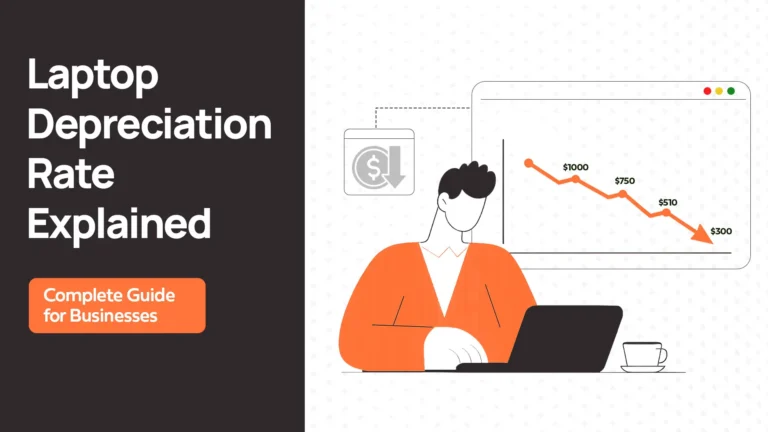
Most manufacturer warranties are tied to purchase date, not activation date or usage. A laptop bought in January and stored unused until October has already burned nine months of coverage it never benefited from. How warranty expiry becomes the practical refresh trigger for most fleets is covered in the depreciation guide — storage accelerates that trigger without anyone touching the device.
2. Market value depreciates on the calendar, not on usage hours
A laptop model’s resale value drops as newer models launch and specs age, regardless of whether the unit itself has one hour of use or a thousand. Two identical laptops — one used daily for a year and one sitting sealed in a closet for that same year — are worth close to the same amount on the resale market. The unused one hasn’t been preserved from depreciation.
3. The battery ages regardless of activity
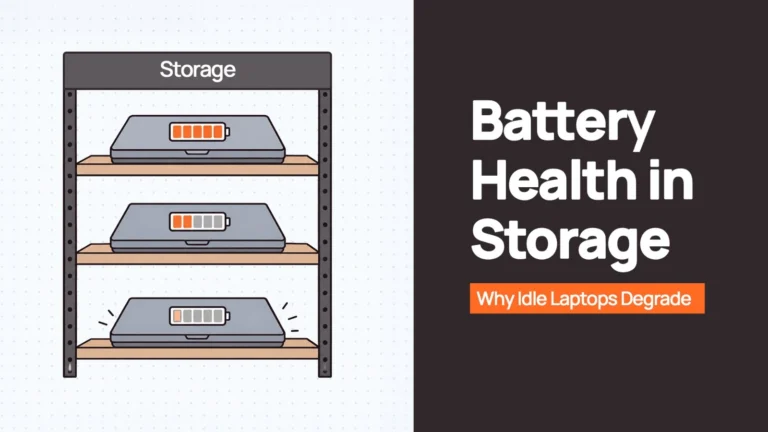
Lithium-ion batteries lose capacity over time even when the device is off, and storage conditions — charge level, temperature — affect how fast. A laptop stored at a poor charge level for a year can need a battery replacement before it’s ever handed to someone, adding a real cost to what should have been a free redeployment.
None of this is usage-driven. It’s why ‘it’s basically new, it’s barely been touched’ is a misleading way to think about a laptop that’s been sitting for a year.
The Storage Timeline: What Changes at 3, 6, 12, and 24 Months
There’s no hard cutoff, but the pattern is consistent enough to plan around.
| Time in storage | What’s typically still true | What starts becoming a problem |
| 0–3 months | Battery, specs, and warranty are essentially unchanged | Nothing significant yet |
| 3–6 months | Still generally redeployable as-is | Warranty coverage is measurably shorter; battery may need a charge-level check |
| 6–12 months | Hardware still works | Resale / trade-in value has visibly dropped; battery health should be verified before reassignment, not assumed |
| 12–24 months | Device may still be functional | Often outside standard warranty; a spec generation behind; battery replacement increasingly likely |
| 24+ months | Still an asset on paper | Frequently cheaper to redeploy a newer refurbished unit than to recondition this one |
The 6-to-12-month range is the real inflection point. Before it, storage was close to free. After it, every additional month adds a small, specific cost — whether that’s a battery, a warranty gap, or a spec mismatch with what the next role actually needs.
Does a Laptop Lose Value Just From Sitting Unused?
Yes — and this is worth stating plainly because it contradicts the intuition most people have. A laptop that’s never been opened still loses value on a shelf, through the same three mechanisms above. ‘Unused’ doesn’t mean ‘preserved.’ It means the depreciation is happening without any offsetting productivity, which is arguably worse than a device that’s at least being used while it depreciates. This is why idle inventory is a genuine budget problem, not just a tidiness one — a laptop in a closet still shows up as capital tied up with no return. The total-cost-of-ownership framework treats storage costs for idle inventory as part of the full device cost for exactly this reason.
When Does Storage Cost More Than It Saves?
The point of keeping spare inventory is to avoid buying new devices for every hire. That logic holds only as long as the spare is actually cheaper than a new purchase once you account for what it needs before redeployment.
A rough way to think about it: add up the battery replacement cost (if needed), any repair to bring the device to a working state, and the gap between what the role actually needs and what the device can deliver. If that total starts approaching the cost of a refurbished unit — or worse, a new one — the ‘free’ spare isn’t free anymore. The question of how many spare laptops to hold in the first place is separate from this: buffer size is about how many devices to hold; this is about how long to hold each one before it stops being the cheaper option.
How to slow down value loss during storage
Store at a moderate battery charge — not full or empty — and check periodically rather than leaving it untouched for a year.
Track the storage start date per device, not just ‘in storage’ as a status. Duration is the variable that matters, and it’s invisible without a timestamp.
Set a review point — commonly somewhere in the 6-to-12-month range — rather than letting devices sit indefinitely until someone happens to need one.
Keep it in a stable, moderate-temperature environment. Heat is consistently the biggest accelerant of both battery and general hardware wear.
None of this stops depreciation — nothing does — but it keeps the decay predictable instead of discovering it all at once when someone finally needs the device.
Related Reads
Each angle of the storage and value decision connects to a deeper guide:
- Laptop Depreciation: Cost, Rate and What It Means for Your Fleet — the calendar-driven value decline that storage accelerates.
- How Many Spare Laptops Should You Keep? A Buffer Stock Guide — sizing the spare pool so storage stays proportionate.
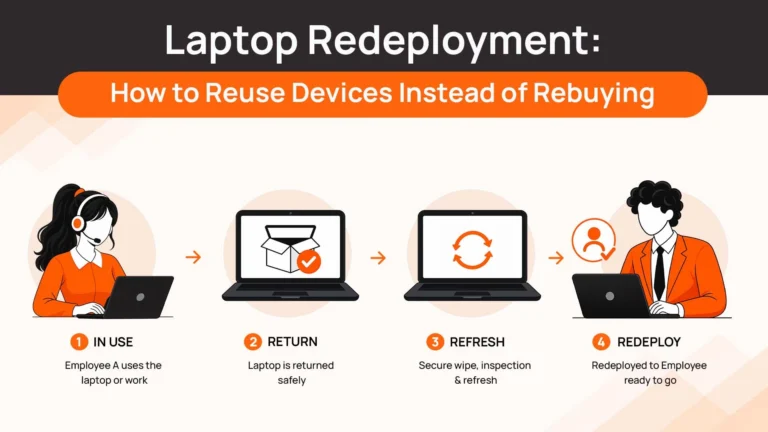
- Laptop Redeployment: How to Reuse Devices Instead of Rebuying — how to move a stored device back into productive use before it loses more value.
- Laptop Total Cost of Ownership: The Full Lifecycle Math — where idle storage costs show up in the full device cost model.
- Corporate Laptop Disposal: A Complete Guide — what to do with devices that have been stored too long to redeploy economically.
Signs a Stored Laptop Should Be Retired, Not Redeployed
Not every device that’s been sitting a while is worth reconditioning. A few signals worth watching for:
- Battery health has dropped enough that replacement cost approaches the value of the device itself.
- The warranty has expired and the specs no longer meet the requirements of any current role.
- The model is old enough that software or security updates are becoming inconsistent.
- It’s been sitting for well over a year with no clear near-term assignment.
When several of these line up, redeploying a more recently retrieved device is often the cheaper path, and the older unit becomes a candidate for resale, donation, or certified disposal.
Turning Idle Inventory Into Inventory You Can Actually Trust
The real problem with laptop storage usually isn’t the shelf space — it’s not knowing how long a given device has been sitting or what condition it’s actually in by the time someone needs it. That’s what makes ‘we have spares’ different from ‘we have spares we can confidently hand to a new hire tomorrow.’ Remoasset’s device storage is built around that gap: real-time inventory visibility so a device’s storage duration and condition are tracked automatically rather than discovered the day someone goes looking for it. When it’s time to redeploy, you’re working from data, not a guess about how long that laptop’s actually been sitting there. Book a demo to see how unused laptops become ready-to-deploy inventory rather than an unknown pile.
Frequently Asked Questions
How long can a laptop sit in storage before it loses significant value?
Meaningful value loss typically becomes noticeable between six and twelve months, driven by warranty expiration, market depreciation, and battery aging — not by whether the device was used.
Does an unused laptop still depreciate?
Yes. Market value depreciation and warranty expiration both run on the calendar, and battery capacity declines during storage regardless of activity. Sitting unused doesn’t pause any of these.
What’s the maximum time you should store a spare laptop?
There’s no universal number, but most fleets benefit from a review point around 6 to 12 months, after which the device should be checked for battery health, warranty status, and whether it still matches current role requirements before automatic redeployment.
Is it cheaper to store an old laptop or replace it?
It depends on the device’s condition and how long it’s been sitting. Once battery replacement, repairs, and spec gaps add up to close to the cost of a refurbished or new unit, storage stops being the cheaper option.