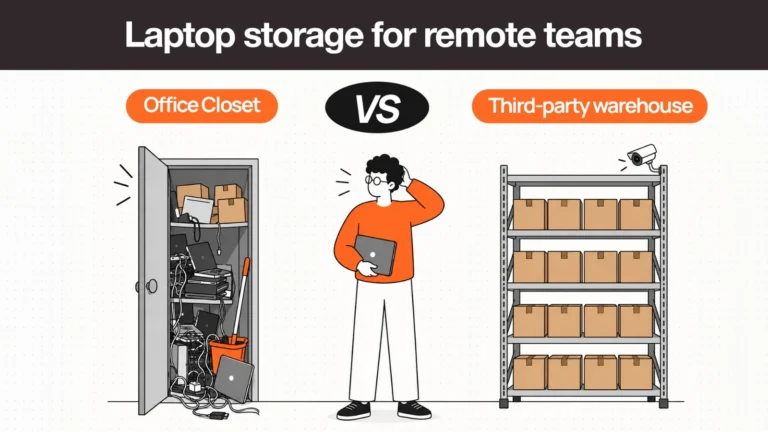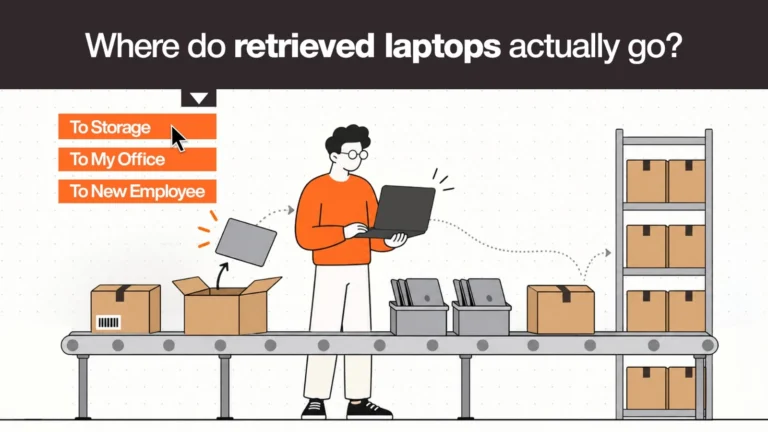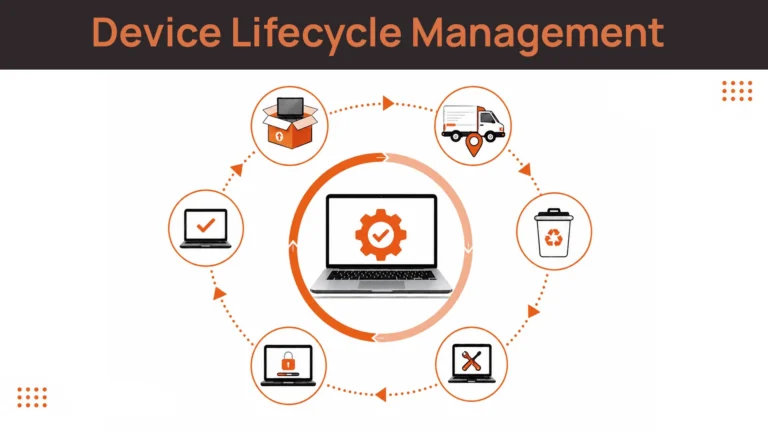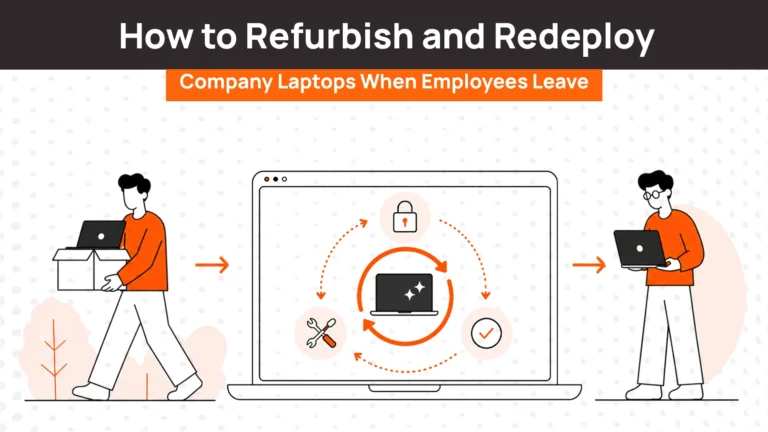

A laptop gets returned after an employee leaves. IT wipes it, logs it as available, and puts it in the storage room. Six months later, a new hire needs a machine. It looks untouched — still in its original condition — but the battery no longer holds a charge the way it should.
Not using a laptop doesn’t stop its battery from aging. Battery age, charge level, temperature, and how long the device has been sitting all affect how much capacity it has left by the time someone actually needs it.
How Long Do Laptop Batteries Last in Storage?
There’s no single number that applies to every laptop battery in storage. Lithium-ion cells continue to age even when the device is switched off, and how quickly they degrade depends heavily on the conditions the device is stored in. High temperatures speed up degradation, and storing a battery at a very high or very low charge for months isn’t ideal either. Microsoft’s own guidance for Windows devices recommends storing at around 40 to 60 percent charge, in a cool, dry place, and checking the battery level periodically rather than leaving it untouched indefinitely.
For an IT team, the useful question is: how long has this specific device been sitting unused, and under what conditions? Two identical laptops stored for the same six months can have meaningfully different battery health depending on where they sat and what charge they were left at.
What Happens to a Laptop Battery When It Sits Unused?
An employee offboarded following your offboarding checklist and returned their device. Here’s what’s happening to the battery while it waits:
1. Capacity decreases over time
This happens naturally as a battery ages, whether it’s being used or not. A battery that’s a year old simply holds less charge than it did new, regardless of how carefully it’s stored.
2. High charge levels can speed up degradation
A battery left at or near 100 percent for extended periods experiences more internal stress than one stored at a moderate level. This is part of why Microsoft recommends keeping stored devices at 40 to 60 percent for long-term battery health.
3. Deep discharge is a risk too
Batteries slowly lose charge on their own while sitting in storage. A device left long enough can drop into a very low or fully depleted state, which creates problems when someone finally goes to use it.
What Is Good Battery Health for a Laptop?
Battery health is how much capacity a battery currently holds compared to what it was designed to hold. If a battery’s original design capacity was 60,000 mWh and it now reports a full-charge capacity of 48,000 mWh, it’s retaining roughly 80 percent of its original capacity.
There’s no universal percentage at which every business should automatically replace a battery. What makes sense depends on the device’s age, how the employee will actually use it, expected runtime, manufacturer guidance, and whether the rest of the laptop is still worth redeploying. A battery at 80 percent capacity might be perfectly fine for a desk-bound role that’s mostly plugged in. The same battery could be a problem for someone who needs to work untethered all day. The decision always comes back to matching the device’s actual condition to the requirements of the next role, not hitting an arbitrary threshold. For how that fits into the broader redeployment decision, see how to refurbish and redeploy company laptops.
How to Store Laptops for Better Long-Term Battery Health
Following a consistent intake and storage process is the practical difference between a spare pool that’s ready to deploy and one that needs remediation every time someone reaches for a device.
Before putting a laptop into storage
Record the asset ID, storage location, and intake date. Check the physical condition and battery. Set the battery to a suitable charge level (around 40–60%). Complete any required wipe or configuration steps before it goes on the shelf, not after.
While the laptop is in storage
Keep it in a cool, dry environment, away from direct sunlight and spaces that get hot. Check on stored devices periodically rather than treating storage as a set-and-forget status. Inspect for swelling or physical damage, and avoid letting a device sit long enough to reach a prolonged deep discharge.
Storage rules that apply to every device
- Don’t store a laptop at 100 percent charge, and don’t let it sit for months at or near empty either.
- Check stored devices periodically rather than assuming the charge level hasn’t moved.
- Keep the storage environment cool and dry — heat is the biggest accelerant of battery wear.
- Follow the specific manufacturer’s guidance for each model where it differs from general practice.
Related Reads
Battery health is one part of a broader device-readiness question. These guides cover the surrounding decisions:
- How Long Can You Store a Laptop Before It Loses Value? — battery health alongside warranty and market depreciation as the three storage costs.
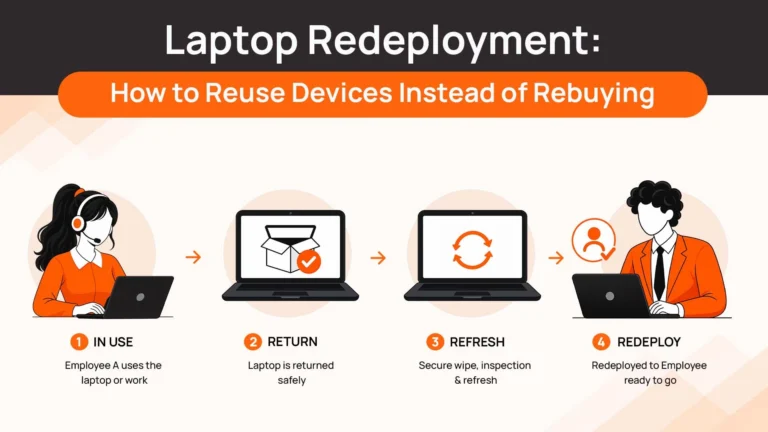
- Laptop Redeployment: How to Reuse Devices Instead of Rebuying — the full readiness-check process before a stored device goes to the next hire.
- Where Do Retrieved Laptops Actually Go? Inside a Device Warehouse — the intake, grading, and inspection steps that happen before a device enters storage.
- How Many Spare Laptops Should You Keep? — sizing the spare pool so storage stays proportionate.
How to Check Laptop Battery Health Before Redeployment
On Windows 10 and 11, running powercfg /batteryreport from an administrator command prompt generates an HTML report with detailed battery information:
| Battery information | What it tells IT |
| Design capacity | Original battery capacity |
| Full-charge capacity | Current reported maximum capacity |
| Capacity history | How capacity has changed over time |
| Battery usage | Recent battery usage patterns |
macOS and individual laptop manufacturers provide battery-health information through their own system tools. Run this check as part of the standard intake process rather than at the moment someone requests a device — by that point, a battery problem creates a delay that could have been caught weeks earlier.
What Should IT Do With Laptops That Have Poor Battery Health?
| Device condition | Possible action |
| Good battery + good device condition | Redeploy |
| Reduced battery capacity + otherwise usable | Assess battery replacement |
| Battery swelling or physical damage | Remove from deployment pool and assess safely |
| Old device + poor battery + other hardware issues | Compare repair vs. retirement costs |
| Device no longer meets company requirements | Retire or recycle according to company policy |
For devices where the cost of refurbishment starts to approach the cost of a newer replacement, comparing repair against retirement rather than defaulting to either extreme produces a more defensible procurement decision.
Keep Stored Laptops Ready for Redeployment
Most IT teams have an ‘unused laptops piling up in a closet’ problem — devices that are technically in inventory but nobody’s sure are actually ready to hand to the next hire. Battery condition is exactly the kind of thing that gets missed in that gap. Remoasset’s device storage is built around that specific handoff: secure warehousing paired with real-time inventory visibility, so a stored laptop is tracked, assessable, and redeployable without someone physically digging through a closet to find out what’s actually in there. When a device comes out of storage, the question shouldn’t be ‘does this still work’ — it should already have an answer. Book a demo to see how returned devices are tracked from intake through redeployment.
Frequently Asked Questions
How long can a laptop battery last in storage?
There’s no fixed timeframe. It depends on storage conditions, charge level, and how the battery was aging before storage began — not just how many months it’s been sitting.
What battery health is good for a laptop?
Battery health is current full-charge capacity compared to original design capacity. There’s no single percentage that’s universally ‘good’ — it depends on how the device will be used and what runtime the next employee actually needs.
What charge level is best for storing a laptop?
Around 40 to 60 percent, per Microsoft’s guidance, in a cool, dry location. Avoid storing at 100 percent or letting a device sit for months near empty.
How do you check laptop battery health in Windows 11?
Run powercfg /batteryreport from an administrator command prompt. It generates an HTML report showing design capacity, full-charge capacity, capacity history, and recent battery usage.
Can a laptop battery degrade even when the laptop is not being used?
Yes. Lithium-ion batteries continue to age in storage. Charge level and temperature during that time affect how much capacity is lost by the time the device is needed again.