As organisations transition to remote-first and hybrid working models, one of the silent yet critical challenges they face is hardware return and lifecycle management. Laptop retrieval services are no longer optional, they are foundational. In 2026, choosing the right laptop retrieval services is pivotal to safeguard data, recover hardware value, and streamline offboarding.
This guide unpacks how these services work, what features matter most, and highlights the leading providers in the space. It also shows where Remo Asset fits into or competes in this evolving landscape.
Why Laptop Retrieval / IT Asset Recovery Is Critical in 2026
1. Remote & Distributed Workforce Raises Risk
With more employees working remotely or across geographies, devices like laptops often leave the controlled office perimeter. Without a structured retrieval process, organisations expose themselves to increased risk of unreturned, lost or unsecured devices.
2. Financial Impact: Hardware Loss & IT Leakage
Unreturned laptops represent direct cost in lost hardware, wasted capital and potentially redundant licences. Moreover, when devices stay unmanaged, they may undergo unauthorized usage or become obsolete before reclamation.
3. Data & Security Liabilities
Every unreturned laptop carries data risk: sensitive files, credentials, cached passwords, and access tokens. In the 2025 IT-Asset Disposition (ITAD) market, data security is one of the top trends.
Certified data wiping, chain-of-custody logs and secure logistics are no longer nice-to-haves—they are must-haves.
4. Audits, Compliance & Responsible Lifecycle Management
The global ITAD market is growing rapidly. For example, the global IT asset disposition market was estimated at USD 25.31 billion in 2024 and is projected to reach about USD 54.54 billion by 2030.
In North America alone, the ITAD market size in 2025 is around USD 4.85 billion with a CAGR of ~10.4%.
That scale underscores the increasing regulatory, sustainability and audit pressures. For a CIO, IT director or operations lead, a robust retrieval service is an imperative for hardware lifecycle integrity.
How Laptop Retrieval Services Work — Standard Workflow
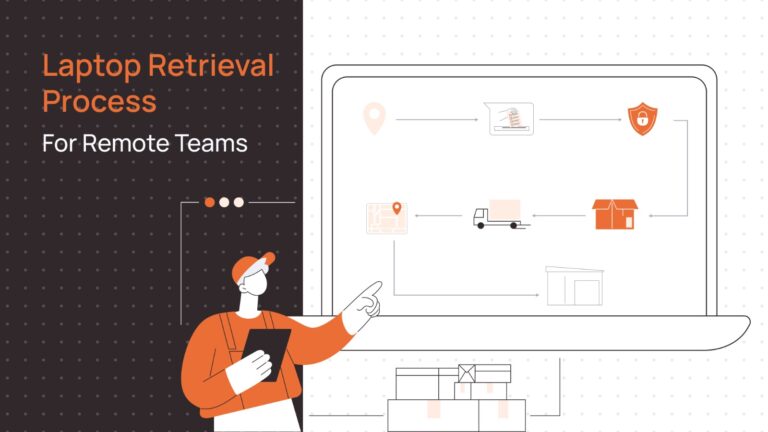
Here’s a typical end-to-end workflow for laptop retrieval / IT asset recovery services:
- Retrieval Initiation
- The trigger may be employee offboarding, contract end, hardware refresh or lease expiry.
- The retrieval service is notified and a service request is opened.
- Dispatching Return Kits & Instructions
- The service sends prepaid return kits, with labels, packaging and detailed instructions.
- Employee receives the kit and prepares the laptop and its accessories.
- Employee Packs Laptop + Accessories
- The employee packs the laptop, charger, docking station (if applicable), plus any accessories.
- Instructions include how to backup/purge personal data and prepare the device.
- Prepaid Shipping / Pickup Logistics
- The service either schedules a pickup or the employee uses a prepaid shipping label.
- Logistics may vary by region; some global services provide same-day pickup in major cities.
- In-Transit Tracking & Chain-of-Custody
- Real-time tracking of shipments, with visibility for the enterprise’s IT/asset team.
- Documentation of chain-of-custody to ensure no tampering or loss in transit.
- Inspection & Data Wiping (Secure Erasure)
- On receipt at the processing facility the laptop is logged, inspected for damage, accessories itemised, and then securely wiped according to certified protocols (e.g., GDPR, ISO standards).
- Some services also certify destruction of SSDs or retain for resale if value remains.
- Redeployment, Resale, Recycling or Disposal
- Depending on condition and policy, the device may be redeployed within the organisation, resold on secondary market, or responsibly recycled/disposed.
- Most services provide reporting on residual value recovered and environmental impact.
This workflow underscores how laptop retrieval is more than shipping back a device, it is a lifecycle management service that spans logistics, data security and asset recovery.
Key Features & Evaluation Criteria for Laptop Retrieval Services
When evaluating retrieval services in 2026, here are the key feature lenses:
- Logistics Coverage & Speed (Global vs Regional)
Can the service handle pickups or returns across geographies? How quickly can it dispatch kits, schedule pickups and track items in transit? - Secure Shipping & Packaging Standards
Does the provider supply dedicated, secure packaging with tamper-evident seals? Are shipping lanes and carriers vetted for chain-of-custody integrity? - Tracking & Transparency / Audit Trail
Does the platform offer dashboards for real-time tracking of returns, status updates and audit logs? Is there full visibility into where each device is in the pipeline? - Certified Data Wiping & Compliance
Does the service provide certified erasure (or destruction) of data, with evidence? Are standards such as ISO 27001, eStewards, GDPR or local equivalents met? Trend reports flag data security as a top ITAD concern in 2026. - Workflow Automation & Integrations (HR, IT, Offboarding Systems)
How well does the service integrate with HR systems (triggering returns at employee exit), IT asset management platforms, lease contracts and asset inventories? Automation reduces manual errors and lost devices. - Bulk or Volume Discounts / Scalability
For organisations with hundreds or thousands of distributed devices, pricing per device, bulk consolidation and volume handling matter. - Redeployment / Resale / Recycling Support
Does the service help maximise residual value via resale or redeployment? Does it manage certified recycling for devices past reuse? Environmental and cost benefits accrue when this is done well. - Reporting, Dashboards & Analytics
The service should deliver meaningful metrics: return rate %, days in transit, cost per device, value reclaimed, e-waste diverted. These analytics help IT asset managers benchmark and optimize.
Selecting a provider that ticks most of these criteria is essential for enterprises that issue laptops to remote and hybrid employees and want to control costs, drive compliance, and protect data.
Leading Laptop Retrieval / IT Asset Recovery Services in 2026
Below is a comparative guide of major retrieval/ITAD providers active in the laptop retrieval space. For each we outline strengths, geographic coverage and limitations.
| Provider | Strengths | Geographic Coverage | Notable Limitations |
|---|---|---|---|
| Remo Asset | Integrated leasing + retrieval, unified dashboard covering monitoring and return logistics; especially suited for remote-first, distributed setups | Global (with emphasis on Australia/APAC, India, Europe) – roadmap underway for full global coverage | Relatively new in full retrieval execution vs legacy ITAD players; needs more public case/reference data |
| GroWrk | Full ITAD lifecycle service including asset recovery, w/ emphasis on remote employee equipment and logistics; solid platform approach | US, UK, EMEA and remote workforce friendly markets | Less focus on resale value or global bulk returns in APAC may require custom quotes |
| Workwize | Strong regional logistics in Europe, dedicated return-kit service, rapid local pickup options | Europe-centric (UK, Germany, France) with some global expansions | Limited global footprint outside Europe; smaller analytics/insights capability compared with larger ITAD suites |
| ReadyCloud | Emphasis on subscription/volume model for device retrieval, decent redeployment/resale channel; decent for SME volume | US, Canada, some global shipping options | May not support full global variations (e.g., remote APAC/India returns) as seamlessly; packaging/shipping standards vary by locale |
- For organisations with global remote teams, a service that offers global logistics, region-specific return kits, and real-time tracking is critical.
- Legacy ITAD players are strong at recycling and destruction, but some lack remote-employee retrieval logistics or offboarding automation tailored for modern needs.
- Remo Asset positions itself as a premium or differentiated option by combining device monitoring/lease management with retrieval logistics—making it a strong contender for remote-first enterprises that issue laptops at scale.
Cost Considerations & Pricing Models
When budgeting for laptop retrieval services, IT/operations leaders should examine the following cost models and hidden variables:
- Fixed per-device return fee
Common model: “return kit + shipping + processing” charged per device.
- Subscription or retainer models
Organisations with ongoing refresh cycles may prefer a subscription covering unlimited returns or a defined pool of devices.
- Volume-based discounts
The greater the number of devices returned (bulk refresh or large offboarding), the lower the per-device cost.
- Hidden costs to watch
- Shipping surcharges for remote or international locations
- Failed returns (device not shipped back or lost)
- Data wipe or destruction fees beyond basic cleaning
- Handling or inspection costs for damaged devices
- Redeployment or resale value loss if condition is poor
- Shipping surcharges for remote or international locations
- Value recovery
Some services offset cost via residual value from resale or redeployment. The net cost may then be lower than headline price.
In short, cost modelling must factor not only the return logistics but also the residual value recovered and the risk/cost of unmanaged devices.
How Remo Asset Could / Should Differentiate in Retrieval Services
For organisations evaluating retrieval services, here is how Remo Asset offers compelling differentiators:
- Integration with leasing + monitoring stack
Many companies lease or issue laptops, and separately manage retrieval services. Remo Asset unifies issuing, monitoring, retrieval and reporting in one platform—reducing operational fragmentation.
- Seamless offboarding triggers
The moment an employee exit is registered in the HR system or a lease ends, retrieval workflow kicks off automatically. This automation reduces delays and lost devices.
- Turn-key return kits, logistics + data wipe + redeploy
A fully managed service: return kit sent, pickup scheduled, data wiped, device redeployed or recycled, all visible in the dashboard, with no need to manage multiple vendors.
- Unified dashboard combining retrieval + monitoring + leasing
IT directors get one pane of glass: how many devices are out, which are returned, which ones are still in employee hands, condition, residual value and compliance documentation.
- Competitive pricing + transparency
With one-stop model and volume scale, Remo Asset can deliver cost per device that is competitive, and provide full cost breakdowns upfront—there are no hidden fees.
- Sustainability / EOL disposal angle
By redeploying viable devices, remarketing or responsibly recycling, Remo Asset helps clients meet ESG/ESG reporting goals—an increasingly important factor in 2026. Reports show sustainability is playing a key role in ITAD decision-making.
For IT leaders evaluating retrieval services, this combination of integration, automation, visibility and sustainability makes Remo Asset a distinctive choice.
Use Cases & Sample Scenarios
Scenario 1: Remote Employee Leaves the Company
A software company issues laptops to all engineers globally. An engineer based in Latin America resigns. The retrieval workflow triggers automatically via Remo Asset’s HR-IT integration. A prepaid kit ships to the employee’s location, laptop is returned, logged, data wiped, and redeployed within the company. Result: no hardware gets stranded and data risk is eliminated.
Scenario 2: Bulk Hardware Refresh Across Distributed Teams
A fintech scale-up with 500 remote employees across APAC decides to refresh laptops. They engage a retrieval service to capture existing devices. Kits shipped globally, pickups scheduled in each major city, devices tracked back, data erased, older devices remarketed. The retrieval cost is offset by resale value and the refresh is delivered within one month.
Scenario 3: Recovering Devices in a Merger / Acquisition / Downsizing
An enterprise acquires a smaller competitor and inherits ~1,200 laptops spread across multiple countries. Speed and accountability are critical. A retrieval provider offers chain-of-custody tracking, condition reporting, and redeployment logistics to consolidate and harmonise the hardware pool. The enterprise repairs and redeploys 70% of devices and recycles the rest, recovering value and reducing e-waste.
Each scenario shows how retrieval services support cost control, data security and operational agility in real-world settings.
Conclusion
In 2026, managing laptop retrieval is no longer a back-office afterthought. It is a strategic imperative for remote and hybrid organisations that issue hardware at scale. Effective laptop retrieval services combine logistics, data security, redemption of hardware value and visibility.
When evaluating options, IT asset managers, infrastructure leads and procurement heads should measure services by logistics coverage, data-erasure certification, workflow automation, return-kit quality, reporting and resale support.
In this evolving space, Remo Asset stands out by offering an integrated leasing-to-retrieval model, automation, dashboard visibility, and architecture designed for the remote-first enterprise. For organisations seeking a trusted partner to safeguard hardware, data and lifecycle value, contacting Remo Asset is a logical next step.
Contact Remo Asset to learn how our integrated leasing + retrieval model can safeguard your hardware and simplify offboarding.